Secondary menu - Advertising and subscriptions

  • Got stories? - Contributors Guidelines
  • Advertising
  • Subscribe to X-Ray Mag

Brugerkontomenu

  • Log in
Home
  • Magazine
  • News
      1. Latest news
      2. Press releases
      3. Breaking News
  • Travel
      1. Destinations
        1. Australia & New Zealand
        2. Continental Asia
          • Japan
          • China
          • South Korea
        3. Southeast Asia
          • Indonesia
            • Bali
            • Komodo
            • Lembeh
            • Maluku
            • Raja Ampat
            • Sulawesi
          • Malaysia
          • Papua New Guinea
          • Philippines
          • Thailand
          • Timor-Leste
        4. South Pacific & Oceania
          • Fiji
          • French Polynesia
          • Micronesia
            • Chuuk (Truk)
            • Marshall Islands
            • Yap
          • Palau
          • Samoa
          • Solomon Islands
          • Tonga
          • Vanuatu
        5. Indian Ocean
          • Madagascar
          • Maldives
          • Seychelles
        6. Red Sea
        7. Africa
          • Egypt
          • Malawi
          • Mozambique
          • Namibia
          • South Africa
          • Sudan
          • Tanzania
        8. Mediterranean & Adriatic
          • Croatia
          • Cyprus
          • France
          • Greece
          • Italy
          • Malta & Gozo
          • Portugal
          • Spain
          • Turkey
        9. Europe
          • Northern Europe
            • Denmark
            • England
            • Finland
            • Iceland
            • Ireland
            • Norway
            • Scotland
            • Sweden
          • Eastern Europe
            • Albania
            • Bosnia-Hercegovina
            • Croatia
            • Czech Republic
            • Hungary
            • Poland
            • Russia
              • Northwest Russia
              • Russian Far East
              • Siberia
          • Western Europe
            • Austria
            • France
            • Germany
            • Switzerland
          • Southern Europe
            • Cyprus
            • Greece
            • Italy
            • Malta & Gozo
            • Portugal
            • Spain
        10. Atlantic
          • Azores
          • Canary Islands
          • Falkland Islands
          • St Helena
        11. North America
          • Canada
          • Great Lakes
          • United States
            • East Coast
            • West coast
            • Alaska
            • Hawaii
            • US Virgin Islands
            • Guam
          • Mexico
        12. Caribbean & Central America
          • Bahamas
          • Belize
          • Cayman Islands
          • Bonaire
          • Cuba
          • Dominican Republic
          • Mexico
          • Columbia
          • Grenada
          • Costa Rica
          • Saba
          • Honduras
          • Turks & Caicos
          • US Virgin Islands
          • Nicaragua
        13. South America
          • Argentina
          • Brazil
          • Ecuador
        14. Polar Regions
          • Artic
          • Antarctica
      2. Promotions
      3. My Favorite Dive
  • Ecology
      1. Ocean Mysteries series by Ila France Porcher
      2. Sharks, Rays and Nudibranch stories by Andy Murch
      3. Sentience
      4. Conservation
      5. Coral Reefs
      6. Dolphins
      7. Fish
      8. Jellyfish
      9. Mantas & Stingrays
      10. Nudibranchs
      11. Octopus & Squid
      12. Sea Turtles
      13. Seals & Sea Lions
      14. Sharks
      15. Whales
  • Wrecks
      1. Vic Verlinden
      2. Ancient Wrecks
      3. Artificial Reefs
      4. Marine Archaeology
      5. Older Warships
      6. Steamships & Cargo
      7. Tall & Wooden Ships
      8. WWI Wrecks
      9. WWII Wrecks
  • Training & Tech
      1. Rebreathers
      2. Sidemount
      3. Deep Wrecks
      4. Cave Diving & Mines
      5. Ice Diving
      6. Diver Health & Safety
        1. Divers Alert Network - DAN
        2. Safety Culture
      7. Adaptive Diving
  • More
      1. Equipment
        1. BCDs, Wings & Sidemounts
        2. Dive Computers
        3. Dive Watches
        4. Drysuits & Undergarments
        5. Hoods, Gloves & Boots
        6. Lamps & Torches
        7. Masks, Fins & Snorkels
        8. Regulators
        9. Wetsuits & Rashguards
      2. Photo & Video
        1. Equipment
          • Cameras & Optics
          • Editing & Post-processing
          • Housings
          • Lighting
          • Useful Tools
        2. Tutorials
          • Techniques & Tips
            • Mike Bartick
            • Rico Besserdich
          • Composition
          • Editing & Post-processing
        3. News & Announcements
        4. Contributors' Picks
      3. Books & Media
        1. Works by our contributors
      4. Profiles & Interviews
        1. In Memoriam
      5. Lifestyle
        1. Portfolios & Ocean Arts
        2. Apres Dive & Apparel
        3. Editorials
      6. Contributors
        1. Pundits
          • Mike Ange
          • Gareth Lock
          • Michael Menduno
          • Mark Powell
          • Simon Pridmore
        2. Regular writers
          • Scott Bennett
          • Andrey Bizyukin
          • Larry Cohen & Olga Torrey
          • Pierre Constant
          • Brent Durand
          • Jennifer Idol
          • Scott Johnson
          • Steve Jones
          • Kate Jonker
          • Kelly LaClaire & Kate Holt
          • Matthew Meier
          • Brandi Mueller
          • Svetlana Murashkina
          • Barb Roy
          • Don Silcock
          • Claudia Weber-Gebert
          • Lawson Wood
        3. Columnists
          • Scott Bennett
          • Rico Besserdich
          • Rosemary 'Roz' E. Lunn
          • Ila France Porcher
  • ⚲ Search

Breadcrumb

  1. Home
  2. What sank the Soviet destroyer Moscow?

What sank the Soviet destroyer Moscow?

December 25, 2020 • Wrecks & Archaeology
Profile picture for user Chief minion
By Chief minion on
  • facebook-f
  • twitter
  • envelope
  • print
1577

Nearly 80 years ago, on the night of 22 June 1941, German troops crossed the Soviet border, and opened up the East Front. It is a common belief that the Soviets were taken by surprise and the command was passive and slow to respond during the first days of fighting. This may be the case in other places but not in the Black Sea. Already the same morning the city of Sebastopol was blacked out, and the Black Sea Fleet put on the highest alert. And by 3:15 the same morning anti-aircraft batteries shot down the first German aircraft.
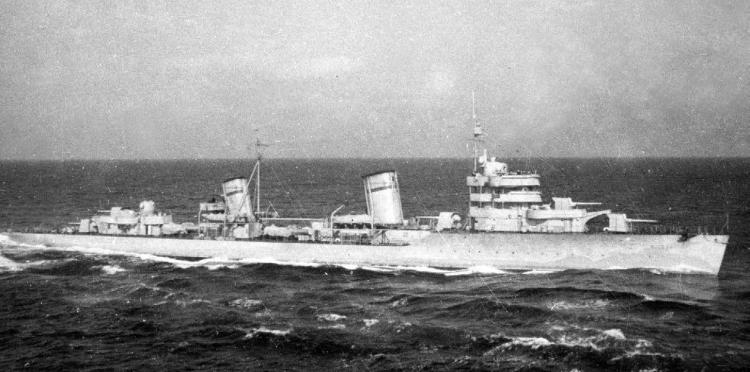
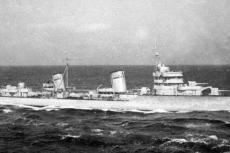
Photographer, source or credit: Unknown official photographer Permission or license: Public Domain

WW2 Soviet Destroyer 'Moscow'

Photographer/credit
Unknown official photographer
Permission or license
Public Domain
Black Sea
Romania
Russia
WWII Wrecks

About 13 hours later, at 4:40 pm, three submarines—Щ-205, Щ-206 and Щ-209 (Щ is short for Щука or shuka, which means pike in Russian)—received approval from the Kremlin to move towards the eastern shores of the Black Sea, while the M-33 and M-34 left for long-range patrol near the main base. It was the first day of the war in the Black Sea.

On the night of June 26, Soviet warships attacked the Romanian port of Constanta. The artillery fire from the Soviet vessels, which were led by the Kiev and Moscow, completely destroyed the port’s oil reserves and also took out several trains with arms and ammunition destined for Romanian troops and the invasion of Ukraine.

These events were reported to the Soviet government, but it was through the Soviet Information Bureau that the whole world learned about the successful raid. But, as often happens, the full story was not told. It was left out that the otherwise successful operation had cost the Soviet Navy one of its finest ships—the destroyer, Moscow.

Even after so many years, it is quite difficult to determine the course of events and what actually caused the loss of the ship. According to the testimonies on both sides, the explosion was so monstrous that a column of white flame and smoke shot more than 30 meters into the air. The ship broke midships, and the bow almost immediately sank while the stern, with the still rotating propellers now sticking up in the air, remained afloat for several minutes. Until it too slipped under the waves, the aft bridge was continuously strafing enemy aircraft with anti-aircraft fire.

Surprisingly, during all these years the story of the ship and its sailors has been shrouded in an information vacuum. Perhaps in the depths of the (Russian – ed.) Central Naval Archives answers to all these questions can be found, but researchers have never been able to reconcile any of the official versions with where the wreck was actually located.

The prevailing official theories as to what sank the Moscow come in four varieties: she was hit by a large-caliber grenade from coastal artillery; fire from enemy ships hit her; she hit a mine; or she was attacked by a submarine. As regards to the location of the sinking, scans were made of the sea floor at the alleged position, which was marked on sea charts but no remains of the ship were detected.

Dive team

On 1 May 2011, a Romanian-Russian-Ukrainian team of divers arrived in the city of Constanta, following an invitation by the leader of the Respiro Diving Society, Mircea Popa, who has been searching the Moscow for more than two years.

The first day, the team scanned the seabed in a sector that archival Romanian sketches showed was the battlefield, but it produced no results. During the debriefing the same evening, the team once more went over the various information discarding the scenarios that they considered improbable.

First, the team discarded the theory that artillery from enemy ships sunk the Moscow. The armament of the Romanian Royal Navy’s destroyers, Regina Maria and Marasti, were probably too light for such a devastating hit, and combined with the fact that the Soviet vessels were taking evasive manoeuvres and were hidden under a smoke screen and already at the maximum range of their 120mm Bofors cannons, this scenario struck the team as quite unlikely.

Also the team considered it unlikely that the Moscow were hit by heavy artillery from the Tirpiz coastal artillery battery. According to German sources, as well as the report of the flotilla’s flagship, Kharkov, the battery’s first salvo only came quite late in the battle. It landed dangerously close to the Kharkov, but only after the Moscow had already exploded. The team was then left with the options of hitting a mine or being struck by a torpedo.

The team did not really believe in the latter option either. According to available archival documents the only Romanian submarine, the Delfinul, was much further north at that time. The only submarine in any meaningful proximity was the Soviet U-206 under command of Lieutenant-SA Karakaya. However, this vessel was not involved in the raid, and in fact, he most likely knew nothing about it. It should be noted, however, that the northern position of the boat was only seven to eight miles from the alleged location of these events, and only a small error in navigation could have put this submarine within the battlefield. However, the Kharkov made an observation of wakes from two torpedoes just a few seconds before the explosion. Nonetheless, the team felt that this scenario was the least likely of the two and turned their attention to the minefield theory.

After analyzing all available information, the team pinpointed what was the most likely position for the sinking—the first quadrant (south-western part) of the S-10 mine barrier. Unfortunately, all sources differ in regards to the accounting of the movement of the Soviet vessels before the explosion, but by comparing the information, the team estimated the most logical course of the ship, taking all circumstances into account.

The next day produced some interesting moments. Firstly, the team managed to meet with the historian, Prof. John Damaschin, who has spent more than a decade trying to understand the events of 26 June 1941. The meeting took place in the offices of the Marea Noastra magazine and was attended by Rear Admiral Petre I. Zamfir, who served on the destroyer, Regina Maria, remembered the battle. This meeting opened with an interesting piece of information, which was not mentioned in any of the Soviet sources.

According to this information, the Soviet vessels which were beyond the range of the German heavy (280mm) Tirpiz coastal batteries attracted the fire from the Romanian (105mm) battery, Elisabeth, which, unlike the German batteries, opened fire three minutes after the Sovient vessels entered the battle at 5:05. At that time the Soviet ships were moving at 26-28 knots, heading 221°, which took them, directly towards the Elisabeth battery. The light calibre of the battery was insufficient to defeat the ships at the beginning of the operation, but it’s probable that the fire from the Elisabeth battery made the Soviet ships change their course and withdraw along a bearing of 123°.
 

Image
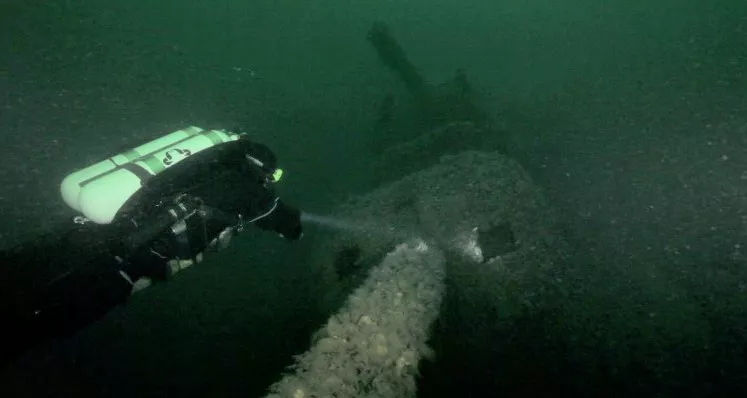
Diving Soviet Destroyer Moscow

Diving the site

While part of the team was at the meeting, the other part of the team was busy searching the area that was selected the previous evening. The first part of the day was devoted to the complete search of the area north of the S-10 mine field in order to exclude this region from further search. During the second part, after about ten hours of searching with sonar at a depth of 45 meters, they first located an indefinable object with the dimensions of eight by six meters, later affectionately nicknamed the “box”, and a few seconds later, the sonar pictured the hull of a vessel about 90 feet long.

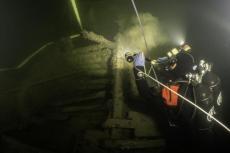
On May 5, divers went down to examine the wreck, and they were able to confirm beyond a doubt that the Moscow was finally found! The ship had rolled onto its left side and was resting at a degree of 35º rising about ten meters above the seabed. The divers inspected the intact rudder and propeller. The whole aft part appeared to be in a good state of preservation up to the first boiler compartment—aft gun turrets, anti-aircraft cannons, stern fire post and filled torpedo tubes. But further ahead, it was just a tangle of collapsed metal, and it is impossible to comprehend the magnitude of the destruction. The team did two dives with a bottom time of 40 minutes, which allowed for a preliminary inspection of the ship, but obviously was not enough for detailed study.

From the condition of the “box”—which in size was very similar to the main superstructure, which was located at the edge of the S-10 minefield—the team concluded that the ship exploded as a result of striking a mine. But it is difficult to understand how a 200-kilo mine could cause such severe destruction of the bow by itself. This could be explained by accounts that during the beginning of the war, spare torpedoes were kept directly on the deck near the explosion. Perhaps then, it was a detonation of the torpedoes on the port side that caused the terrible explosion.

Indirectly, this theory is substantiated by the fact that after the operation in Constanta, such torpedos were removed across the entire fleet. Furthermore, upon examining of the wreck, the divers did not find any spare torpedoes except one detached from the main part of the crew compartment, which was on the right side of the ship.

Unfortunately, neither the weather nor the time allowed the team to dive to the cherished “box”, and it will await exploration by future researchers.

On 26 June 2011, on the 70th anniversary of the loss of the Moscow, the Respiro Diving Society is planning to drop a memorial plate on the deck of the Moscow and a wreath in memory of the dead sailors and the first Soviet warship, which perished during the Great Patriotic War.

As a result of the expedition, all the data and project materials, as well as information about the location of the wreck will be sent to the archives of Romania and Russia, and various web-resources. Everyone in any way interested in further information on the project, should contact pgscuba@gmail.com

Thanks

The members of the expedition would like to thank Colonel Banshatsu Boris Shoylovichu and Lubyanovu Kolmogorov for the great job they have done compiling a large number of documents and versions in the book, The leader of the destroyers—Moscow. Thanks goes also to Professor John Damascene who assisted and provided valuable information not previously studied. The team is also grateful to all those who directly or indirectly helped in the search and believed in the success of the expedition.

Note: Submarine U-206 did not return to base and is considered “missing in action”. It is difficult to say how credible the reports are about the torpedo track at the Battle of Konstanz before the sinking of the Moscow, and several hours later, the sinking of the Kharkov. There are documents about the successful attack of the destroyer, Soobrazitelnyi (the quick-witted)—the vessel, that protected Kharkov—directed towards an unknown submarine in the square 3953. On the other hand, there is no confirmation of the sinking of a U-boat from Kharkov, which, in fact, hailed the Soobrazitelnui to protect and attack submarines. This is another dark page in history to be investigated further. ■

  • Log in to post comments
Profile picture for user Chief minion
Chief minion
1577
6
min read
A- A+
  • facebook-f
  • twitter
  • envelope
  • print

Other articles and news about Russia, Ural

Diver inspects the wreck of the Vera Figner wreck. Photo by Pavel Lapshin

Vera Figner Wreck: 20th-Century Paddle Steamer in Russia's Silva River

Aug 06, 2021
Artifacts from the 16th century Battle of Sudbischen. Photo by Stanislav Trofimov

Russian 16th Century Discovery: Battle of Sudbischen

Jul 16, 2021
Stage Gostiny Dvor Exhibition Center

Moscow Dive Show 2021 show report

Apr 19, 2021
Diveheart partners with Tourism Malaysia for Moscow Dive Show 2021

Diveheart partners with Tourism Malaysia for Moscow Dive Show 2021

Apr 07, 2021
Islands of the Valaam Archipelago in Lake Ladoga, Russia. Photo by Stanislav Trofimov.

Wrecks of Russia's Lake Ladoga

Feb 11, 2021

Moscow Dive Show to go ahead as planned

Feb 11, 2021

What sank the Soviet destroyer Moscow?

Dec 25, 2020

Lockdown Local Diving

Oct 31, 2020

Black Sea Wrecks

Sep 24, 2020
Swimming Pools and Underwater Photography

Swimming Pools and Underwater Photography

Jan 24, 2020

The Prometheus Project

Oct 15, 2018
Dive like a Russian

Dive Like a Russian: Busted Myths & Concrete Facts

Oct 12, 2018

Scubatlon: Environmental Protection as a Sport

Sep 17, 2018

Rescuing Seals in Vladivostok

Sep 14, 2018

Lake Baikal: Technical Diving in the Deepest Lake on Earth

Jun 25, 2018

Soviet Sub found and identified

May 03, 2018

Black Water Diving in the East Sea

Apr 12, 2018

Ice Diving in the White Sea

Mar 05, 2018

Invasion of the King Crabs

Apr 12, 2017

On the Other Side of the Ice: Ice Diving Competition in Russia

Mar 01, 2017

Trending

Lion fish

Conscious Fish?

Ecology & Science
SS United States

Increasing Opposition to the Sinking of SS United States

Wrecks & Archaeology
Eagles' wreck

2,000-Year-Old Roman Shipwreck Found in a Swiss Lake

Wrecks & Archaeology
Mantis Shrimp

The Mantis Shrimp: Language in Light

Ecology & Science
nudibranchs respond to damage to their nervous systems

Nudibranchs Offer Clues to Brain Regeneration

Ecology & Science
Doug Allan Cameraman

Doug Allan Remembered as Underwater Filming Pioneer

Profiles & Interviews
Southern Right Whale

Southern Right Whales Face Growing Pressures

Ecology & Science
Global shark bites

Global Shark Bites Return to Average Levels

Ecology & Science

Latest updates from archives

Groundbreaking research suggests sperm whale clicks may represent a complex language system

Deciphering the Language of Whales

Ecology & Science
Cruise ships

Caymans Continue To Conflict Over Cruise Ship Development

Travel & Trips
SS United States in a deteriorated condition

Ocean Liner SS United States Could Be Sunk To Become an Artifical Reef

Wrecks & Archaeology
Spookfish

Spookfish has mirrors for eyes

Ecology & Science
Sleeper shark illustration

A Shark in the Coldest Sea on Earth

Ecology & Science
Black Rockfish

How Fish Voices Are Transforming Ocean Science

Ecology & Science
Barrel sponge

Large Sponges can be reattached to Coral Reefs

Ecology & Science
Photograph of German submarine U-9.

Hitler's 'lost' submarine fleet found in the Black Sea

Wrecks & Archaeology

Latest updates

Emperor Divers Backs New Research Into Decompression Sickness
17 Apr, 2026 - 21:01
Lion fish
Conscious Fish?
17 Apr, 2026 - 13:07
DAN Achieves Milestone of 1,000 First Aid Providers Trained in Indonesia
16 Apr, 2026 - 21:28
SS United States
Increasing Opposition to the Sinking of SS United States
15 Apr, 2026 - 19:01
More
Advertisement

Related content

What sank the Soviet destroyer Moscow?
25 Dec, 2020    
Black Sea Wrecks
24 Sep, 2020    
Photograph of German submarine U-9.
Hitler's 'lost' submarine fleet found in the Black Sea
10 Feb, 2008    

Upcoming Events & Expos

5 Jun, 2026 ➢ 7 Jun, 2026

Malaysia International Dive Expo (MIDE) 2026

Malaysia International Trade and Exhibition Centre (MITEC), Kuala Lumpur

9 Sep, 2026 ➢ 12 Sep, 2026

ABOFA – Aqaba Blue Ocean: Future in Action

Aqaba, Jordan

5 Dec, 2026 ➢ 6 Dec, 2026

Dive-Expo

Antwerp Expo, Belgium

Stay tuned with us

Don’t forget that you can connect with us through all major social media, by simply clicking on the corresponding logo below.

Advertisement
Advertisement

Books & Media by our contributors

Lusitania: The Underwater Collection

Lusitania: The Underwater Collection, by Vic Verlinden

Jan 02, 2023 Vic Verlinden
The Airplane Graveyard book cover

The Airplane Graveyard, by Brandi Mueller

Aug 15, 2018 Brandi Mueller , Alan Axelrod
True Nature of Sharks book cover

The True Nature of Sharks

Apr 11, 2017 Ila France Porcher
The World Beneath cover

The World Beneath

Apr 23, 2021 Richard Smith

Sponsored Content | Paid Posts

Eco-Friendly Products for Organizing Self Storage Units

Sponsor : Cadmus O'Sullivan

Your Minor Fender Bender Can Result in Serious Vehicle Damage

Sponsor : Susan Melony

Budget Diving 101: Exploring the Ocean on Student Funds

Sponsor : Jane Venety

How to Plan a Diving Trip to Maldives on a Student Budget

Sponsor : Mark Banks

Storing Your Travel Memories: How Self-Storage Can Archive Your Adventures

Sponsor : Cadmus O'Sullivan

How to write an essay about your first diving trip

Sponsor : Josh Collins

What Do Marine Biology Students Study?

Sponsor : Rob Talley

How Can I Start Crypto Trading? Crypto Signals Help to Trade

Sponsor : Safetrading
Home
International Dive Magazine

About X-Ray Mag

AquaScope Media logo

Compiled by an international network of top dive editors and world-class underwater photographers, X-RAY MAG is the planet's only truly global premier dive lifestyle magazine. Subscription and downloads are free. Published since 2003.

Image
DEMA Member

Published by:

AquaScope Media ApS - Copenhagen - © 2026

A closer look below the surface.

Advertising

  • General info / Distribution
  • Rate cards
    • Media kit - $ (USD)
    • Media kit - € (EUR)
    • Media kit - £ (GBP)
  • Ad Sizes and Formats
    • Magazine Ad Copy sizes

    • Banner ad sizes
  • General trading terms

Privacy & GDPR

  • Privacy and Cookie Policy

Subscriptions

  • US Newsletter
  • Canadian Newsletter
  • European Newsletter
  • UK Newsletter
  • Asia-Pacific Newslettre
  • Other / Global
  • 😪 Unsubscribe

Brand Assets / Logos

  • Banner ads
  • Logos
  • SoMe Collaterals

Contact

  • Contact us
  • About us
Clear keys input element