A disputed charge involving a renowned underwater filmmaker and YouTuber has brought renewed attention to a long-running problem for visiting photographers—and this time Mexico's dive industry and authorities are responding.
Complaints about Mexican customs charges on visiting underwater photographers are not new. X-Ray Mag first investigated the issue five years ago after one of our principal photojournalists, Scott Bennett, was charged US$570 for bringing his own underwater photographic equipment into the country.
What is it like to discover a new cave in the jungles of the Yucatán? Cave explorer and technical diver Cory Courson tells the tale of discovering not just one, but multiple unexplored cenotes in Tulum, Mexico, with the Mac-Ha exploration team.
It was 9 a.m., and the day started just like so many before. My dive buddy, Adam “Ace” Machado, and I met at the dive shop, made a plan, bought water and headed out before the hot, humid Caribbean summer beat down on us with all its might.
Recently, through a personal connection, I had gained access to a private property deep in the jungle. I was eager to have a second set of eyes with me and felt we had a huge opportunity. But, like many times before, I was wary.
Aside from Cozumel’s colourful reefs and dazzling drift dives, experienced divers and underwater photographers can enjoy blackwater diving for encounters with weird and wonderful sea creatures. Franz Behrmann has the story.
Have you ever imagined exploring the deep sea? Absolute darkness. Weightlessness. Strange creatures, unlike anything found on land—or on the reef. For most divers, encounters with this hidden world belong to the realm of expensive submersibles and deep-ocean expeditions. But what if you could experience a glimpse of it without descending thousands of metres?
Observing bull sharks up close is a profound experience, where the safety of divers and the protection of sharks are crucial considerations. Underwater photographer Larry Cohen shares his impressions and photos of diving with pregnant bull sharks at Playa del Carmen, in Mexico.
Every year in November, a large number of pregnant bull sharks migrate to the Playa del Carmen coastline, where they remain until February or March. Female sharks separate from the males to protect their juveniles from being eaten. Since around 2007, dive shops and boats have been bringing divers to observe the sharks. While some shops chum the waters and feed the sharks, others believe it is more natural to see the sharks without feeding.
In the sheltered waters of Mexico’s upper Gulf of California, a remarkable sighting stirred conservationists: a small pod of vaquitas, the world’s most endangered marine mammal, was observed together, suggesting that hope for recovery may yet exist. The species, long believed to number in the single digits, appears to have shown signs of resilience—albeit fragile—and the sighting has renewed calls for rigorous protection and enforcement.
Cave diving is a challenge in the best of circumstances, but managing fear after a few unnerving experiences can plague even seasoned cave divers. Pierre Constant shares his insights and perspectives on the mindset in cave diving.
When you are young, you are bold. You have no fear of anything, being naturally confident, especially if you have plenty of muscles, tattoos and are stuffed with a big ego. All in all, a strong, self-assured attitude. You are ready to tackle any challenges that would boost your self-esteem. It is a zest for adventure, a visceral pull towards the unknown and the excitement of an adrenaline rush. Cave diving can lure you into a new dimension when you are mentally ready for the exploration of the underworld.
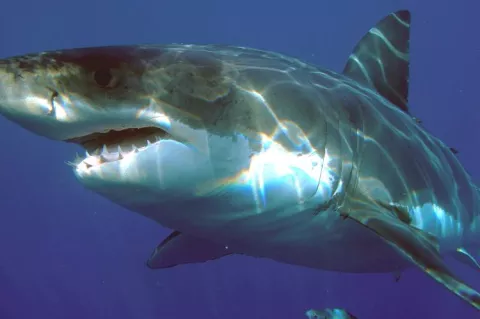
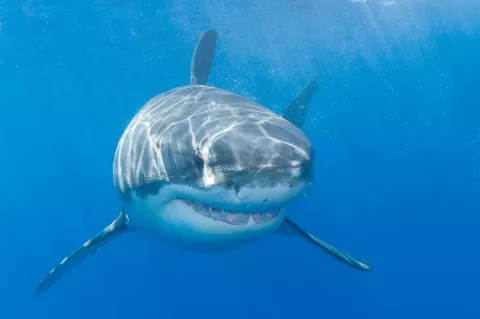
A remarkable discovery in a limestone quarry in north-east Mexico has unveiled the fossilized remains of a colossal ancient shark, a distant relative of the great white shark, that prowled the oceans alongside dinosaurs.
Unveiled by an international team of archaeologists and palaeontologists, this finding provides an intriguing glimpse into the ancient seas and the life of a previously unknown apex predator of the Late Cretaceous period.
In a groundbreaking discovery, researchers have identified what is now considered the world's deepest underwater sinkhole, located off the coast of Mexico. This remarkable geological feature which reaches depths exceeding 1,300 feet (420 meters) could potentially house hidden caves and tunnels, offering new insights into Earth's subterranean mysteries.
Effective January 9, 2023, the Mexican Government has closed Isla Guadalupe indefinitely to all diving activities, film and television productions. Essentially eliminating one of the best places on the planet to cage dive with great white sharks.
This action expands on the 2022 closure of the Guadalupe Island Biosphere Reserve by the National Commission of Natural Protected Areas (CONANP), the federal agency tasked with managing Mexico’s protected natural areas.
They also closed the island to cage diving in 2021 and the pandemic closed down operations in 2020.
There is no doubt that Yucatán in Mexico is a fascinating region. Not only for its culture, its unique nature and wildlife or the archaeological sites of the ancient Maya, but for the simple fact that it is a cave diver’s paradise. Pierre Constant has the story.
It was my fifth time visiting Yucatán in the last five years. Back in 2017, I had taken part in a TDI Sidemount Cave Course in Playa del Carmen. In 2018, I dived the cenotes around Merida and was back again the following year for more. In 2020, my cave training was pushed one step further with a Stage Cave Course in Playa and with a DPV Cave Course (Diver Propulsion Vehicle) in Tulum—even more exciting, but nonetheless challenging. At this level, you cannot use an underwater camera anymore, since you need both hands to deal with the equipment.