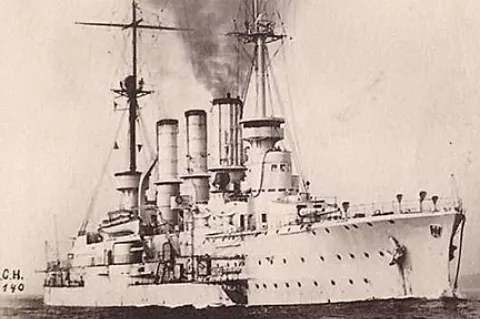
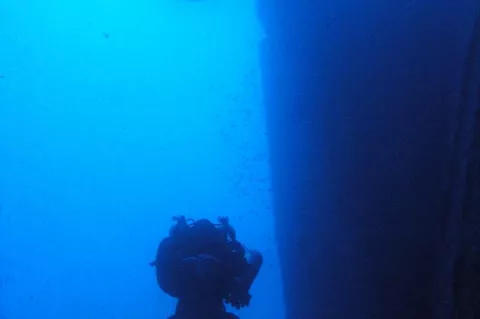
The armoured cruiser Carl Friedrich was constructed in the year 1902 at the well-known shipyard of Blohm & Voss in Hamburg, Germany. The armoured cruiser had a length of 126m and was equipped with an impressive array of guns and torpedo launchers. She was the second ship of the Prinz Adalbert class when she was commissioned by the Imperial German Navy on 12 December 1903.
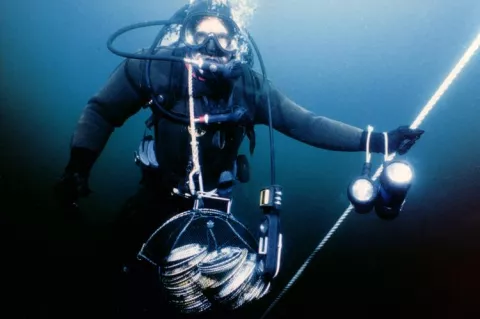
In the early years, she served as a torpedo training ship. Because of her three engines, she could reach a top speed of 20 knots. During the outbreak of the First World War, she served as the flagship of Rear Admiral Ehler Behring. At this time, she was converted to carry two seaplanes. She was the first ship of the Imperial Navy able to carry and launch seaplanes.
Legendary American explorer John Moyer has dived many wrecks along the North American eastern seaboard. But his name is synonymous with the Andrea Doria wreck, on which he made over 120 dives in the '80s and ‘90s, salvaging artifacts, and conducted in-depth research. In this interview by Andrea Murdock Alpini, we gain insight into his life and deep relationship with the Andrea Doria.
John Moyer is a legendary American explorer. He will be turning 70 years old soon and has lived most of his life in Vineland, New Jersey, about a one-hour drive from the ocean. Throughout his life, Moyer has always had two passions: shipwrecks and motorcycles.
In the past, he would dive on shipwrecks all year round, and the only thing that would stop him would be high winds, or if the dive boat was frozen in ice at the dock. He has dived on wrecks all the way up and down the US East Coast, from Canada to Florida.
For years and years, people have often asked me, “Hey, why aren’t you a cave diver?” And I would respond simply, “When I have dived all the wrecks of the world (twice), I will then think about diving Wet Rocks!”
I learnt to dive in 1989, doing my initial training dives in the quarry at Stony Cove in England, a popular inland dive location about 125 miles north of London. I remember, to this day, doing my first training dives. It was January, in mid-winter. The water temperature was 4°C (that’s the recommended temperature for drinking Heineken) and I was in a wetsuit!
Ranging from calm shore dives for beginner divers to technical diving on elusive, unmarked wreck sites, which can only be found via depth sounder—diving in Malta has it all. Just beyond Malta’s dramatic underwater landscapes of strange rock formations, chimneys and caves, visitors can discover Malta’s intriguing and piquant past.
To aid visiting divers, a newly created Underwater Cultural Heritage Unit (UCHU) has been formed within the Heritage Malta agency under the country’s cultural ministry to manage the deep historical wreck sites of Malta. The UCHU provides information regarding the history of the wrecks, how to appreciate them and what the proper etiquette is when visiting these war graves.
Currently rated as the world’s tenth smallest and fifth most densely populated country, Malta is the biggest of the three islands of the Maltese Archipelago, which also includes Gozo and Comino islands. This archipelago sits in the middle of the Mediterranean Sea, 93km south of Italy and 288km north of Africa, surrounded by warm clear waters and year-round temperate climate.
Bikini Atoll—without a doubt—is the undisputed top wreck diving destination on the planet. I remember when I first started diving back in 1989, I would sit around the table and listen to members of our dive club in South London, salivating at the concept of diving Bikini Atolls’ Saratoga, an aircraft carrier and one of the world's largest diveable wrecks. Only a brave few divers ever ventured to this remote place deep within the Marshall Islands. Costing a small fortune to get to, Bikini was only a destination for the elite (and stinking rich!!). It was a place every diver dreamed of getting to.
This was my third trip to Bikini but this didn’t lessen my enthusiasm to getting back there. Traveling to this Atoll, deep within the Marshal Island group, takes some doing. Getting there from Auckland, New Zealand, I flew to Cairns, then Guam, then onto Kwajalein via an island hopper, which stopped at four other Micronesian islands. Some 27 hours later, getting into Kwajalein meant that we were only half way there.
June 2017 — Fifty-six-year-old explorer Martin McClellan is determined to revisit the SS Tahoe to conduct an extensive photogrammetric survey of the wreck. The 169ft (52m)-long 19th century steamship, which was scuttled in 1940, rests intact on a steep underwater slope at a maximum depth of 470ffw (144mfw) beneath Glenbrook Bay in Lake Tahoe, Nevada, USA.
McClellan was the first to dive the Tahoe with Brian Morris under the banner of his organization New Millennium Dive Expeditions (NMDE) in 2002, and has conducted 10 open-circuit dives on the wreck over the last 15 years. The burly six-foot-two tech diver was instrumental in getting the shipwreck listed on the National Park Service’s National Register of Historic Places in 2004.1 He now wants to return with a team of GUE rebreather divers and high-definition video cameras to create a detailed 3D image of the wreck.
NOTES: 1Though the NPS manages the National Register of Historic Places, the SS Tahoe is not a NPS managed asset, and Lake Tahoe is not a national park. 2Http://www.projectbaseline.org 3Watch for an upcoming article, “The twenty deepest tech shipwreck dives,” by Michael Menduno. 4Https://en.wikipedia.org/wiki/Boesmansgat 5High profile technical diver David Shaw died on a rebreather dive at Boesmangat in 2005.
There have been a few times during my life as a diver that I have had the opportunity to dive an extraordinary wreck. The Graf Zeppelin is one such wreck. It is more than a shipwreck, it is also one of the great mysteries of World War II. Most people do not know that the Germans built an aircraft carrier. Here is her story.
There are places in the world where time seems to stand still, where you will find contemporary witnesses of events that can take your breath away. I visited just such a place more than 100 meters deep in a French lake—Lac du Bourget. Here, for more than 70 years, rests a Focke-Wulf Fw 58C—a German WWII airplane. This particular aircraft is one of the last of its kind that exist in the world.
On the nights of 26 and 27 November 1942, Airport Bruon in France was under German control. The Navigation School Number 4 of the 3rd Air Fleet was housed there. Young students were trained on the Focke-Wulf Fw 58C aircraft to become radio operators of the bomb squadron of the air force. The Focke-Wulf was used in WWII for the connection between the air bases in Bruon on Lac du Bourget and Lyon, and for monitoring the surrounding area.
The dive
Oliver and I descended along the shotline. The visibility was good but it grew dark quickly. At a depth of 95m (312ft), we reached the tail of the aircraft. I got a shiver down my spine when I saw the swastika symbol, which was lit up by my torch. It looked like it had been painted on the airplane only yesterday.
One of the things I value the most about planning specialized wreck diving trips around the world is not only getting an opportunity to dive these sites, but also getting totally immersed in the history and circumstances that put these steel hulks at the bottom of the ocean. The more I read and learn about the bravery and heroism of the people who died in fierce battle during these conflicts, the more I am humbled by diving these graveyards of the deep.
Hermes was no different. On 5 April 1942, HMS Hermes and the destroyer HMAS Vampire were sent to Trincomalee in Ceylon (now called Sri Lanka) to prepare for Operation Ironclad, the British invasion of Madagascar during World War II. After advance warning of a Japanese air raid on 9 April 1942, the vessels left Trincomalee and sailed south down the Ceylon coast before the air raid arrived.
Gary Gentile not only helped pioneer deep wreck diving, but also documented its art and craft, in addition to his finds so that others may follow in his footsteps.
They are big shoes, err, fins to follow. The 66-year explorer and author has made over 2,000 decompression dives including more than 200 dives on the Andrea Doria, and has published 58 books—38 on diving including his best sellers,
The Technical Diving Handbook, Shadow Divers Exposed, and shipwreck Dive Guide series, along with 17 science fiction novels. He has also published more than 3,000 photographs.