  • X-Ray International 🇬🇧
  • Sportsdykkeren.dk 🇩🇰
  • XRay-Mag.SE 🇸🇪

Secondary menu - Advertising and subscriptions

  • Got stories? - Guidelines
  • Advertising
  • Subscribe to X-Ray Mag
Home
  • Magazine
  • News
      1. Latest news
      2. Press releases
      3. Breaking News
  • Travel
      1. Destinations
        1. Australia & New Zealand
        2. Continental Asia
          • Japan
          • China
          • South Korea
        3. Southeast Asia
          • Indonesia
            • Bali
            • Komodo
            • Lembeh
            • Maluku
            • Raja Ampat
            • Sulawesi
          • Malaysia
          • Papua New Guinea
          • Philippines
          • Thailand
          • Timor-Leste
        4. South Pacific & Oceania
          • Fiji
          • French Polynesia
          • Micronesia
            • Chuuk (Truk)
            • Marshall Islands
            • Yap
          • Palau
          • Samoa
          • Solomon Islands
          • Tonga
          • Vanuatu
        5. Indian Ocean
          • Madagascar
          • Maldives
          • Seychelles
        6. Red Sea
        7. Africa
          • Egypt
          • Malawi
          • Mozambique
          • Namibia
          • South Africa
          • Sudan
          • Tanzania
        8. Mediterranean & Adriatic
          • Croatia
          • Cyprus
          • France
          • Greece
          • Italy
          • Malta & Gozo
          • Portugal
          • Spain
          • Turkey
        9. Europe
          • Northern Europe
            • Denmark
            • England
            • Finland
            • Iceland
            • Ireland
            • Norway
            • Scotland
            • Sweden
          • Eastern Europe
            • Albania
            • Bosnia-Hercegovina
            • Croatia
            • Czech Republic
            • Hungary
            • Poland
            • Russia
              • Northwest Russia
              • Russian Far East
              • Siberia
          • Western Europe
            • Austria
            • France
            • Germany
            • Switzerland
          • Southern Europe
            • Cyprus
            • Greece
            • Italy
            • Malta & Gozo
            • Portugal
            • Spain
        10. Atlantic
          • Azores
          • Canary Islands
          • Falkland Islands
          • St Helena
        11. North America
          • Canada
          • Great Lakes
          • United States
            • East Coast
            • West coast
            • Alaska
            • Hawaii
            • US Virgin Islands
            • Guam
          • Mexico
        12. Caribbean & Central America
          • Bahamas
          • Belize
          • Cayman Islands
          • Bonaire
          • Cuba
          • Dominican Republic
          • Mexico
          • Columbia
          • Grenada
          • Costa Rica
          • Saba
          • Honduras
          • Turks & Caicos
          • US Virgin Islands
          • Nicaragua
        13. South America
          • Argentina
          • Brazil
          • Ecuador
        14. Polar Regions
          • Artic
          • Antarctica
      2. Promotions
      3. My Favorite Dive
  • Ecology
      1. Ocean Mysteries series by Ila France Porcher
      2. Sharks, Rays and Nudibranch stories by Andy Murch
      3. Sentience
      4. Conservation
      5. Coral Reefs
      6. Dolphins
      7. Fish
      8. Jellyfish
      9. Mantas & Stingrays
      10. Nudibranchs
      11. Octopus & Squid
      12. Sea Turtles
      13. Seals & Sea Lions
      14. Sharks
      15. Whales
  • Wrecks
      1. Vic Verlinden
      2. Ancient Wrecks
      3. Artificial Reefs
      4. Marine Archaeology
      5. Older Warships
      6. Steamships & Cargo
      7. Tall & Wooden Ships
      8. WWI Wrecks
      9. WWII Wrecks
  • Training & Tech
      1. Rebreathers
      2. Sidemount
      3. Deep Wrecks
      4. Cave Diving & Mines
      5. Ice Diving
      6. Diver Health & Safety
        1. Divers Alert Network - DAN
        2. Safety Culture
      7. Adaptive Diving
  • More
      1. Equipment
        1. BCDs, Wings & Sidemounts
        2. Dive Computers
        3. Dive Watches
        4. Drysuits & Undergarments
        5. Hoods, Gloves & Boots
        6. Lamps & Torches
        7. Masks, Fins & Snorkels
        8. Regulators
        9. Wetsuits & Rashguards
      2. Photo & Video
        1. Equipment
          • Cameras & Optics
          • Editing & Post-processing
          • Housings
          • Lighting
          • Useful Tools
        2. Tutorials
          • Techniques & Tips
            • Mike Bartick
            • Rico Besserdich
          • Composition
          • Editing & Post-processing
        3. News & Announcements
        4. Contributors' Picks
      3. Books & Media
        1. Works by our contributors
      4. Profiles & Interviews
        1. In Memoriam
      5. Lifestyle
        1. Portfolios & Ocean Arts
        2. Apres Dive & Apparel
        3. Editorials
      6. Contributors
        1. Pundits
          • Mike Ange
          • Gareth Lock
          • Michael Menduno
          • Mark Powell
          • Simon Pridmore
        2. Regular writers
          • Scott Bennett
          • Andrey Bizyukin
          • Larry Cohen & Olga Torrey
          • Pierre Constant
          • Brent Durand
          • Jennifer Idol
          • Scott Johnson
          • Steve Jones
          • Kate Jonker
          • Kelly LaClaire & Kate Holt
          • Matthew Meier
          • Brandi Mueller
          • Svetlana Murashkina
          • Barb Roy
          • Don Silcock
          • Claudia Weber-Gebert
          • Lawson Wood
        3. Columnists
          • Scott Bennett
          • Rico Besserdich
          • Rosemary 'Roz' E. Lunn
          • Ila France Porcher
  • ⚲ Search

How a school of fish moves as one

Large schools of fish always move as one, and researchers have discovered just how they manage to achieve such seamless coordination.

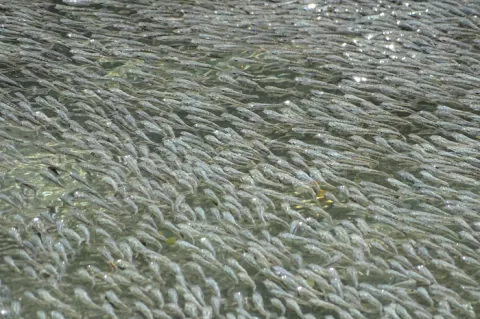
Tight school of glassfish in the bay of Aqaba
Ecology & Science

We’ve all seen those huge schools of fish that move as one and coordinate their movements so perfectly. New research has come up with a way to map the chain of direct interaction in such schools of fish, discovering that the fish pay attention to one or two of their neighbours at a time when the school moves as a group.

Light-sensing Skin Cells Make Hogfish a Master of Camouflage

Scientists uncover a unique layer of cells in hogfish skin that enhances their ability to blend seamlessly into their surroundings.

The hogfish, also known as boquinete, doncella de pluma or pez perro in Mexico is a species of wrasse native to the Western Atlantic Ocean
Ecology & Science

Hogfish, Lachnolaimus maximus, possess an uncanny ability to alter their skin colour, transitioning from a mottled white to a deep coral orange within mere seconds. This remarkable transformation is a survival mechanism, allowing them to seamlessly blend with their environment, evading potential predators.

The trumpetfish's unique hunting strategy

An experiment on coral reefs provides the first evidence that predators use other animals for motion camouflage to approach their prey without detection.

When the trumpetfish swims alongside another species, it either remains hidden or is not recognised as a threat due to its altered shape
Ecology & Science

The trumpetfish, with its long, slender body, shadows non-threatening species like the parrotfish. This allows it to get closer to its prey, such as damselfish, without being detected. Dr Sam Matchette, a leading researcher from the University of Cambridge, explains that when the trumpetfish swims alongside another species, it either remains hidden or is not recognised as a threat due to its altered shape.

Neon tetra fish wait their turn when evacuating through narrow opening

Imagine you are a fish swimming amongst other fish and a fish net suddenly corrals everyone towards a small opening in the side of the tank. Would you expect to experience a mad rush or an orderly exit through the opening?

Tetra fish
Ecology & Science

Scientists have observed neon tetra fish queuing up when exiting through a narrow opening, according to a study in the journal Scientific Reports.

In the study, Aurélie Dupont, a biological physicist in the Laboratoire Interdisciplinaire de Physique at University Grenoble Alpes, and her team set up two fish tanks connected to each other by a narrow opening. The diameter of the passageway varied from 1.5 to 4 centimeters.

Fish Recognises Itself in Photographs

Cleaner fish (Labroides dimidiatus) likely recognise their own mirror image using a mental image of the self-face, comparable to humans.

Ecology & Science

A new study demonstrates how animals recognise self-images.

Some animals have the remarkable capacity for mirror self-recognition (MSR), yet any implications for self-awareness remain uncertain.

In a test of MSR ability in cleaner fish, mirror-naive fish initially attacked photograph models of both themselves and unfamiliar strangers. In contrast, after all fish had passed the mirror mark test, they did not attack their own (motionless) images, but still frequently attacked those of unfamiliar individuals.

Lionfish invades Brazilian waters

Lionfish have been spotted near Brazil’s Fernando de Noronha Marine National Park, a biodiversity haven and iconic scuba diving destination off the country’s northeastern coast.

Ecology & Science

First spotted in the Atlantic Ocean off Florida in the 1980s, they later spread across the Caribbean, reshuffling coral reefs and other ecosystems by feasting on fish unfamiliar with the voracious predator.

Why damselfish chasing away cleaner fish's customers is bad for reefs

When sharknose gobies offer their cleaning services at reefs where there are damselfish, the damselfish chase away the gobies’ "customers." A study uncovers why they do that.

Ecology & Science

Many of us are familiar with the scenes at cleaning stations, where cleaner fish and cleaner shrimp feed on the parasites and dead tissues of their “clients.”

Under normal circumstances, sharknose gobies (Elacatinus evelynae) would set up a cleaning station at a coral reef, and use it as a base to attend to their “clients”—usually the parrotfish, surgeonfish, butterflyfish, etc— by eating the parasites and dead body tissue off their client's skin, fins and mouth. 

However, at reefs with damselfish, things are not always so peaceful.

Cod stick to their own shipwreck

Adult cod have, one would think, the entire ocean at their disposal, and yet apparently each individual cod still chooses ‘their own’ local shipwreck, which they swim back to faithfully day after day.

Ecology & Science

This is just one of the fascinating results from research using acoustic tags which has yielded new insights into what cod get up to below the surface of the sea.

Fishes look out for their buddies

Fishes, which are commonly considered to be cold, unsocial, and unintelligent, are capable of negotiating reciprocal cooperative systems, Australian researchers find.

Masked spinefoots (S. puellus)
Ecology & Science

In pairs of coral reef rabbitfishes (f. Siganidae), one fish frequently assumes an upright vigilance position in the water column, while the partner forages in small crevices in the reef substratum. Both behaviours are strongly coordinated and partners regularly alternate their positions, resulting in a balanced distribution of foraging activity.

Fish larvae use external clues to find their way

In the vast open oceans, how do fish larvae manage to find their way around? Or do they simply drift along with the currents?

Claire Paris (second from left) and co-author Jean-Olivier Irisson (third from left), deploying the Drifting In Situ Chamber (DISC), equipped with an imaging system, during an expedition at the Australian Museum Lizard Island Research Station
Ecology & Science

In this study, researchers discovered that fish larvae around the world used external cues like the sun, Earth’s magnetic field and sounds to find their way around in the open ocean. 

The fish larvae were able to control their destination and migrate by keeping a bearing. 

Pagination

  • First page « First
  • Previous page ‹‹
  • Page 1
  • Page 2
  • Current page 3
  • Page 4
  • Page 5
  • Page 6
  • Page 7
  • Page 8
  • Page 9
  • …
  • Next page ››
  • Last page Last »
Subscribe to Fish

Latest updates

X-Ray Mag 140 cover
X-Ray Mag #140
15 May, 2026 - 19:54
We have agency
We Have Agency
14 May, 2026 - 20:59
Conscious fish
Conscious Fish?
14 May, 2026 - 18:36
DAN Debuts Continuing Education for Dive Professionals – Course 3: Barotrauma Legal Drama
13 May, 2026 - 20:47
More

Upcoming Events & Expos

5 Jun, 2026 ➢ 7 Jun, 2026

Malaysia International Dive Expo (MIDE) 2026

Malaysia International Trade and Exhibition Centre (MITEC), Kuala Lumpur

9 Sep, 2026 ➢ 12 Sep, 2026

ABOFA – Aqaba Blue Ocean: Future in Action

Aqaba, Jordan

23 Oct, 2026 ➢ 26 Oct, 2026

Diving Talks

Lisbon, Portugal

3 Nov, 2026 ➢ 6 Nov, 2026

DEMA 2026

New Orleans, Lousiana

5 Dec, 2026 ➢ 6 Dec, 2026

Dive-Expo

Antwerp Expo, Belgium

Stay Social

Don’t forget that you can connect with us through all major social media, by simply clicking on the corresponding logo below.

Reviews

Books & Media

Marine Life of the North Sea and English Channel

Lawson Wood’s Marine Life of the North Sea and English Channel is an extensive guide dedicated to the exploration and understanding of the diverse marine ecosystems found between the British Isles and the coasts of northern France, Belgium, the Netherlands, Denmark, Norway and southern Sweden.

Cover  Marine LIfe of the North Sea and English Channel
Works by Our Contributors
Review
Books
Lawson Wood
Books & Media

Scuba Diving Operational Risk Management

An SAS approach to principles, techniques and application in recreational and technical diving.

Book cover
Review
Books
Books & Media

Technically Speaking

Simon Pridmore's aim in writing this book was to examine and record where technical diving came from, how it developed, how it expanded across the world, who the important movers were and how the efforts of a few determined people changed our little field of human endeavour forever.

Technically Speaking
Works by Our Contributors
Review
Books
Simon Pridmore
Books & Media

Reefs of Time

In Reefs of Time, geoscientist and science educator Lisa S. Gardiner offers a compelling and accessible exploration of how fossil coral reefs can inform our understanding of the threats facing reefs today. 

Book cover:  Reefs of Time
Review
Advertisement
Advertisement
Home
International Dive Magazine

About X-Ray Mag

AquaScope Media logo

Compiled by an international network of top dive editors and world-class underwater photographers, X-RAY MAG is the planet's only truly global premier dive lifestyle magazine. Subscription and downloads are free. Published since 2003.

Image
DEMA Member

Published by:

AquaScope Media ApS - Copenhagen - © 2026

A closer look below the surface.

Advertising

  • General info / Distribution
  • Rate cards
    • Media kit - $ (USD)
    • Media kit - € (EUR)
    • Media kit - £ (GBP)
  • Ad Sizes and Formats
    • Magazine Ad Copy sizes
    • Banner ad sizes
  • General trading terms

Privacy & GDPR

  • Privacy and Cookie Policy

Subscriptions

  • US Newsletter
  • Canadian Newsletter
  • European Newsletter
  • UK Newsletter
  • Asia-Pacific Newslettre
  • Other / Global
  • 😪 Unsubscribe

Brand Assets / Logos

  • Banner ads
  • Logos
  • SoMe Collaterals

Contact

  • Contact us
  • About us

Brugerkontomenu

  • Log in
Clear keys input element