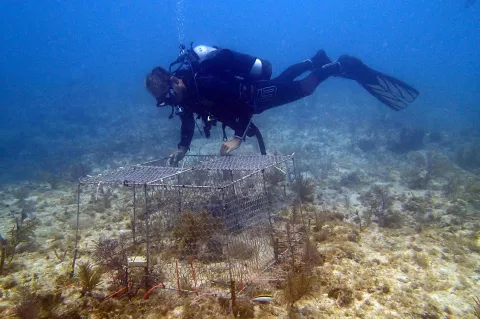
Florida’s seagrass flats used to be the place where anglers from around the world would congregate to catch the bonefish. However, this is no longer the case, as populations of the fish—nicknamed “grey ghosts”—have fallen by more than 50 percent over four decades.
In an article published in The Guardian, according to Dr Jennifer Rehage, a fish ecologist and associate professor at Florida International University (FIU), many anglers had said they could not find bonefish in the seagrass flats anymore.
The hamlets, a group of reef fishes from the wider Caribbean, sport a stunning array of colours and patterns, but the genetic basis of this morphological variety is unclear.
Although the hamlet lineage is about 26 million years old, the diversification of colours appears to have occurred only within the last 10,000 generations in a burst of diversification that ranks among the fastest in fishes.
Researchers on board the research vessel estimated that the area contained 60 million nests of the Jonah's icefish—likely the most spatially extensive contiguous fish breeding colony discovered to date.
Using a towed camera system, researchers discovered the world’s largest fish breeding area near the Filchner Ice Shelf, south of the Antarctic Weddell Sea.
The nests belonged to the Jonah’s icefish (Neopagetopsis ionah). Mapping the area suggested a total extent of 240 square kilometres. Based on the density of the nests and the size of the breeding area, it was estimated that there were about 60 million nests.
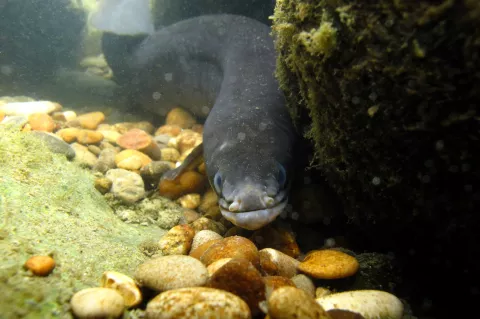
Many of us are familiar with photos of moray eels snug in their caves or crevices, peering out into the open sea.
One might imagine them venturing out to hunt for prey when hunger pangs strike or an unfortunate prey swims by, but do you know that a particular species of moray eels—the snowflake moray—can hunt on dry land as well?
At least, this was what happened when a group of scientists from UC Santa Cruz filmed snowflake morays emerging out from the water onto dry land, then grabbing a piece of meat with their fangs, and swallowing it.
What can a small fish do to escape the eyes of a potential predator? Apparently quite a lot, if you're talking about a large school of sulphur mollies, it seems.
While fish are generally no match for predatory birds that hunt them from above, the sulphur molly, a freshwater fish species which can grow up to 4.5 inches, appear to have developed an effective defence mechanism.
When the school spots a potential predator (not necessarily birds, but any other species that may prove a threat, including humans), the school start swimming in waves that were conspicuous, repetitive and rhythmic.
And it is not just a few hundred sulphur mollies involved in this display—we're talking about a much larger number.
Thanks to increased awareness, we are all aware of how some plastic food utensils can leach Bisphenol-A (BPA) into our food.
BPA is an endocrine disruptor and it can interfere with how the hormones in our bodies function. Studies have shown that pollutants like BPA tend to feminize animals like freshwater fish, rats and mice.
How does it affect animals whose gender is determined by its environment?
Fish rubbing themselves against a shark's body may sound as if they have a death wish, but this is precisely what some fish have been spotted doing. And it turns out that such behaviour is more widespread and frequent than one would think.
A study led by the University of Miami (UM) Shark Research and Conservation Program at the Rosenstiel School of Marine and Atmospheric Science uncovered over 40 instances of fish rubbing themselves against a shark’s skin in over ten locations around the globe.
While chafing has been well documented between fish and inanimate objects, such as sand or rocky substrate, this shark-chaffing phenomenon appears to be the only scenario in nature where prey actively seek out and rub up against a predator.
Seahorses appear to be slow passive hunters as they use their tail to cling to coral or seaweed. However, this can be deceiving, as they are swift, efficient hunters.
A recent study by Tel Aviv University, published in the Journal of Experimental Biology, documents the speed at they hunt.
Three species of seahorses with varying snout lengths were chosen for the study: Jayakar's seahorses, sea ponies and short-snouted seahorses.
In social animals living in the wild, individuals rely on their buddies to alert them if a predator is lurking.
All animals aim to balance the risk of predation against the energy investment necessary to execute an escape, to maximise the number of correct reactions (e.g. reacting to the presence of a predator) and minimise reactions to inaccurate information (e.g. reacting to harmless stimuli).
Trust among individuals is critical. This is true for humans as well as many other species, including fishes.