  • Sportsdykkeren.dk 🇩🇰
  • XRay-Mag.SE 🇸🇪
  • Dykmässan (diveshow)

Secondary menu - Advertising and subscriptions

  • Got stories? - Guidelines
  • Advertising
  • Subscribe to X-Ray Mag
Home
  • Magazine
  • News
      1. Latest news
      2. Press releases
      3. Breaking News
  • Travel
      1. Destinations
        1. Australia & New Zealand
        2. Continental Asia
          • Japan
          • China
          • South Korea
        3. Southeast Asia
          • Indonesia
            • Bali
            • Komodo
            • Lembeh
            • Maluku
            • Raja Ampat
            • Sulawesi
          • Malaysia
          • Papua New Guinea
          • Philippines
          • Thailand
          • Timor-Leste
        4. South Pacific & Oceania
          • Fiji
          • French Polynesia
          • Micronesia
            • Chuuk (Truk)
            • Marshall Islands
            • Yap
          • Palau
          • Samoa
          • Solomon Islands
          • Tonga
          • Vanuatu
        5. Indian Ocean
          • Madagascar
          • Maldives
          • Seychelles
        6. Red Sea
        7. Africa
          • Egypt
          • Malawi
          • Mozambique
          • Namibia
          • South Africa
          • Sudan
          • Tanzania
        8. Mediterranean & Adriatic
          • Croatia
          • Cyprus
          • France
          • Greece
          • Italy
          • Malta & Gozo
          • Portugal
          • Spain
          • Turkey
        9. Europe
          • Northern Europe
            • Denmark
            • England
            • Finland
            • Iceland
            • Ireland
            • Norway
            • Scotland
            • Sweden
          • Eastern Europe
            • Albania
            • Bosnia-Hercegovina
            • Croatia
            • Czech Republic
            • Hungary
            • Poland
            • Russia
              • Northwest Russia
              • Russian Far East
              • Siberia
          • Western Europe
            • Austria
            • France
            • Germany
            • Switzerland
          • Southern Europe
            • Cyprus
            • Greece
            • Italy
            • Malta & Gozo
            • Portugal
            • Spain
        10. Atlantic
          • Azores
          • Canary Islands
          • Falkland Islands
          • St Helena
        11. North America
          • Canada
          • Great Lakes
          • United States
            • East Coast
            • West coast
            • Alaska
            • Hawaii
            • US Virgin Islands
            • Guam
          • Mexico
        12. Caribbean & Central America
          • Bahamas
          • Belize
          • Cayman Islands
          • Bonaire
          • Cuba
          • Dominican Republic
          • Mexico
          • Columbia
          • Grenada
          • Costa Rica
          • Saba
          • Honduras
          • Turks & Caicos
          • US Virgin Islands
          • Nicaragua
        13. South America
          • Argentina
          • Brazil
          • Ecuador
        14. Polar Regions
          • Artic
          • Antarctica
      2. Promotions
      3. My Favorite Dive
  • Ecology
      1. Ocean Mysteries series by Ila France Porcher
      2. Sharks, Rays and Nudibranch stories by Andy Murch
      3. Sentience
      4. Conservation
      5. Coral Reefs
      6. Dolphins
      7. Fish
      8. Jellyfish
      9. Mantas & Stingrays
      10. Nudibranchs
      11. Octopus & Squid
      12. Sea Turtles
      13. Seals & Sea Lions
      14. Sharks
      15. Whales
  • Wrecks
      1. Vic Verlinden
      2. Ancient Wrecks
      3. Artificial Reefs
      4. Marine Archaeology
      5. Older Warships
      6. Steamships & Cargo
      7. Tall & Wooden Ships
      8. WWI Wrecks
      9. WWII Wrecks
  • Training & Tech
      1. Rebreathers
      2. Sidemount
      3. Deep Wrecks
      4. Cave Diving & Mines
      5. Ice Diving
      6. Diver Health & Safety
        1. Divers Alert Network - DAN
        2. Safety Culture
      7. Adaptive Diving
  • More
      1. Equipment
        1. BCDs, Wings & Sidemounts
        2. Dive Computers
        3. Dive Watches
        4. Drysuits & Undergarments
        5. Hoods, Gloves & Boots
        6. Lamps & Torches
        7. Masks, Fins & Snorkels
        8. Regulators
        9. Wetsuits & Rashguards
      2. Photo & Video
        1. Equipment
          • Cameras & Optics
          • Editing & Post-processing
          • Housings
          • Lighting
          • Useful Tools
        2. Tutorials
          • Techniques & Tips
            • Mike Bartick
            • Rico Besserdich
          • Composition
          • Editing & Post-processing
        3. News & Announcements
        4. Contributors' Picks
      3. Books & Media
        1. Works by our contributors
      4. Profiles & Interviews
        1. In Memoriam
      5. Lifestyle
        1. Portfolios & Ocean Arts
        2. Apres Dive & Apparel
        3. Editorials
      6. Contributors
        1. Pundits
          • Mike Ange
          • Gareth Lock
          • Michael Menduno
          • Mark Powell
          • Simon Pridmore
        2. Regular writers
          • Scott Bennett
          • Andrey Bizyukin
          • Larry Cohen & Olga Torrey
          • Pierre Constant
          • Brent Durand
          • Jennifer Idol
          • Scott Johnson
          • Steve Jones
          • Kate Jonker
          • Kelly LaClaire & Kate Holt
          • Matthew Meier
          • Brandi Mueller
          • Svetlana Murashkina
          • Barb Roy
          • Don Silcock
          • Claudia Weber-Gebert
          • Lawson Wood
        3. Columnists
          • Scott Bennett
          • Rico Besserdich
          • Rosemary 'Roz' E. Lunn
          • Ila France Porcher
  • ⚲ Search

Clownfish Shrink to Survive

A surprising study reveals that clownfish can reduce their body size in response to rising temperatures and social pressures.

Ecology & Science

Clown anemonefish, iconic residents of coral reefs, are now known to physically shrink to survive. A new study in Science Advances monitored 134 clownfish in Papua New Guinea during a 2023 marine heatwave and found that over 70 percent of individuals shrank at least once during the five-month event.

Mackerel Meltdown: Overfishing Pushes Stocks to the Brink

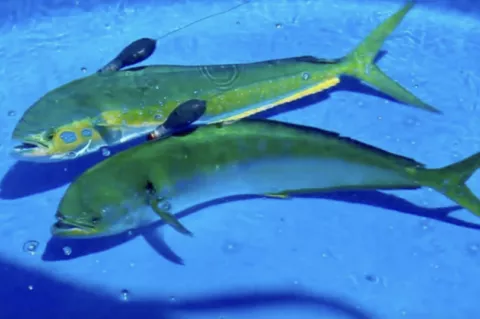
In a stark warning, marine experts are sounding the alarm as mackerel stocks in the north-east Atlantic teeter on the edge of collapse, joining a troubling trend seen in fisheries targeting other species, including sharks.

mackerel
Ecology & Science

The Marine Conservation Society (MCS) has downgraded mackerel from a sustainable seafood choice to a cautionary amber rating, urging consumers to switch to herring or Cornish sardines instead. 

Tuna Use Sharks as Back Scratchers

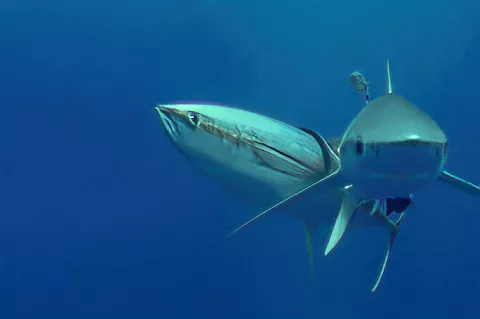
In the open ocean, life is a struggle for survival, and threats come in many forms, from predators to parasites. While close interactions between species, which benefit both individuals, have been recorded, those among oceanic dwellers remain mysterious. But now, researchers have found that some of the large pelagic fish use sharks to scrape off their parasites.

School of tuna
Ecology & Science

This groundbreaking research documents the behaviour in several oceanic fish species spanning three oceans. It describes the first recorded instances of fish using sharks and other fish to brush and scrape against, with the goal of freeing themselves of parasites.

Newly Described Species of Moray Eel Prefers Dark, Murky Environments

A new species of moray eel that lurks in the murky river mouths of the Indo-Pacific is now in the spotlight, thanks to a paper that formally describes it in the Zookeys journal. 

Ecology & Science

The Hades’ snake moray (Uropterygius hades) is a slender, dark brown eel which stands out for its unique adaptations to and preference for dim, turbid environments.

Unlike most of its marine relatives, which thrive in coral reefs, it is at home in estuarine habitats, a characteristic that is unusual among the 230 known species of moray eels. It is distributed across the Central Indo-Pacific, and has been found in southern Japan, Taiwan, the Philippines, southern Java, and Fiji.

Outsmarting the Predator: Sardines vs Marlin

A study examines how sardines collectively evade their predators and how their predators adapt to outsmart them.

Ecology & Science

In a recent study, researchers investigated how sardines that find themselves on a predator's radar collectively employ collective evasive manoeuvres and how their predators respond to outsmart them.

Using computational modelling and aerial video footage, the team from the Cluster of Excellence “Science of Intelligence” (SCIol), the Humboldt-Universität zu Berlin, the Leibniz Institute of Freshwater Ecology and Inland Fisheries, and Cambridge University focussed on the predator-prey behaviour of striped marlins and sardine shoals in the open ocean. 

Fish Embryos Decide When to Hatch

A study has uncovered the process by which fish embryos actively determine the timing of their hatching.

Ecology & Science

When it comes to making its grand entrance into the world, fish embryos do not leave things to chance.

Researchers, led by Dr. Matan Golan of the Hebrew University of Jerusalem and the Agricultural Research Organization-Volcani Institute, have discovered that the hatching process of fish embryos is not a passive process. 

Fishing Is Causing Fish To Flee When They Should Mate

Human activity such as fishing can disrupt the natural behaviour of marine animals, forcing them to prioritise survival over reproduction. In a study led by Lancaster University, researchers examined how fishing pressure changed the behaviour of male squaretail groupers in the Lakshadweep archipelago in India.

Squaretail coral grouper (Plectropomus areolatus)
Ecology & Science

Several times a year, squaretail groupers gather at spawning aggregation sites to mate, typically around the new and full moons between December and March. The males show up several days before to establish their territories, while the females arrive a day before the new moon. Then, both groups will attempt to pair and spawn in synchrony with the moon’s cycles.

For this species, these brief encounters are their only opportunities to reproduce.

X-RAY MAGAZINE FEATURE

The Beautiful & Elusive Pygmy Angelfish

The shy and enigmatic pygmy angelfish is found on coral and rocky reefs, primarily in the Indo-Pacific region, but a few species can also be found in the western Atlantic. Nigel Marsh takes a closer look at this elusive family of fish.

Words:
Nigel Marsh
Images:
Nigel Marsh
Bicolor angelfish. Photo by Nigel Marsh.
➥ Download the full article as pdf ⬅︎
Ecology & Science

It had already been a wonderful dive when I suddenly spotted a group of small yellow fish a few metres away. Always on the lookout for rare and unusual fish, I got very excited when I realised the small yellow fish were Herald’s angelfish. I slowly crept forward, hoping the fish would stay in the open. Unfortunately, the shy fish disappeared into a crevice before I could get within camera range. I decided to wait and see if they would reappear, and today was my lucky day, as one fish emerged, posed perfectly for my camera and then vanished again.

Can Clownfish Count?

To discern friend from foe, clownfish count stripes. A recent study found that common clownfish displayed aggressive behaviour predominantly towards members of their own species with three white bands, engaging in confrontations lasting several seconds. In contrast, intruders of other species faced milder aggression.

Ecology & Science

Clownfish, also known as anemonefish, are feisty critters that vigorously defend their anemone homes from intruders, particularly those of their own species, displaying aggressive behaviour. Anemonefish species living in the same areas exhibit a variety of stripe patterns, ranging from three vertical bars to none, as observed by Kina Hayashi from the Okinawa Institute of Science and Technology, Japan.

X-RAY MAGAZINE FEATURE

A Matter of Sentience

Fish feel pain, or don’t they? Despite a growing body of sound evidence that fish do indeed feel pain and are sentient beings capable of all the types of cognition found in the “higher” mammals, with the possible sole exception of the ability to imitate, a group of critics seems to systematically seek to discredit this research. But for what reasons? Ila France Porcher takes a closer look at the stakes involved.

Words:
Ila France Porcher
Images:
Peter Symes
Download the full article as pdf ⬇︎
Ecology & Science

It was in 2003 that Dr Lynne Sneddon of the University of Liverpool found through rigorous scientific research that fish are sensitive to pain and suffer. In the years since then, many other researchers around the world have confirmed her findings and expanded on them.

Pagination

  • First page « First
  • Previous page ‹‹
  • Page 1
  • Current page 2
  • Page 3
  • Page 4
  • Page 5
  • Page 6
  • Page 7
  • Page 8
  • Page 9
  • …
  • Next page ››
  • Last page Last »
Subscribe to Fish

Latest updates

Professor Simon Mitchell takes blood gas at a depth of 80 metres.
Deepest Blood-Gas Study Probes Freediving Physiology
16 Sep, 2026 - 16:54
Dive Instructor Detained Over Raja Ampat Turtle Case
16 Sep, 2026 - 16:08
The Wolach 919 tankless diving system as displayed on the online trading platform Alibaba.com
Coroner Calls for Ban on Tankless Dive System
12 Sep, 2026 - 17:43
Fanciful underwater waterfall
The Rivers Beneath the Sea
12 Sep, 2026 - 12:51
More

Upcoming Events & Expos

23 Oct, 2026 ➢ 26 Oct, 2026

Diving Talks

Lisbon, Portugal

3 Nov, 2026 ➢ 6 Nov, 2026

DEMA 2026

New Orleans, Lousiana

21 Nov, 2026 ➢ 22 Nov, 2026

Baltictech Conference 2026

Gdynia, Poland

5 Dec, 2026 ➢ 6 Dec, 2026

Dive-Expo

Antwerp Expo, Belgium

16 Mar, 2027 ➢ 19 Mar, 2027

Aqaba Blue: Ocean Future in Action

Aqaba, Jordan

Stay Social

Don’t forget that you can connect with us through all major social media, by simply clicking on the corresponding logo below.

Reviews

Books & Media

Marine Life of the Caribbean

A richly illustrated field guide to the remarkable diversity of one of the world’s great diving regions

Marine Life of the Caribbean by Lawson Wood
Works by Our Contributors
Review
Books
Lawson Wood
Books & Media

Scuba Diving Operational Risk Management

An SAS approach to principles, techniques and application in recreational and technical diving.

Book cover
Review
Books
Books & Media

Technically Speaking

Simon Pridmore's aim in writing this book was to examine and record where technical diving came from, how it developed, how it expanded across the world, who the important movers were and how the efforts of a few determined people changed our little field of human endeavour forever.

Technically Speaking
Works by Our Contributors
Review
Books
Simon Pridmore
Books & Media

Yes, Fish Feel Pain

A thought-provoking examination of fish sentience, behaviour and the growing scientific debate surrounding pain perception in aquatic animals.

Yes, Fish Feel Pain
Works by Our Contributors
Review
Books
Ila France Porcher
Advertisement
Advertisement
Home
International Dive Magazine

About X-Ray Mag

AquaScope Media logo

Compiled by an international network of top dive editors and world-class underwater photographers, X-RAY MAG is the planet's only truly global premier dive lifestyle magazine. Subscription and downloads are free. Published since 2003.

Image
DEMA Member

Published by:

AquaScope Media ApS - Copenhagen - © 2026

A closer look below the surface.

Advertising

  • General info / Distribution
  • Rate cards
    • Media kit - $ (USD)
    • Media kit - € (EUR)
    • Media kit - £ (GBP)
  • Ad Sizes and Formats
    • Magazine Ad Copy sizes
    • Banner ad sizes
  • General trading terms

Privacy & GDPR

  • Privacy and Cookie Policy

Subscriptions

  • US Newsletter
  • Canadian Newsletter
  • European Newsletter
  • UK Newsletter
  • Asia-Pacific Newslettre
  • Other / Global
  • 😪 Unsubscribe

Brand Assets / Logos

  • Banner ads
  • Logos
  • SoMe Collaterals

Contact

  • Contact us
  • About us

Brugerkontomenu

  • Log in
Clear keys input element