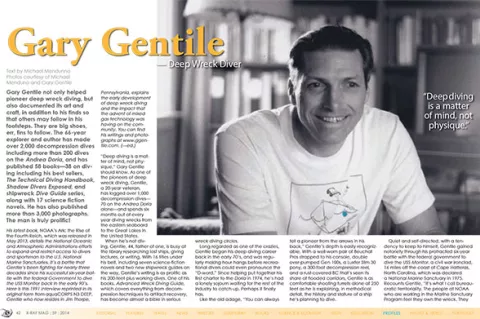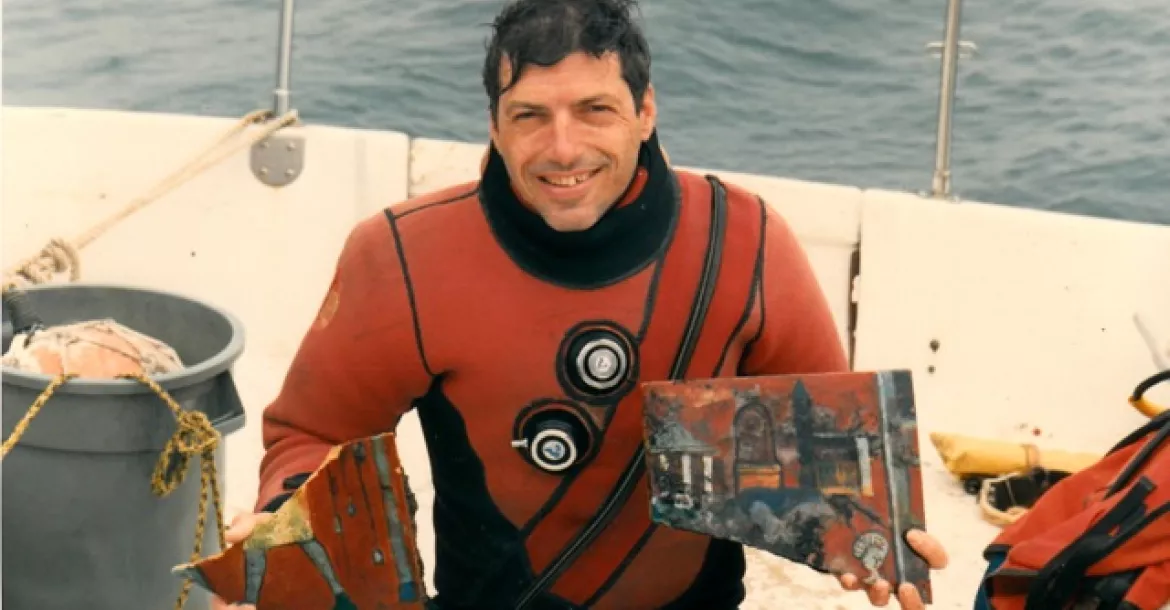
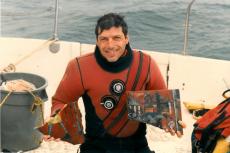
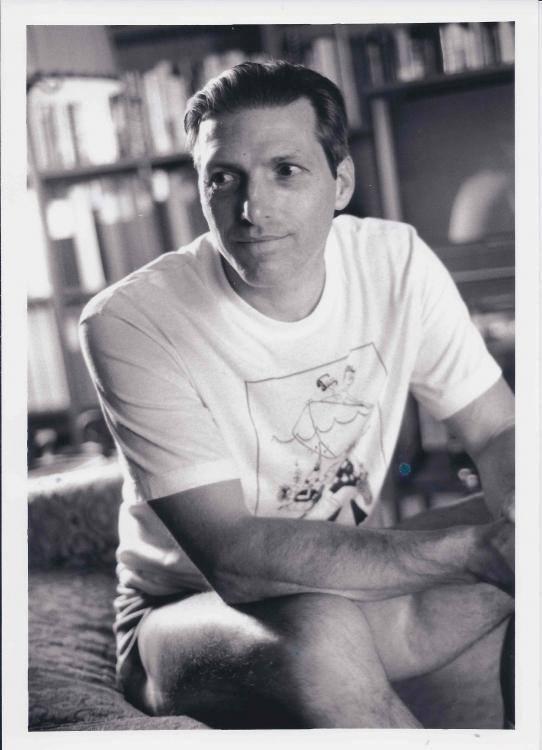
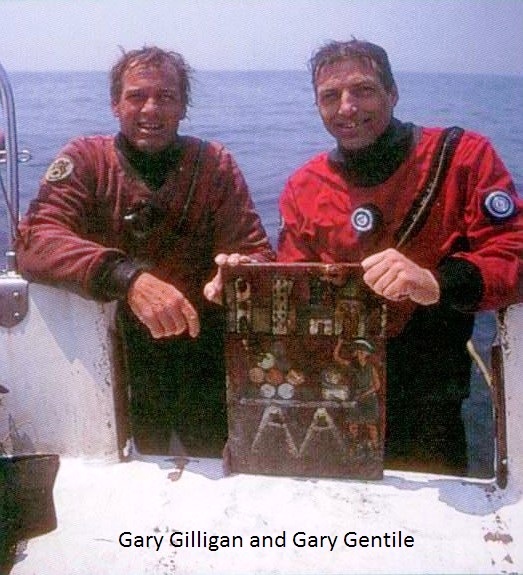
Gary Gentile not only helped pioneer deep wreck diving, but also documented its art and craft, in addition to his finds so that others may follow in his footsteps.
Contributed by
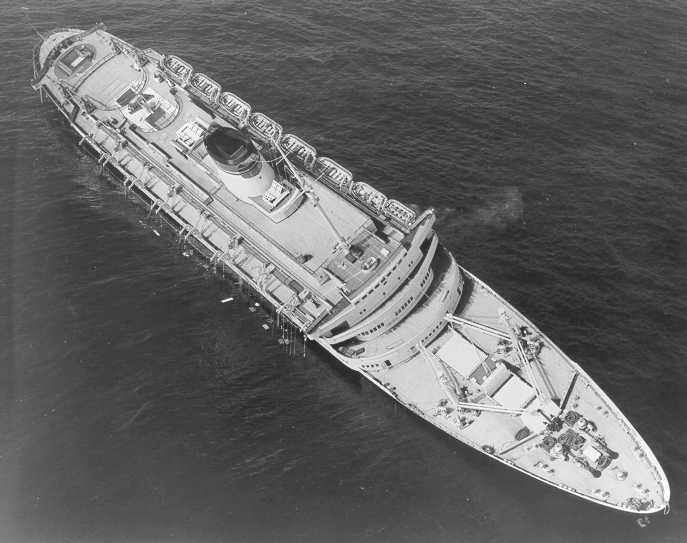
They are big shoes, err, fins to follow. The 66-year explorer and author has made over 2,000 decompression dives including more than 200 dives on the Andrea Doria, and has published 58 books—38 on diving including his best sellers,
The Technical Diving Handbook, Shadow Divers Exposed, and shipwreck Dive Guide series, along with 17 science fiction novels. He has also published more than 3,000 photographs.
The man is truly prolific!
His latest book, NOAA’s Ark: the Rise of the Fourth Reich, which was released in May 2013, details the National Oceanic and Atmospheric Administrations efforts to expand and restrict access to divers and sportsman to the U.S. National Marine Sanctuaries. It’s a battle that Gentile’s been fighting for nearly three decades since his successful six-year battle with the federal Government to dive the USS Monitor back in the early 90’s.
Here is this 1991 interview reprinted in its original form from aquaCORPS N3 DEEP, Gentile who now resides in Jim Thorpe, Pennsylvania, explains the early development of deep wreck diving and the impact that the advent of mixed gas technology was having on the community. You can find his writings and photographs at www.ggentile.com. (—ed.)
“Deep diving is a matter of mind, not physique.” Gary Gentile should know. As one of the pioneers of deep wreck diving, Gentile, a 20-year veteran, has logged over 1,000 decompression dives—70 on the Andrea Doria alone—and spends six months out of every year diving wrecks from the eastern seaboard to the Great Lakes in the United States.
When he’s not diving, Gentile, 44, father of one, is busy at the library researching lost ships, giving lectures, or writing. With 16 titles under his belt, including seven science-fiction novels and two new shipwreck guides on the way, Gentile’s writing is as prolific as his 200-feet plus working dives. One of his books, Advanced Wreck Diving Guide, which covers everything from decompression techniques to artifact recovery, has become almost a bible in serious wreck diving circles.
Long regarded as one of the crazies, Gentile began his deep diving career back in the early 70’s, and was regularly making hour hangs before recreational divers could even pronounce the “D-word.” Since helping put together his first charter to the Doria in 1974, he’s had a lonely sojourn waiting for the rest of the industry to catch up. Perhaps it finally has.
Like the old adage, “You can always tell a pioneer from the arrows in his back,” Gentile’s depth is easily recognizable. With a well-worn pair of Beuchat Pros strapped to his console, double over-pumped Gen 100s, a Luxfer Slim 30 pony, a 300-foot decompression reel, and a rust-covered BC that’s seen its share of flooded corridors, Gentile is as comfortable shooting turrets alone at 250 feet as he is explaining, in methodical detail, the history and stature of a ship he’s planning to dive.
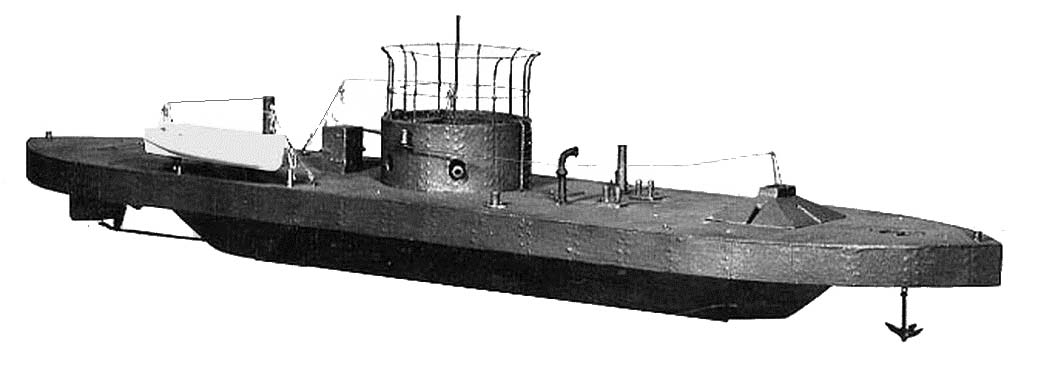
Quiet and self-directed, with a tendency to keep to himself, Gentile gained notoriety through his protracted six-year battle with the federal government to dive the USS Monitor, a civil war ironclad, 16 miles off the coast of Cape Hatteras, North Carolina, which was declared a National Marine Sanctuary in 1975. Recounts Gentile, “It’s what I call bureaucratic territoriality. The people at NOAA who are working in the Marine Sanctuary Program feel they own the wreck. They don’t want private sector encroachment. They look upon it as their wreck, and they view me—the public—as a trespasser.”
But the Monitor battle was more than a struggle for the diving public’s right of access; it became a struggle for the recognition of technical diving as well. NOAA refused the 11 permit applications filed by Gentile and others on the grounds that diving the wreck, which lies in 220 feet of water, was too dangerous using ordinary scuba, placing it beyond the limits of sport diving.
Gentile’s court victory earlier this year and long-awaited permit to dive the Monitor was a professional and personal vindication. The verdict? NOAA’s standards were deemed antiquated and failed to account for advances in diving technology and techniques. Furthermore, the court found that Gentile and his colleagues were wrongly and improperly classified as recreational divers.
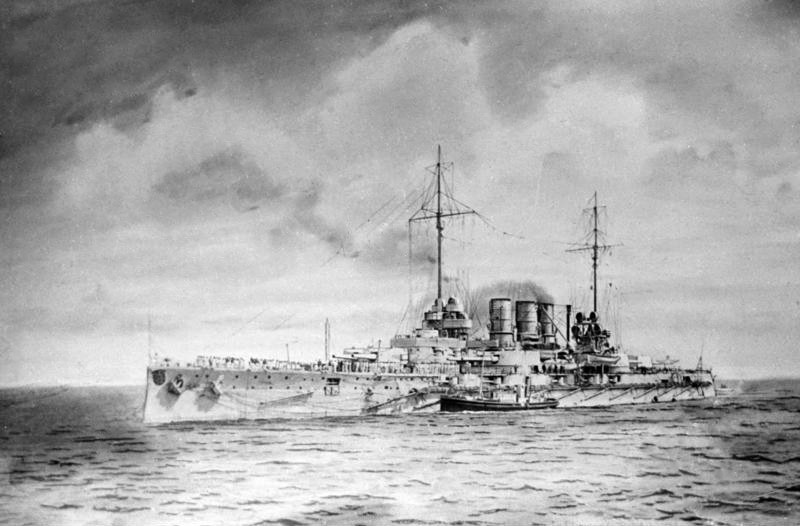
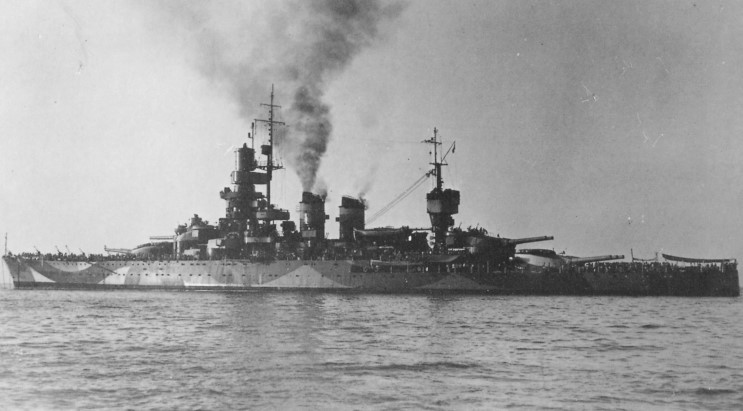
Interestingly enough, Gentile’s July victory dives on the Monitor were conducted as practice runs for a deep dive on the Ostfriesland, a German battleship lying in 380 feet of water, which he and his diving partner, Ken Clayton, successfully conducted on mix a month later.
His motivation? “It’s about freedom,” explains Gentile, “a battle I’ve been fighting all my life. There will always be people who’ll tell you, ‘You shouldn’t be doing this. It’s dangerous. It can’t be done.’ That’s their problem. I just want to live my life the way I want to and for me, that’s what these dives are all about.”
aquaCORPS: Gary, you’ve been on the cutting edge of wreck diving for 20 years and you were one of the first people to dive the Andrea Doria back in 1974. Did you take a lot of heat for your diving back then?
Gary Gentile: My entire diving career, the local people—the people in dive clubs—looked at me as a madman. I’ve gotten back on the boat many times only to have people say to me, “What were you doing down there? Why were you just hanging on the anchor line?”
People didn’t know anything about decompression dives. And those who did didn’t approve because I was doing long decompressions. It wasn’t that I liked decompression diving; it was that I wanted more bottom time. I was willing to sacrifice for it.
aquaCORPS: How did you get trained in decompression?
Gary Gentile: I had the good fortune of falling in with a small group of divers who were doing deep decompression dives. At the time, deep was considered 160, 170 feet. That was the group I first dove the Doria with back in ‘74, and we took a lot of flak for it. People looked at us as crazies because we were doing dives no one else would do.
That’s how I picked up most of my early experience in the water—the things I wasn’t taught in courses. I studied their techniques and developed my own, just like everybody else does. Wreck diving tends to be an evolving sport; everybody who gets into it looks at what other people are doing and adds his own little improvements. I got into that as well. I was really fortunate to get in with a group of expert divers.
aquaCORPS: Would you say that deep wreck diving as practiced today is fairly safe?
Gary Gentile: Absolutely. It’s much safer than it was. Of course, it all depends on your level of expertise. The people that are serious about diving deep wrecks and doing decompression are as comfortable with what they’re doing—probably more comfortable—than the common tourist reef diver who dives to 25 feet, but only goes to Florida or the Caribbean once a year, and is out of shape.
aquaCORPS: How many serious wreck divers are there?
Gary Gentile: I’m finding, as I travel more, that there are many thousands. For example, when I first traveled to the Great Lakes a couple of years ago, I discovered a whole new group of wreck divers I had never known existed. I was astonished at how many good deep wreck divers were there. And that’s just one area. The same is true all around the country.
aquaCORPS: Communication has been a problem, then?
Gary Gentile: A real problem. Most wreck divers are just doing their own thing. They’re not seeking publicity; they’re not in it for an ego trip (some are, of course, but most aren’t). So, there’s not a lot of publicity about it.
aquaCORPS: Would you say it’s a competitive field, people looking at what others are doing and wanting to be the “first” or wanting to be acknowledged? That’s certainly the case in the cave diving community.
Gary Gentile: It’s funny, when I first got into diving, I thought it was the greatest sport in the world because everyone was working with everyone else, and everyone was trying to see that everybody had a good safe dive—no competition. I very quickly found out that wasn’t true.
There were people who wanted to be the first to discover a wreck, or the first to collect an artifact. Artifacts have ruined more friendships than anything I know.
On the other hand, a certain amount of competition is probably good. It means people are interested in exploration and are willing to go out and do something—take action. That helps advance the sport.
aquaCORPS: It’s my impression that the cave diving community is generally better organized than the wreck diving community, and, I would guess, has a much better safety record. Is this true?
Gary Gentile: If that’s true, I think it’s mostly because of better communication among cave divers than among wreck divers—communication of techniques. And that means safety efforts would naturally evolve faster.
But there may be another factor involved in the safety issue. By and large, wreck diving tends to be done in an uncontrolled environment. There are a lot of factors that can compromise safety. Storms can kick up very quickly at sea when divers are in the water; currents can come in when divers are decompressing.
A lot of things can go wrong. It’s the changeable conditions that wreck diving necessarily encounters—being out there in the ocean or on a boat—that compromises safety. There are a lot of injuries just on the boat—getting on, getting off—that kind of stuff. All in all, I think it’s probably true that the safety record among cave divers is better. But it doesn’t have so much to do with the diving as it does with the conditions under which the diving is conducted.
aquaCORPS: What are the skills and expertise required to be a serious wreck diver?
Gary Gentile: Number one is awareness. There are a lot of potential hazards in wreck diving that can be created simply by being unaware of them. For example, entanglement in monofilament—fishing nets—is a very serious problem for wreck divers.
After awareness, I would say it comes down to experience. When you talk real wreck diving, you’re talking about a combination of penetration, deep diving, and decompression diving. Put all three together and you’ve got quite a package.
You have to be an expert at decompression diving. And you’ve got to have the proper equipment for each one of those disciplines, including emergency back-ups, like decompression reels and ponies.
Equipment is important. That’s something you learn only through experience. Get out there and do it; find out what equipment is necessary for decompression when an anchor line breaks loose, for example. You can’t stage bottles like you can in a cave, so you’ve got a problem there if you want to set up a deep dive. And, like the caves, you can’t come right to the surface. So, once you gain awareness and then gather experience, you also need to be properly equipped.
aquaCORPS: Would you say most wreck divers are well equipped?
Gary Gentile: The average wreck diver isn’t equipped—not for technical diving. But you have to understand that the average wreck diver is still the kind of person who dives on a weekend once or twice a month. He doesn’t get that many dives under his belt. He’s under economic constraints and probably won’t be buying the top-of-the-line regulator or BC. He buys equipment he can afford.
Most of these divers are diving wrecks in the 80 to100-foot range, and a few in the 100 to130-foot range. Then there are the people who are diving 130 feet and beyond. You’ll find that their equipment, generally speaking, is far superior to the so-called “tourist divers” running the shallow wrecks.
Shallow wreck diving is essentially the same as reef diving in terms of the kind of expertise that’s required. It’s when you start doing things—recovering artefacts, inflating lift bags, penetrating wrecks, getting into decompression—then you’re talking about a different area. Then you really need the proper equipment.
aquaCORPS: In your book Advanced Wreck Diving Guide you talk a lot about equipment techniques and methods. How did you develop those?
Gary Gentile: I can’t claim to have developed all those techniques. I was part of the wreck diving community when those techniques were being developed. What I can claim credit for is setting them down in writing.
Some of the things I worked on myself, but it was an evolutionary process. To make a decompression reel, you’d look at what someone had said and say, “That’s good, but I can add this and make it better.” Then someone else would look at it and say, “Yes, but let’s do it this way.”
I saw the development occurring; I was in the middle of it. I remember one time trying to retrace who actually developed the idea of making a decompression reel with the disks on the end to prevent the rope from coming out around the pins. No one knew. It had evolved; no one had any awareness of who had done it. It was a group effort that was done incrementally.
aquaCORPS: Do you think recommended procedures and techniques will eventually evolve?
Gary Gentile: Yes, I do. Most of the procedures in Advanced Wreck Diving Guide are now the lowest common denominator. That book is not the end result. It’s a take-off point for the next generation, and I expect to see evolution coming from that. In fact, the sport is evolving already. Some of the things we’re doing now, like using oxygen to add a safety margin in decompression—mostly for deep diving—or using nitrox decompression and custom tables for accelerated decompression times, are still being worked out.
aquaCORPS: How about mixed gas?
Gary Gentile: I think mixed gas diving is going to be the wave of the future in wreck diving because people are already reaching or exceeding the limits of air diving, and yet, they still want to venture further to the deeper wrecks. The only way to do it is with mixed gas; at least, it’s the only way to do it and remember it!
aquaCORPS: What do you see as some of the advantages of mixed gas besides “remembering what you saw”?
Gary Gentile: I’ve had a very curious thought about mixed gas. It’s clearly the wave of the future, but for some people, I think it may also become an end in itself; becoming proficient in managing the technology. I see people wanting to do mixed gas diving as much to do the dive as to see the wreck. They want to do something that other people haven’t done. That’s what the new frontier is all about; to do something that other people haven’t done. That’s exciting; a real challenge.
aquaCORPS: How about you?
Gary Gentile: Personally, I’m a wreck diver. My goals are to be able to use mixed gas to get to a wreck, not to gain the expertise in mixed gas diving itself.
aquaCORPS: You mentioned that “deep” used to be considered 160 or 170 feet. What’s considered deep today in the serious wreck community?
Gary Gentile: These days 200 is not considered deep in the crowd that I dive with. A 200-foot dive…is something you talk about between bites of a sandwich. “Oh, 200? Okay.” If one of them jumped in the water, and you told him he would be diving 200 feet, he’d say, “Okay,” glance at his tables to refresh his mind on what decompression schedules he’d be using, and then go do it. What I’m seeing as deep these days is 250-foot plus. Now we’re talking deep.
aquaCORPS: You’re planning to dive the Ostfriesland. Would you talk about the project?
Gary Gentile: The Ostfriesland is a German battleship that was brought to this country as part of reparations after World War I. The United States Navy did some tests on it and had it sitting in dry dock until Billy Mitchell decided to use it to prove to the Navy that Army bombers could sink Navy capitol ships. So, in 1921, the Ostfriesland was towed some 70 miles off the Virginia coast and Billy Mitchell successfully sank it with an aerial bombardment.
Its position had been lost since that time; nobody cared about it. But it’s been relocated, first through historical records, and then by taking the boat out there and checking the various fishermen’s LORAN coordinates that coincided with the records. It appears to be in some 380 feet of water, so it’s definitely a mixed gas dive.
We dove another battleship last year in Washington. That was 290 feet. It was sunk in 1924 as a naval target.
aquaCORPS: You did it on air?
Gary Gentile: Yep. We did it on air, down to 290 feet. I personally felt that it was pretty close to stretching the envelope. Beyond that, if you really want to accomplish something, you need to switch to mix. And that’s my concern: accomplishing something. Not just getting there and saying you did it, but doing something when you get there. That’s what we’re planning for the Ostfriesland.
aquaCORPS: What do you hope to accomplish?
Gary Gentile: For me, it’s a historical event. I’m a researcher and I’ve written about the Ostfriesland in my upcoming book, Shipwrecks of Virginia. I get a great deal of satisfaction out of doing research; concluding that, yes, a wreck is supposed to be in such-and-such a location, then going out there and verifying and identifying the wreck to prove that my research was valid. That’s what’ll give me the most satisfaction on the Ostfriesland; to actually locate it from when it was lost in 1921.
There’s also the minor satisfaction of conducting a deep dive like I’ve never done before. But if you were to ask Ken Clayton, who I’ll be diving with the same question, he would give you a different answer. I think Ken’s answer would be that his satisfaction will be to dive deeper. Mine is not; I’m coming from the historical perspective of actually being on that wreck. And I don’t mean driving an ROV on it. I’m a person who enjoys the experience of being there myself. I want to be on the Ostfriesland myself.
aquaCORPS: What are some of the planning issues you’ve had to confront in putting together the dive?
Gary Gentile: The most difficult part was planning the mix, staging, and decompression. The initial step was arranging for the gas mix; Dr Bill Hamilton worked with us on that. I see Bill and others like him as being the guiding lights on the evolution of mixed gas diving in the future because they’re the ones that are providing us with the wherewithal to do it. I’m not the expert on it. I rely on his expertise, just as I rely on the captain’s expertise to run the boat out there and locate the wreck.
It all has to be put together. But once you do, the dive itself becomes relatively simple because there are no narcotic effects. It’s just like making any other dive, except it’ll take you longer to get to the bottom. Once you get there, you’ll feel just as comfortable as you do on a 100-foot dive.
aquaCORPS: As I understand it, you’ll be making a fairly short dive to that depth.
Gary Gentile: Eleven minutes. But the complication comes in that you’re no longer self-contained. On air, you go down, come up, and decompress on your own air. But once you get into mixed gas diving, in order to not have to decompress for something like four hours or more, you’ve got to go into an accelerated decompression schedule that requires multiple gas switches during the ascent to several nitrox mixes, and finally O2, based on custom tables.
It means you need surface support personnel: support divers who are going to go down to 100 feet to clip off the nitrox bottles and have the oxygen hoses ready for our 20-foot stop. It means you’re no longer just jumping off the side of the boat, going off on your own, and coming back with your dive done. There’s a lot of set-up when you get there and you can’t do the set-up yourself.
We’re taking clip-on stage bottles, of course, as a back-up. But the biggest thing this means to us is that we have to come back to the anchor line.
aquaCORPS: What will your total decompression time be?
Gary Gentile: Two hours and 15 minutes.
aquaCORPS: That sounds pretty reasonable. It’s probably not any longer than a lot of your deep air dives.
Gary Gentile: We did a two hour and 45-minute decompression on the Monitor. After a 25-minute bottom-time on air, we used computers and O2 as a safety factor.
quaCORPS: There’s some complicated logistics.
Gary Gentile: Mixed gas diving is complicated, and complicated means expensive—much more expensive. But remember, what we’re talking about is not just your everyday adventure. It’s not for people who just sit at home and watch the boob tube. It’s for the kind of people who want to go out and experience something that not everyone can have. We’re willing to do what is necessary to have that experience!
aquaCORPS: Are you going to take pictures on the Ostfriesland?
Unfortunately, we don’t have a camera that’ll go that deep.
aquaCORPS: What are your personal diving goals over the next 12 months?
Gary Gentile: Aside from the Ostfriesland trip, I’m in the middle of writing two books: one is a science fiction novel and the other is Shipwrecks of North Carolina. That keeps me busy when I’m not diving. As for diving, I’m still adventuring looking for dives that I haven’t done before. Not necessarily wrecks that no one has seen, but photogenic wrecks that I haven’t seen.
My emphasis is photography. It’s hard sometimes for me to say that. My interests are split between adventure and photography; I blend the two together. Sometimes I feel guilty having an adventure without taking pictures. It’s like having a good time without anything to show for it, so I always temper myself. I want to share those adventures with other people.
aquaCORPS: What’s your advice for the people who are interested in expanding their wreck diving skills?
Gary Gentile: Work hard. Work hard to gain the experience necessary to do what you want to do. Everyone can enjoy these experiences if they’re willing to put in the time. Just gain the expertise to do them safely.
aquaCORPS: From a practical point of view, how should people go about doing that?
Gary Gentile: There are not a lot of courses, but there are some. I know several dive shops teaching wreck diving courses and actually showing people how to make a decompression dive. So, you don’t have to do it the way I did it the first time; suddenly finding myself in decompression, scared to death because I’d never done it before.
If I’d done it a half dozen times when it didn’t count, when the real time came, it wouldn’t have been so emotionally difficult to handle. That’s why I think the first thing people can do is to take a course or read up on the literature that’s available so they can practice on their own.
Of course, there’s only a certain amount you can do in a course; most of what you learn has to be gained in the field. You’ve got to get out there and do it. That means getting in the water a lot, practicing techniques, doing the diving, gaining the experience—you can’t get that from a book. You just have to go out there and do it. ■
Writer and technologist Michael Menduno published and edited aquaCorps: The Journal for Technical Diving (1990-1996), which helped usher tech diving into the mainstream of sports diving, and coined the term “technical diving.” He also organized the first Tek, EuroTek and AsiaTek conferences, and Rebreather Forums 1.0 and 2.0. Menduno, who is based in Palm Springs, California, USA, remains an avid diver.