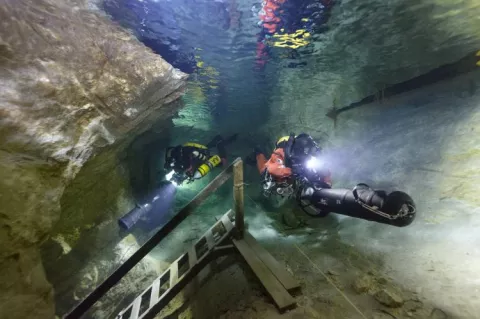
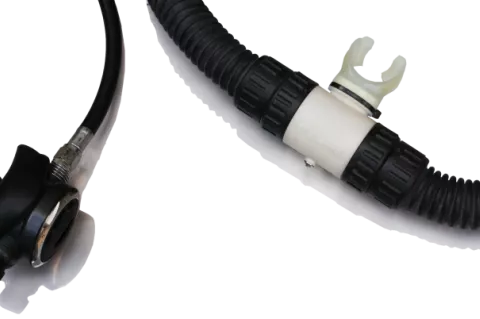
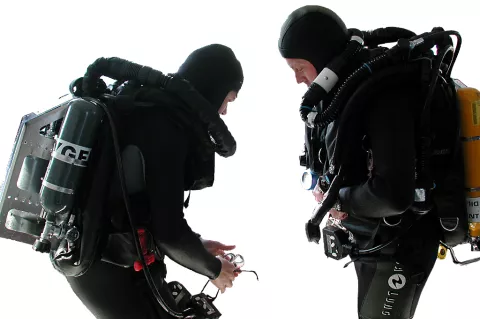
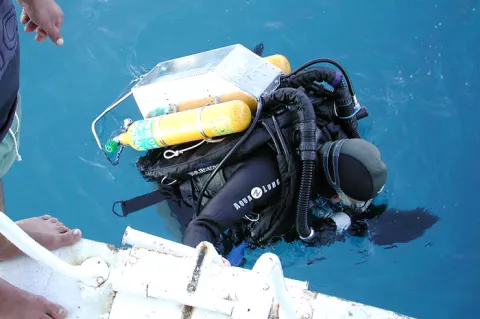
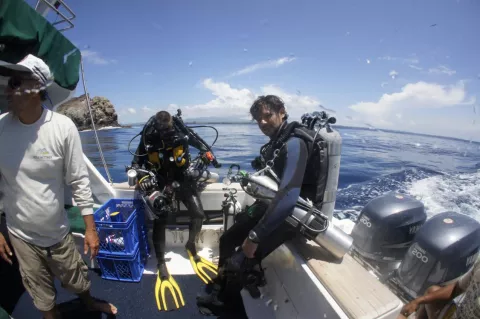
There are many advantages to diving closed circuit for the underwater image creator such as better interaction with wildlife or longer dives. However, there are also a number of disadvantages to consider such as added complexity and task loading.
In February 2015 the scientific diving communities got together to discuss and formulate best practice guidelines for the use of rebreathers for scientific diving.
The meeting was first proposed by the National Park Service (NPS), then quickly supported by National Oceanic and Atmospheric Administration (NOAA), Divers Alert Network (DAN), and the American Academy of Underwater Sciences (AAUS).
A number of key experts were involved in the Catalina Island event including Jeff Bozanic, Simon Mitchell and Richard Pyle.
Over the course of four days standards relating to practice, physiology, incidents and equipment evolution relevant to scientific diving with rebreathers were reviewed.
Paul Raymaekers, CEO of rEvo issued the following statement.
"After more than 10 years of creating, developing and growing rEvo, and knowing that none of my children will or can continue this business, I realised already some time ago that the only way to keep rEvo going, was to look for a partner that had common interests. A strong partner, that was already in the diving business, and had the strength and will to take this work further.
It took months of talking, negotiating, working out synergies, but in the end it became clear that we found the correct ‘modus vivendi’.
Until today there has been no published data that compares the carbon dioxide (CO2) absorption of Spherasorb and Sofnolime 797 when dived in an AP Diving 'Inspiration' rebreather.
This information is needed because a number of divers use Spherasorb in their APD units.
APD recommend that divers should use Sofnolime 797 in their unit - the APD rebreathers are designed and tested using this sorb. However there are times when divers will use an alternative sorb due to cost, availability and / or because of perceived advantages in work of breathing or endurance.
"Due to changes in certification standards and changes in approvals of key electronics components that in turn have led to delays in the CE certification process, the expected delivery time for the first batch of M28 Computers will now be in August.
We sincerely apologize for this delay, however it is out of our hands and we are doing everything we can to keep things moving forward swiftly."
In early 1968 John Kanwisher and Walter Stark met by chance. They soon learned that each man had been considering the feasibility of a mixed gas closed circuit rebreather (CCRB) using electronic sensors to control the Partial Pressure of Oxygen (ppO2). They collaborated and the result was the Electrolung.
The discussions included how often checklists are used (if at all), and how effective are they (when they are used).
To date, there has not been any formal studies undertaken to determine checklist use within the community. Now a PhD research project - primarily examining the role of Human Factors in SCUBA diving - is looking at checklist usage.
Throughout Rebreather Forum 3 experts from all fields - manufacturing, human interface design, accident analysis, rebreather training and diving - all advocated the use of checklists. The benefits of using this tool were highlighted to ensure that units are correctly built and pre-dive checks completed.
After my speech at the International Tech Meeting 2012 (technical diving convention in Bratislava, Slovakia), deep cave explorer Bill Stone asked me to join him for lunch. As a result of that lunch, during the course of the next 12 months, I prepared for the trip of a lifetime! In a full hour of one-on-one discussion with Bill outside of the lecture hall of the Rebreather Forum 3.0 convention in Orlando, Florida, later that year, we discussed how the trip was moving forward.
I have always wanted to start using a rebreather. I wanted to become a true shark of the diving world. There’s nothing more calming than listening to nothing except the undersea life, without the sound of bubbles puffing up to the surface.
After training on the unit, I was up and ready to go diving every weekend just to try out my new toy. Diving in Monterrey Bay [California, USA], became completely different as fishes would bump into me; octopi would look and study the strange human I was; and sharks no longer ran away. Indeed, I became a true shark.
The rebreather, afterall, is a life support machine, and being cheap and fast certainly isn’t a good idea.