  • Sportsdykkeren.dk 🇩🇰
  • XRay-Mag.SE 🇸🇪
  • Dykmässan (diveshow)

Secondary menu - Advertising and subscriptions

  • Got stories? - Guidelines
  • Advertising
  • Subscribe to X-Ray Mag
Home
  • Magazine
  • News
      1. Latest news
      2. Press releases
      3. Breaking News
  • Travel
      1. Destinations
        1. Australia & New Zealand
        2. Continental Asia
          • Japan
          • China
          • South Korea
        3. Southeast Asia
          • Indonesia
            • Bali
            • Komodo
            • Lembeh
            • Maluku
            • Raja Ampat
            • Sulawesi
          • Malaysia
          • Papua New Guinea
          • Philippines
          • Thailand
          • Timor-Leste
        4. South Pacific & Oceania
          • Fiji
          • French Polynesia
          • Micronesia
            • Chuuk (Truk)
            • Marshall Islands
            • Yap
          • Palau
          • Samoa
          • Solomon Islands
          • Tonga
          • Vanuatu
        5. Indian Ocean
          • Madagascar
          • Maldives
          • Seychelles
        6. Red Sea
        7. Africa
          • Egypt
          • Malawi
          • Mozambique
          • Namibia
          • South Africa
          • Sudan
          • Tanzania
        8. Mediterranean & Adriatic
          • Croatia
          • Cyprus
          • France
          • Greece
          • Italy
          • Malta & Gozo
          • Portugal
          • Spain
          • Turkey
        9. Europe
          • Northern Europe
            • Denmark
            • England
            • Finland
            • Iceland
            • Ireland
            • Norway
            • Scotland
            • Sweden
          • Eastern Europe
            • Albania
            • Bosnia-Hercegovina
            • Croatia
            • Czech Republic
            • Hungary
            • Poland
            • Russia
              • Northwest Russia
              • Russian Far East
              • Siberia
          • Western Europe
            • Austria
            • France
            • Germany
            • Switzerland
          • Southern Europe
            • Cyprus
            • Greece
            • Italy
            • Malta & Gozo
            • Portugal
            • Spain
        10. Atlantic
          • Azores
          • Canary Islands
          • Falkland Islands
          • St Helena
        11. North America
          • Canada
          • Great Lakes
          • United States
            • East Coast
            • West coast
            • Alaska
            • Hawaii
            • US Virgin Islands
            • Guam
          • Mexico
        12. Caribbean & Central America
          • Bahamas
          • Belize
          • Cayman Islands
          • Bonaire
          • Cuba
          • Dominican Republic
          • Mexico
          • Columbia
          • Grenada
          • Costa Rica
          • Saba
          • Honduras
          • Turks & Caicos
          • US Virgin Islands
          • Nicaragua
        13. South America
          • Argentina
          • Brazil
          • Ecuador
        14. Polar Regions
          • Artic
          • Antarctica
      2. Promotions
      3. My Favorite Dive
  • Ecology
      1. Ocean Mysteries series by Ila France Porcher
      2. Sharks, Rays and Nudibranch stories by Andy Murch
      3. Sentience
      4. Conservation
      5. Coral Reefs
      6. Dolphins
      7. Fish
      8. Jellyfish
      9. Mantas & Stingrays
      10. Nudibranchs
      11. Octopus & Squid
      12. Sea Turtles
      13. Seals & Sea Lions
      14. Sharks
      15. Whales
  • Wrecks
      1. Vic Verlinden
      2. Ancient Wrecks
      3. Artificial Reefs
      4. Marine Archaeology
      5. Older Warships
      6. Steamships & Cargo
      7. Tall & Wooden Ships
      8. WWI Wrecks
      9. WWII Wrecks
  • Training & Tech
      1. Rebreathers
      2. Sidemount
      3. Deep Wrecks
      4. Cave Diving & Mines
      5. Ice Diving
      6. Diver Health & Safety
        1. Divers Alert Network - DAN
        2. Safety Culture
      7. Adaptive Diving
  • More
      1. Equipment
        1. BCDs, Wings & Sidemounts
        2. Dive Computers
        3. Dive Watches
        4. Drysuits & Undergarments
        5. Hoods, Gloves & Boots
        6. Lamps & Torches
        7. Masks, Fins & Snorkels
        8. Regulators
        9. Wetsuits & Rashguards
      2. Photo & Video
        1. Equipment
          • Cameras & Optics
          • Editing & Post-processing
          • Housings
          • Lighting
          • Useful Tools
        2. Tutorials
          • Techniques & Tips
            • Mike Bartick
            • Rico Besserdich
          • Composition
          • Editing & Post-processing
        3. News & Announcements
        4. Contributors' Picks
      3. Books & Media
        1. Works by our contributors
      4. Profiles & Interviews
        1. In Memoriam
      5. Lifestyle
        1. Portfolios & Ocean Arts
        2. Apres Dive & Apparel
        3. Editorials
      6. Contributors
        1. Pundits
          • Mike Ange
          • Gareth Lock
          • Michael Menduno
          • Mark Powell
          • Simon Pridmore
        2. Regular writers
          • Scott Bennett
          • Andrey Bizyukin
          • Larry Cohen & Olga Torrey
          • Pierre Constant
          • Brent Durand
          • Jennifer Idol
          • Scott Johnson
          • Steve Jones
          • Kate Jonker
          • Kelly LaClaire & Kate Holt
          • Matthew Meier
          • Brandi Mueller
          • Svetlana Murashkina
          • Barb Roy
          • Don Silcock
          • Claudia Weber-Gebert
          • Lawson Wood
        3. Columnists
          • Scott Bennett
          • Rico Besserdich
          • Rosemary 'Roz' E. Lunn
          • Ila France Porcher
  • ⚲ Search

Controlled Ascent, Hidden Risk

CESA training under scrutiny as study reveals potential for silent lung stress 

Tech and Training

Controlled Emergency Swimming Ascents (CESA) are a fundamental component of diver training, simulating ascent without a gas supply. Now, a new study led by Olivier Castagna and colleagues at the French Military Diving School has raised questions about whether this vital drill might be more taxing on the lungs than previously assumed.

Getting seasick? Try Controlling Your Breathing

If you are prone to seasickness, you may prepare for boat rides and dive trips with ginger or a prescription skin patch. Now there's one more remedy: timing your breathing to counteract the nauseating motion.

Ginger is a popular remedy against motion sickness
Medical & Fitness

The technique presumably works because it helps control gravity sensors in the abdomen--a lesser-known input to our fine-tuned balance system.

The brain is traditionally thought to sense body position in three ways. The inner ears sense motions of the head; the eyes see where the head is; and tiny sensory organs in muscles and tendons sense where the rest of the body is.
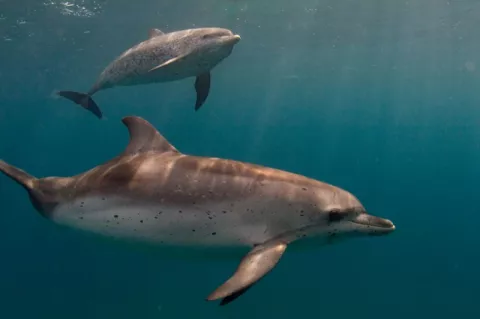
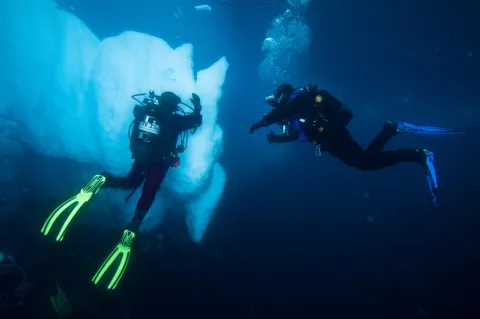
Why aren’t dolphins getting bent?

It appears that by reducing their heart rates, dolphins avoid the typical decompression sickness that afflicts human divers.

Ecology & Science

Marine mammals are not above the physical principles and processes that lead to bubble formation in tissues following decompression. Scientists once thought that diving marine mammals were immune from decompression sickness, but beached whales have been found to have gas bubbles in their tissues—a sign of the bends. In any case, how some marine mammals and turtles can repeatedly dive as deep and as long as they do has perplexed scientists for a very long time.

X-RAY MAGAZINE FEATURE

Thermal stress

Thermal issues affect the comfort, performance and decompression stress experienced by divers. The impact varies with the timing, direction and magnitude of the thermal stress. Thermal protection can be provided by a variety of passive and active systems. Active systems should be used with particular care since they can markedly alter inert gas exchange and decompression risk.

Words:
Neal W. Pollock
Images:
Andrey Bizyukin
Download the full article as pdf ⬇︎
Tech and Training


Increased decompression stress will be experienced by divers remaining warm during descent and bottom phases and cool or cold during ascent and stop phases. Decreased decompression stress will be experienced by divers remaining cool or cold during descent and bottom phases and warm during ascent and stop phases. Dive computers measure water temperature, not thermal status, leaving it to the diver to consciously manage thermal status and risk.

Oxygen Toxicity for Divers

Oxygen toxicity is a serious topic, but one that many divers struggle to understand. We know that calculating oxygen exposure is important to our safety, but we may not know why or what happens if we exceed the safe exposure limits.

Tech and Training
DAN

Following training guidelines and conservatively planning our dives can reduce our risk somewhat, but learning how oxygen toxicity affects us and how we can prevent it can mean the difference between a fun dive and one that ends in injury. Push back against complacency and unquestioning acceptance of common practices—understand the effect of oxygen on your body before you plan your next dive.

Diving with a Defect - Understanding the PFO

The patent foramen ovale (PFO) has been a point of research and concern for divers since it was introduced as a possible risk factor for DCS by researchers in Great Britain and at Duke University in 1989. The relatively benign cardiac defect creates a passage in a wall of the heart that normally separates the left and right upper chambers of the heart. It can be found in as many as 27 percent of adults and normally causes no symptoms. In divers, it may provide a path for venous gas bubbles to bypass the lungs and enter into arterial circulation, which increases a diver’s risk of DCS.

Medical & Fitness
DAN

Modern discussion has led to a wide variety of recommendations on the topic from a number of sources, leading to some confusion. While some agencies and physicians recommend diving conservatively with a known PFO, others recommend surgical closure, and still others advise that there may not be a benefit to closure and that divers should just be aware of their condition.

Can Antioxidants Protect Scuba Divers?

Intake of antioxidants Vitamin C and E prior to a scuba dive can reduce alterations in cardiovascular function caused by dives

Ecology & Science

A recent study, published in The Journal of Physiology, shows that acute oral intake of antioxidants Vitamin C and E prior to a scuba dive can reduce alterations in cardiovascular function that are caused by a single air dive.

A group of professional divers were studied before and after a moderate scuba dive to a depth of 30 meters for 30 minutes, similar to those enjoyed by countless recreational divers.

X-RAY MAGAZINE FEATURE

Understanding Asthma

Asthma is a respiratory condition that affects 3-8% of the general population, thus also divers or would-be divers. It is defined as an increased responsiveness to the lower airways to multiple stimuli.

Words:
Dr Kevin U. Chan
Images:
Download the full article as pdf ⬇︎
Medical & Fitness

This increased responsiveness may be episodic and during such asthma attacks the brochi and brochioles will become inflamed and constrict and lined with mucus. This airway narrowing causes symptoms such as wheezing, shortness of breath, chest tightness, and coughing. The effects may range from mild without limitations of the patients’ activity to severe and life threatening. At times this obstruction may persist for days or weeks and it is called status asthmaticus.

Larger spleen enables Bajau to remain underwater longer

Researchers have discovered that the Bajau are able to free dive to depths of up to 70 metres due to a genetically enlarged spleen.

Medical & Fitness

The Bajau are an indigenous people in parts of Indonesia renowned for their breath-holding ability when diving for food. They have been known to dive up to 70 metres using nothing more than a set of weights and a pair of wooden goggles.

Previously, scientists have speculated on whether dive capacity is related to spleen size, though no formal studies have been done on humans on a genetic level.

DDRC launches diving ear survey

Diving Diseases Research Centre (DDRC) Healthcare has launched an anonymous online survey to gain a better understanding of ear health and the frequency of ear problems suffered by sport divers.

Medical & Fitness

Ear health problems are one of the most commonly reported issues by divers. Problems can range from a relatively simple condition, for example, “swimmers ear,” to a more serious condition such as barotrauma, which can result in lasting damage to the ear.

Currently, anonymous field data is sparse, therefore Devon-based DDRC is hoping to find out what type of ear problems are most frequently encountered whilst diving if any medical advice was obtained; and if not, what was the outcome.

Pagination

  • Current page 1
  • Page 2
  • Page 3
  • Next page ››
  • Last page Last »
Subscribe to Physiology

Latest updates

Closed-circuit rebreathers, DPVs and technical diving systems were used by the Finnish recovery team to search the cave.
Maldives Recovery: Exclusive Interview With DAN Europe’s Laura Marroni and Sami Paakkarinen
8 Jul, 2026 - 17:29
Juvenile sea turtle photo by Tay Liang Wei
Lens Beyond Ocean Photo Competition 2026 Winners
8 Jul, 2026 - 16:52
Advanced nitrox diving
Crucible, Part I: A Deep Dive Into the Early Days of Technical Diving
8 Jul, 2026 - 16:12
Java Sidemount
Java Sidemount
8 Jul, 2026 - 13:55
More

Upcoming Events & Expos

9 Sep, 2026 ➢ 12 Sep, 2026

ABOFA – Aqaba Blue Ocean: Future in Action

Aqaba, Jordan

23 Oct, 2026 ➢ 26 Oct, 2026

Diving Talks

Lisbon, Portugal

3 Nov, 2026 ➢ 6 Nov, 2026

DEMA 2026

New Orleans, Lousiana

5 Dec, 2026 ➢ 6 Dec, 2026

Dive-Expo

Antwerp Expo, Belgium

Stay Social

Don’t forget that you can connect with us through all major social media, by simply clicking on the corresponding logo below.

Reviews

Books & Media

Secret Seas

Professional underwater photographer, Paul Flandinette and marine scientist and underwater photographer Michel Claereboudt take the reader on a breathtaking journey of discovery into Oman's underwater world.

Book cover
Review
Books
Books & Media

Reefs of Time

In Reefs of Time, geoscientist and science educator Lisa S. Gardiner offers a compelling and accessible exploration of how fossil coral reefs can inform our understanding of the threats facing reefs today. 

Book cover:  Reefs of Time
Review
Books & Media

Technically Speaking

Simon Pridmore's aim in writing this book was to examine and record where technical diving came from, how it developed, how it expanded across the world, who the important movers were and how the efforts of a few determined people changed our little field of human endeavour forever.

Technically Speaking
Works by Our Contributors
Review
Books
Simon Pridmore
Books & Media

Scuba Diving Operational Risk Management

An SAS approach to principles, techniques and application in recreational and technical diving.

Book cover
Review
Books
Advertisement
Advertisement
Home
International Dive Magazine

About X-Ray Mag

AquaScope Media logo

Compiled by an international network of top dive editors and world-class underwater photographers, X-RAY MAG is the planet's only truly global premier dive lifestyle magazine. Subscription and downloads are free. Published since 2003.

Image
DEMA Member

Published by:

AquaScope Media ApS - Copenhagen - © 2026

A closer look below the surface.

Advertising

  • General info / Distribution
  • Rate cards
    • Media kit - $ (USD)
    • Media kit - € (EUR)
    • Media kit - £ (GBP)
  • Ad Sizes and Formats
    • Magazine Ad Copy sizes
    • Banner ad sizes
  • General trading terms

Privacy & GDPR

  • Privacy and Cookie Policy

Subscriptions

  • US Newsletter
  • Canadian Newsletter
  • European Newsletter
  • UK Newsletter
  • Asia-Pacific Newslettre
  • Other / Global
  • 😪 Unsubscribe

Brand Assets / Logos

  • Banner ads
  • Logos
  • SoMe Collaterals

Contact

  • Contact us
  • About us

Brugerkontomenu

  • Log in
Clear keys input element