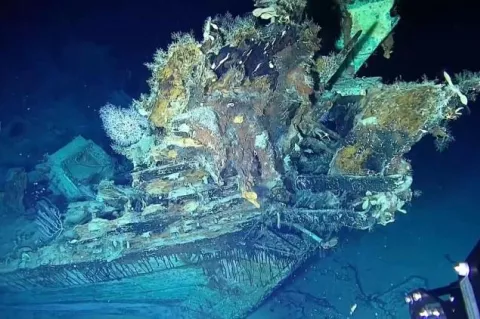
The discovery was made in autumn 2025 by the Swedish Navy vessel HMS Belos during an exercise, and has now emerged as one of the most interesting marine archaeological finds in Sweden in recent years.
Dated to the late 16th century
Following initial analyses, researchers have established that the wreck was probably built in the late 16th century. The findings are based on dendrochronological analyses of wood samples, a method that facilitates high-precision dating of timber.
Marine archaeologists have identified the wreck of the Danish battleship Dannebroge, lost during the Battle of Copenhagen in 1801, in waters just outside the Danish capital.
The discovery, announced by the Viking Ship Museum, confirms the location of one of Denmark’s most historically significant warships, more than two centuries after it was destroyed during the naval battle on 2 April 1801.
The Dannebroge served as a Danish flagship during the battle, part of the wider conflict between Denmark-Norway and the British Royal Navy. During the engagement, the ship caught fire under heavy bombardment before eventually exploding, with heavy loss of life.
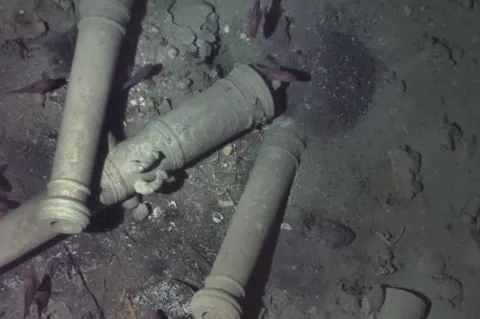
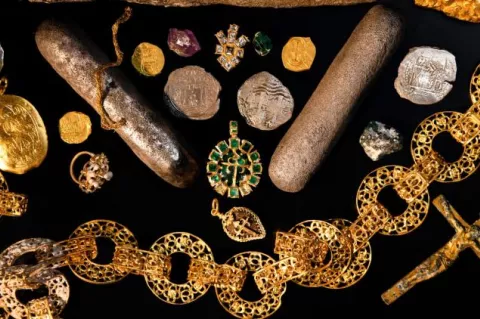
Colombian scientists have recovered the first artefacts from the wreck of the San José, a Spanish galleon sunk in 1708 during the War of Spanish Succession. Long described as the “Holy Grail” of shipwrecks due to its immense cargo of bullion, ceramics and private wealth, the site has remained untouched for over 300 years until the recent carefully controlled extraction.
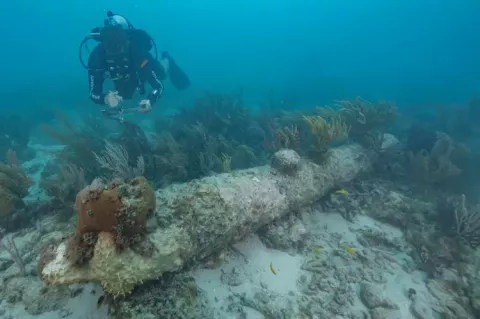
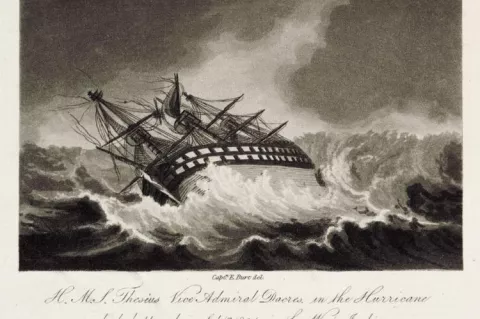
New dives funded by Historic England have revealed that the wreck of the 18th-century warship Northumberland, lost during the Great Storm of 1703, is far more intact than previously thought. The wreck, a Protected Site since 1981, lies in shallow waters off the Kent coast and is now confirmed to include multiple wooden decks, intact chests, and coils of rope—rare organic materials that have survived three centuries thanks to burial under seabed sediments.
From 1 November 2025, Scotland’s underwater heritage gains new protections: the shipwrecks of Scapa Flow and the 1745 wreck of the Swedish East Indiaman Queen of Sweden are now designated Historic Marine Protected Areas. The move ensures these powerful symbols of maritime history remain preserved—and accessible—while defended against disturbance.
The seas around Denmark have seen thousands of shipwrecks from ancient times until today. We take a look at a selection of wrecks from WWII minesweepers to WWI Battle of Jutland armoured cruisers to Age of Sail vessels with cannons.
The Battle of Jutland was the largest surface naval battle ever, in terms of displacement, and the only full-scale clash of battleships during the First World War. Britain suffered more casualties and lost more ships than Germany, but the outcome was a strategic success for the British since it resulted in the successful containment of the German Imperial Navy’s High Seas Fleet. Of the 249 ships that fought in the Battle of Jutland, 25 were sunk.
Diamond miners have unearthed a 500-year-old Portuguese vessel in the Namib Desert, near where it meets the Atlantic coast, laden with gold coins, copper ingots and ivory.
In an extraordinary archaeological discovery, the remains of a 16th-century Portuguese ship, along with a treasure trove of gold coins and navigational instruments, have been unearthed in the Namibian desert. The wreck was first discovered in 2008 by diamond miners working along Namibia’s Skeleton Coast. While excavating the area, part of the ship’s hull and numerous artefacts came to light, including bronze cannons, navigational tools and over 2,000 gold coins, primarily Portuguese cruzados and Spanish excelentes.
NOAA maritime archaeologists are “blown away and stunned“ by shipwrecks in Lake Ontario. A recent survey conducted within the Lake Ontario National Marine Sanctuary has identified 17 additional shipwreck sites.
A team from the University of Rhode Island conducted a mission using their remotely operated vehicle (ROV), Rhody, to help confirm these new wrecks within NOAA’s protected waters. Researchers were able to map wrecks with centimetre-level accuracy and create photorealistic 3D models thanks to the ultra-high-resolution imaging Stereo Camera that was mounted on the ROV. This advancement will help with the interpretation and preservation of the sites.
Archaeologists in Barcelona have uncovered the remains of a large medieval ship beneath the site of a former fish market. The discovery was made during excavations for a new biomedicine and biodiversity research centre and lies five metres below sea level.
The vessel—believed to have sunk during a storm in the 15th or 16th century when the site was still underwater—has been named Ciutadella I, after the nearby park. A 10-metre-long and three-metre-wide section of the stern was revealed, featuring more than 30 curved ribs and a hull fastened with both wooden and iron nails. The construction is consistent with Mediterranean and European shipbuilding techniques from the mid-15th century onwards.