Secondary menu - Advertising and subscriptions

  • Got stories? - Contributors Guidelines
  • Advertising
  • Subscribe to X-Ray Mag

Brugerkontomenu

  • Log in
Home
  • Magazine
  • News
      1. Latest news
      2. Press releases
      3. Breaking News
  • Travel
      1. Destinations
        1. Australia & New Zealand
        2. Continental Asia
          • Japan
          • China
          • South Korea
        3. Southeast Asia
          • Indonesia
            • Bali
            • Komodo
            • Lembeh
            • Maluku
            • Raja Ampat
            • Sulawesi
          • Malaysia
          • Papua New Guinea
          • Philippines
          • Thailand
          • Timor-Leste
        4. South Pacific & Oceania
          • Fiji
          • French Polynesia
          • Micronesia
            • Chuuk (Truk)
            • Marshall Islands
            • Yap
          • Palau
          • Samoa
          • Solomon Islands
          • Tonga
          • Vanuatu
        5. Indian Ocean
          • Madagascar
          • Maldives
          • Seychelles
        6. Red Sea
        7. Africa
          • Egypt
          • Malawi
          • Mozambique
          • Namibia
          • South Africa
          • Sudan
          • Tanzania
        8. Mediterranean & Adriatic
          • Croatia
          • Cyprus
          • France
          • Greece
          • Italy
          • Malta & Gozo
          • Portugal
          • Spain
          • Turkey
        9. Europe
          • Northern Europe
            • Denmark
            • England
            • Finland
            • Iceland
            • Ireland
            • Norway
            • Scotland
            • Sweden
          • Eastern Europe
            • Albania
            • Bosnia-Hercegovina
            • Croatia
            • Czech Republic
            • Hungary
            • Poland
            • Russia
              • Northwest Russia
              • Russian Far East
              • Siberia
          • Western Europe
            • Austria
            • France
            • Germany
            • Switzerland
          • Southern Europe
            • Cyprus
            • Greece
            • Italy
            • Malta & Gozo
            • Portugal
            • Spain
        10. Atlantic
          • Azores
          • Canary Islands
          • Falkland Islands
          • St Helena
        11. North America
          • Canada
          • Great Lakes
          • United States
            • East Coast
            • West coast
            • Alaska
            • Hawaii
            • US Virgin Islands
            • Guam
          • Mexico
        12. Caribbean & Central America
          • Bahamas
          • Belize
          • Cayman Islands
          • Bonaire
          • Cuba
          • Dominican Republic
          • Mexico
          • Columbia
          • Grenada
          • Costa Rica
          • Saba
          • Honduras
          • Turks & Caicos
          • US Virgin Islands
          • Nicaragua
        13. South America
          • Argentina
          • Brazil
          • Ecuador
        14. Polar Regions
          • Artic
          • Antarctica
      2. Promotions
      3. My Favorite Dive
  • Ecology
      1. Ocean Mysteries series by Ila France Porcher
      2. Sharks, Rays and Nudibranch stories by Andy Murch
      3. Sentience
      4. Conservation
      5. Coral Reefs
      6. Dolphins
      7. Fish
      8. Jellyfish
      9. Mantas & Stingrays
      10. Nudibranchs
      11. Octopus & Squid
      12. Sea Turtles
      13. Seals & Sea Lions
      14. Sharks
      15. Whales
  • Wrecks
      1. Vic Verlinden
      2. Ancient Wrecks
      3. Artificial Reefs
      4. Marine Archaeology
      5. Older Warships
      6. Steamships & Cargo
      7. Tall & Wooden Ships
      8. WWI Wrecks
      9. WWII Wrecks
  • Training & Tech
      1. Rebreathers
      2. Sidemount
      3. Deep Wrecks
      4. Cave Diving & Mines
      5. Ice Diving
      6. Diver Health & Safety
        1. Divers Alert Network - DAN
        2. Safety Culture
      7. Adaptive Diving
  • More
      1. Equipment
        1. BCDs, Wings & Sidemounts
        2. Dive Computers
        3. Dive Watches
        4. Drysuits & Undergarments
        5. Hoods, Gloves & Boots
        6. Lamps & Torches
        7. Masks, Fins & Snorkels
        8. Regulators
        9. Wetsuits & Rashguards
      2. Photo & Video
        1. Equipment
          • Cameras & Optics
          • Editing & Post-processing
          • Housings
          • Lighting
          • Useful Tools
        2. Tutorials
          • Techniques & Tips
            • Mike Bartick
            • Rico Besserdich
          • Composition
          • Editing & Post-processing
        3. News & Announcements
        4. Contributors' Picks
      3. Books & Media
        1. Works by our contributors
      4. Profiles & Interviews
        1. In Memoriam
      5. Lifestyle
        1. Portfolios & Ocean Arts
        2. Apres Dive & Apparel
        3. Editorials
      6. Contributors
        1. Pundits
          • Mike Ange
          • Gareth Lock
          • Michael Menduno
          • Mark Powell
          • Simon Pridmore
        2. Regular writers
          • Scott Bennett
          • Andrey Bizyukin
          • Larry Cohen & Olga Torrey
          • Pierre Constant
          • Brent Durand
          • Jennifer Idol
          • Scott Johnson
          • Steve Jones
          • Kate Jonker
          • Kelly LaClaire & Kate Holt
          • Matthew Meier
          • Brandi Mueller
          • Svetlana Murashkina
          • Barb Roy
          • Don Silcock
          • Claudia Weber-Gebert
          • Lawson Wood
        3. Columnists
          • Scott Bennett
          • Rico Besserdich
          • Rosemary 'Roz' E. Lunn
          • Ila France Porcher
  • ⚲ Search
Featured
X-RAY MAGAZINE FEATURE

Safety Culture - diving in the zone

“Thank [beep] for that! How lucky were we? We better not do that again.

Don’t tell anyone though, we don’t want to look like amateurs...”

Words:
Gareth Lock
Images:
Gareth Lock
Download the full article as pdf ⬇︎
Tech and Training

The problem with not letting people know what happened is two-fold. Firstly, others can’t learn from your mistakes; and secondly, the ‘authorities’ don’t obtain the evidence to show that there is a problem with whatever it was that went wrong.


DCS Risk Factors

Decompression sickness (DCS) is often covered in open-water courses but then mentioned only briefly in continuing education. While it’s true that our understanding of the condition has been mostly stagnant for the past two decades, that is beginning to change, and it’s time to start updating divers and students as researchers discover new information. 

Medical & Fitness
DAN

A recent big-data study performed by a DAN Europe research team used modern statistical analysis techniques to dig into a sample of nearly 40,000 open-circuit recreation dives and look for patterns and clues about DCS risk factors in real-world cases. Some of what they’ve found confirms our previous knowledge and opens entirely new avenues for research into the factors that contribute to DCS risk. Here’s what we’ve learned.

Divers Adrift – Surviving Being Lost at Sea

Exploration isn’t easy — if it were, everyone would do it. The reality is that the next big shipwreck to be found may be hundreds of miles from the nearest coast, tucked into a remote cove hours from civilization or in an area with huge tidal currents. 

Tech and Training
DAN

The more difficult a wreck is to get to, the more rewarding its discovery, but also the more likely it is that you’ll run into trouble during or after your dive. Challenges become hazards quickly, and many offshore adventures are rife with risk factors that make it more likely that you’ll surface from your dive without a boat in sight.

Whether your charter sprung a leak and became a new dive site or drifted off in search of another diver here’s what you need to know to survive.

Gas Management 101

It’s almost impossible to overstate the importance of gas management — unless you have gills, running out of air will get you in big trouble underwater. Planning your dive around gas consumption isn’t difficult and shouldn’t take long, but both new and experienced divers continue to put themselves in harm’s way by forgetting or forgoing this type of planning. 

Tech and Training
DAN

Checking your air a few times during a dive and coming up as the gauge nears zero is not dive planning. Before you hit the water this summer, brush up on the basics of gas management — this will help keep you safe and might even extend your bottom time.

Neurological DCS for Divers

Cases of decompression sickness (DCS) that involve neurological symptoms are fortunately rare, but advanced and mixed-gas divers in particular should be aware of the signs and symptoms and know how to respond if they or one of their buddies experiences a dive injury.

Medical & Fitness
DAN

Whether you have the skills and training to care for a diver yourself or you want to be prepared to help until a more experienced caregiver is available, learn the basics of assessing post-dive symptoms.

Articles like this one are no replacement for training, but they are a good way to refresh or build your awareness of the importance of emergency-response skills.

Rising to the Occasion — Ascent Rates for Experienced Divers

There are almost as many approaches to ascending from a dive as there are divers to try them. Most divers follow contemporary guidelines and approximate a 30 feet-per-minute ascent rate, while others may opt for double that rate. Some divers will follow whatever their computer dictates, and still others will ascend just a touch slower than their own bubbles. The result is widespread confusion about where the data for these various approaches comes from, and what constitutes a safe ascent rate. Is there a magic formula that divers can use to ascend at the end of dives to minimize their risk of decompression illness (DCI), and what are the costs of ascending too quickly?

Medical & Fitness
DAN

Almost all experts in dive medicine agree that divers should ascend slowly following dives, whether they’re recreational, working or technical. The reality is that very little direct evidence exists about what ascent rate is safest. Most of the recommendations come from observational studies of bubble grade found using Doppler ultrasound or are based on anecdotal or theoretical concerns.

Safety in Expedition Diving

Expedition diving covers a broad range of environments, types of diving, and logistical needs. An expedition can be a single extremely challenging dive in a nearby cave, a weekend trip to the Andrea Doria, or a research project that takes diving in the Antarctic for months.

Tech and Training
DAN

However you define your expedition it is important to recognize that once you begin planning it you have crossed out of the realm of normal recreational or technical and entered a world that requires serious oversight, preparation, and risk mitigation. Expedition diving does not have to be technical or extreme – a recreational diving trip to a destination like Truk Lagoon could put you hours or days away from the nearest medical help and require expedition level preparations for medical treatment and evacuation.

Breathing from a free flowing regulator

It is getting colder and wintery in the Northern hemisphere. Now's probably a good time to rehash your basic training.

Tech and Training

What to do:

Hold the regulator second stage loosely in your mouth, allowing excess air to escape. If possible, angle your head slightly to avoid bubbles in front of your eyes.

X-RAY MAGAZINE FEATURE

Full Cave Navigation Protocols in Mexico

I started cave diving in Italy in 1990. At that time, the rules were very clear, codified and related to the kind of caves that were encountered in my region. Very often, they were resurgences with current (sometimes strong) or sumps inside caves, with water ranging from crystal clear to the color of coffee and variable visibility, depending on the rains. After years of cave diving, having acquired a certain level of experience, I thought I knew “the whole panorama” of cave diving procedures. But then I got involved in a new project in 2017, when I decided to move to Mexico to live and work there.

Words:
Massimo Ardizzoni
Images:
Larry Cohen
Massimo Ardizzoni
Download the full article as pdf ⬇︎
Tech and Training

Once I arrived in the Yucatán Peninsula—more precisely, in Quintana Roo—I started working as a guide and dive instructor (an occupation in which I had been practicing for over 20 years). I realized that much of the knowledge and procedures in caves, which I had acquired over many years, had almost no value here, because the needs in Mexican cenotes were not very compatible with the needs of “my” Italian caves.

X-RAY MAGAZINE FEATURE

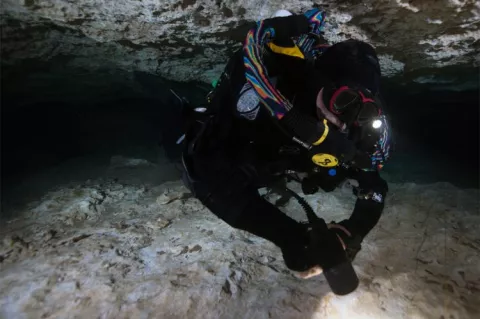
Getting Lined Up: Troubleshooting Sidemount Tank Configuration

I like sidemount. I will frequent­ly, jokingly, disparage the configuration, but I do like it. It can be comfortable and streamlined. It can be very flexible. There is an argument to be made for completely isolated redundancy. Mostly, it is good for moving through places no bigger than the space below your coffee table.

Words:
Robert Williams
Images:
Roger Williams
Cave photo by S.J. Alice Bennet
Download the full article as pdf ⬇︎
Tech and Training

What it is not—as has been lamentably sold with such popularity—is it being just as easy as buying a new harness and putting two tanks on your sides.

There are a ton of harnesses on the market, each of which have their benefits and drawbacks. Some are more heavily weighted on the benefits side; some are complete crap. For all of them, it is going to depend pretty heavily on your body type, philosophies, preferred tanks and diving style. Most importantly, contrary to what anyone might tell you, there is no perfect system.

X-RAY MAGAZINE FEATURE

Going Pro, Part II: The Road from Instructor to Dive Professional

“Wait, wait,” you may say when you read the title of this column, “What are you talking about? Aren’t those two things the same? Isn’t a dive instructor by definition a scuba professional? And what do you mean by ‘Road’?”

Words:
Simon Pridmore
Images:
Andrey Bizyukin
Download the full article as pdf ⬇︎
Op'eds and commentaries

A professional is someone who gets paid for plying a trade. At the point when you become a dive instructor, you may have done a lot of paying, that’s for sure, but it is unlikely that you will have seen any cash coming your way yet. What you have achieved when you successfully complete your instructor course is the acquisition of a title that you can use on your business card. You have a few more steps to take before you have a profession—hence, the concept of a road to take.

Pagination

  • First page « First
  • Previous page ‹‹
  • …
  • Page 2
  • Page 3
  • Page 4
  • Page 5
  • Current page 6
  • Page 7
  • Page 8
  • Page 9
  • Page 10
  • …
  • Next page ››
  • Last page Last »
Subscribe to Training

Latest updates

Emperor Divers Backs New Research Into Decompression Sickness
17 Apr, 2026 - 21:01
Lion fish
Conscious Fish?
17 Apr, 2026 - 13:07
DAN Achieves Milestone of 1,000 First Aid Providers Trained in Indonesia
16 Apr, 2026 - 21:28
SS United States
Increasing Opposition to the Sinking of SS United States
15 Apr, 2026 - 19:01
More

Upcoming Events & Expos

5 Jun, 2026 ➢ 7 Jun, 2026

Malaysia International Dive Expo (MIDE) 2026

Malaysia International Trade and Exhibition Centre (MITEC), Kuala Lumpur

9 Sep, 2026 ➢ 12 Sep, 2026

ABOFA – Aqaba Blue Ocean: Future in Action

Aqaba, Jordan

5 Dec, 2026 ➢ 6 Dec, 2026

Dive-Expo

Antwerp Expo, Belgium

Stay tuned with us

Don’t forget that you can connect with us through all major social media, by simply clicking on the corresponding logo below.

Advertisement
Advertisement
Home
International Dive Magazine

About X-Ray Mag

AquaScope Media logo

Compiled by an international network of top dive editors and world-class underwater photographers, X-RAY MAG is the planet's only truly global premier dive lifestyle magazine. Subscription and downloads are free. Published since 2003.

Image
DEMA Member

Published by:

AquaScope Media ApS - Copenhagen - © 2026

A closer look below the surface.

Advertising

  • General info / Distribution
  • Rate cards
    • Media kit - $ (USD)
    • Media kit - € (EUR)
    • Media kit - £ (GBP)
  • Ad Sizes and Formats
    • Magazine Ad Copy sizes
    • Banner ad sizes
  • General trading terms

Privacy & GDPR

  • Privacy and Cookie Policy

Subscriptions

  • US Newsletter
  • Canadian Newsletter
  • European Newsletter
  • UK Newsletter
  • Asia-Pacific Newslettre
  • Other / Global
  • 😪 Unsubscribe

Brand Assets / Logos

  • Banner ads
  • Logos
  • SoMe Collaterals

Contact

  • Contact us
  • About us
Clear keys input element