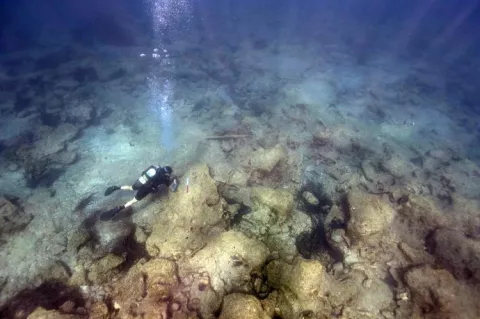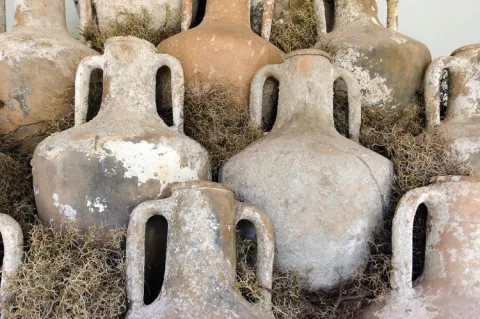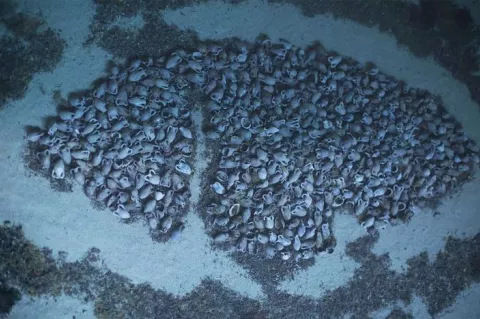
Underwater archaeologists have recovered obsidian cores from what is believed to be a Neolithic shipwreck, potentially one of the oldest maritime discoveries.
The discovery was made near Capri’s famous Blue Grotto, a site historically used as a private bath by Roman emperors. Divers from the Naples Police Headquarters’ underwater unit located the wreck, which contained obsidian core material at a depth of around 40m. One of the cores, showing clear traces of chiselling and carving, measures approximately 28 x 20 x 15 cm and weighs almost 8kg.
In an unprecedented archaeological feat, the shipwreck known as "Marausa 2," which sank off Marausa, Sicily, in the late 3rd century, has been meticulously recovered from the seabed in its entirety. This marks the first instance where a Roman ship has been raised in its complete form, as opposed to being retrieved piece by piece.
The submerged relic, a testament to the advanced seafaring capabilities of the ancient Phoenicians, lies off the coast of Mazarrón in the Mediterranean Sea.
Unveiling Phoenician maritime prowess
Discovered more than three decades ago, this Phoenician ship is one of the best-preserved examples of ancient seafaring vessels. The remarkable condition of the shipwreck promises invaluable insights into Phoenician shipbuilding, navigation and trade practices that were a cornerstone of their civilization.
Archaeologists have recovered exquisitely preserved Roman glassware from a 2,000-year-old shipwreck near the coast of Rome, shedding light on ancient maritime trade routes.
Underwater archaeologists recently discovered the remains of an ancient Roman cargo ship off Rome's coast. This significant find goes beyond merely finding another shipwreck; it offers an intriguing glimpse into the complexities of ancient Roman seafaring, trade practices and the far-reaching influence of Rome's maritime network.
The Capo Corso 2 wreck was discovered in 2012 at a depth of around 350 metres between Sicily's Capo Corso and the island of Capraia which lies off Tuscany, Italy.
Recent underwater archaeological efforts by UNESCO and eight Member States have revealed three shipwrecks, contributing to the protection of our shared underwater heritage.
According to reports, these shipwrecks are believed to date back to Roman times. Although the Mediterranean Sea is known for its rich history of maritime trade and naval warfare, the discovery of intact ancient shipwrecks remains a rare occurrence.
The shipwrecks were discovered during an operation intended to protect underwater heritage. UNESCO and the eight participating Member States launched this mission, recognizing the critical value of these sites in understanding our collective past.
Held in the Adriatic coastal town of Kotor, “Underwater Cultural Landscapes of Montenegro” will run from 21 April until 3 May. The event aims to illuminate and make accessible to the general public the numerous cultural facets of Montenegro's underwater cultural heritage.
The project will promote underwater cultural assets and target tourism development by using a multidisciplinary approach to present and document the shipwrecks, navigation routes, harbours, anchorages, and other archaeological sites along the Montenegrin coast.
Wisconsin Historical Society maritime archaeologists recovered a historic dugout wood canoe from the bottom of Lake Mendota in the US state of Wisconsin yesterday, just a few months after learning of its existence in June 2021. The canoe is a remarkable artifact, made from a single tree.
Divers have discovered a rare military vessel amid the sunken ruins of the ancient Egyptian city of Thônis-Heracleion - once Egypt's largest port on the Mediterranean - and a funerary complex illustrating the presence of Greek merchants.
Prior to the founding of Alexandria by Alexander the Great in the year 331 BC, Thônis-Heracleion was the largest port city in Egypt, controlling the entrance to the country at the mouth of a western branch of the Nile River and dominating the area for centuries.
Destroyed and sunk along with a wide area of the Nile delta by several earthquakes and tidal waves, Thônis-Heracleion was rediscovered in 2001 in Abu Qir Bay near Alexandria, now Egypt's second-largest city.
Amongst the artefacts recovered from two wrecks in Singapore waters is the world's largest haul of blue-and-white porcelain recovered from a documented shipwreck.
In 2015, commercial and salvage diver Ahmad Qamarulhazman was clearing debris underwater near Pedra Branca island, 24 nautical miles east of Singapore, after two bulk loader cranes that were in danger of toppling were blown up.
On his final dive of the operation, he spotted something wedged between rocks 8m deep. His trained eye told him that it was not something natural, but it was tough to see what it was as it was encrusted with algae, molluscs and organisms.
There are many benefits to living in Asia. One advantage is that the waters around Asia still have countless numbers of unexplored shipwrecks. As a certified technical diver and an explorer at heart, the Gulf of Thailand has been my playground.
During my stay in Thailand, I have had the opportunity to meet and dive with some of the nicest people. I have fond memories working with members of the Thailand Underwater Archaeology Division, also known as the UAD. The UAD office and museum are located in a small town called Chanthaburi, which is located about a 251km, three-hour drive from Bangkok. At the museum, you can see displays of ancient pottery, which have been surveyed and excavated from some of these wrecks.