Long after the jet lag and the first day back to work, you slip into your favorite dive T-shirt eager to keep the essence of your most recent underwater experience pulsing through your mind and body. Proudly wearing large print logos across your chest is a way of celebrating your passion for diving and sharing it with the rest of the world.
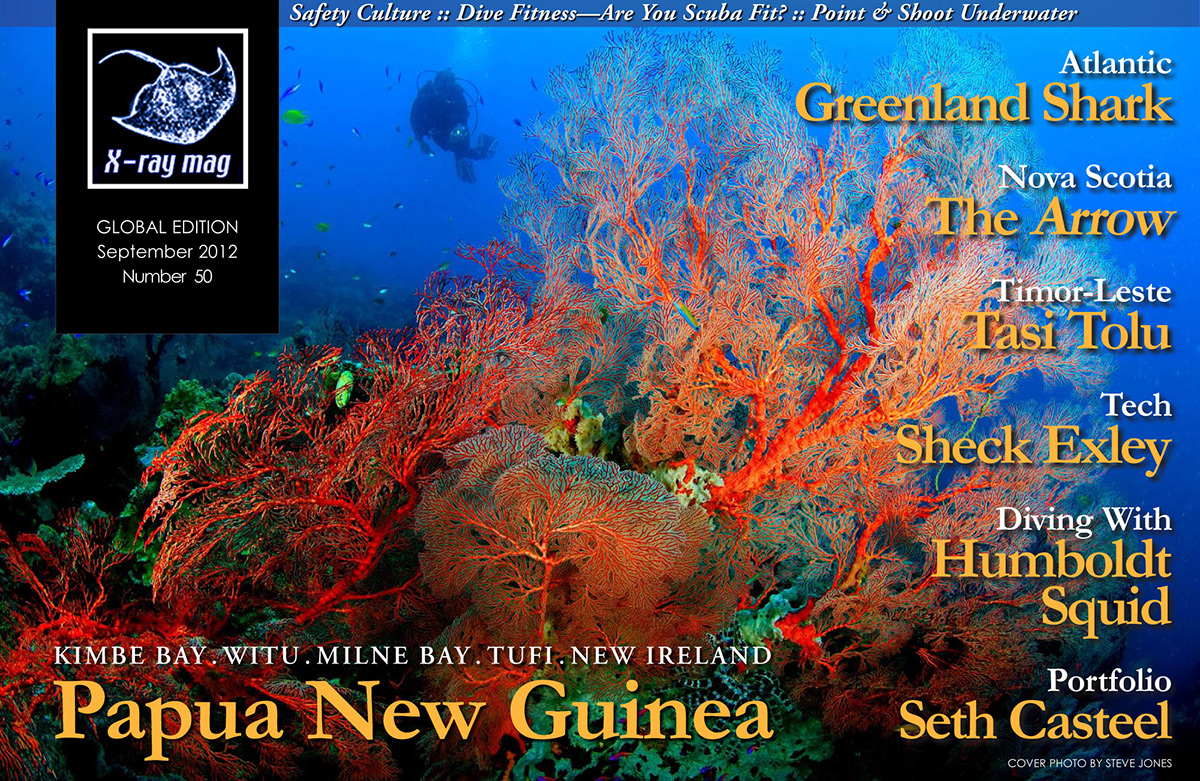
Feature articles in this issue with stand-alone pdfs
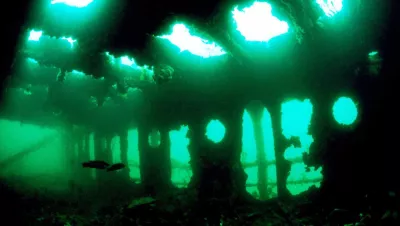
It’s an unsettled kind of morning on Chedabucto Bay of Canada’s east coast. The sun is shining—it’s really quite pleasant—but there’s a brisk wind blowing from the southwest. What that translates into here in the waters between Cape Breton Island and Nova Scotia is heavy seas. We’re pounding through four to six foot swells in a 25-foot rigid hull inflatable boat. The ride out to the dive site is turning out to be a wild, you might say bone-jarring, experience. All this for a dive that I’m still not certain I want to do at all.
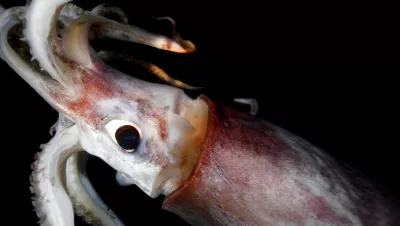
The rather dark reputation of Humboldt squid has been readily reinforced by various wildlife television programs and other media which present these creatures as giant animals hungry for blood or ruthless monsters, uncompromisingly attacking their prey.
I first spoke with Sheck Exley in the summer of 1991. I had begun publishing aquaCORPS: The Journal for Technical Diving, a year earlier and I was working out of the office at Capt. Billy Dean’s dive shop in Key West, Florida, the first technical diving training center in the United States. “Technical diving”, a term we had just coined to describe this new style of diving, was just in its infancy.
Is there another country anywhere with so much diversity? The six million inhabitants of this nation of mountains and islands are spread over 463,000km2 of mountainous tropical forests and speak over 800 different languages (12 percent of the world total). Papua New Guinea occupies half of the third largest island in the world as well as 160 other islands and 500 named cays.
I’ve been on the road for 36 hours now, and I’m pretty much on the other side of the world from where I started back in rain drenched England. At last, I’m approaching the final legs of the journey—just a short one-hour flight to go.
Things have gone smoothly so far, I’m thinking, as I wander up to the check-in desk for the last leg of my trip. “The flights full,” the attendant tells me, “You’ll have to wait until tomorrow.
In order to create images with point-and-shoot digital cameras that are a step above snap-shots, we have to use the same techniques used with DSLR cameras. By using a few different techniques, one can get outstanding results no matter what size camera is used.
“Thank [beep] for that! How lucky were we? We better not do that again.
Don’t tell anyone though, we don’t want to look like amateurs...”
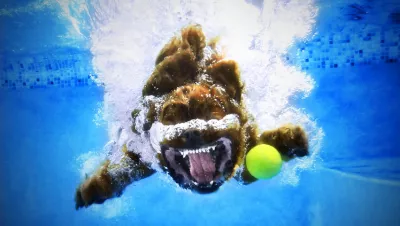
Move over human divers, you’re not the only ones who love to dive. Apparently, divers these days are not just of the hominid kind—American photographer, Seth Casteel, has captured the astounding and often humorous side of our canine companions who love to dive underwater.
There can’t be many dive sites that owe their existence to the direct intervention of the country’s president, but Tasi Tolu, on the outskirts of Timor Leste’s capital Dili, can claim that unique patronage.