

Trekking Canada’s Sub-Arctic Region in Manitoba

X-Ray Mag #36
Click HERE ⬇︎ to download — Links open in a new window
X-Ray Mag Global edition ~50 Mb
Feature articles in this issue with stand-alone pdfs
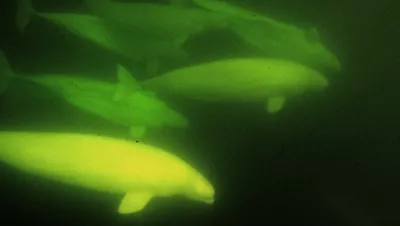
Beluga whales, Churchill, Canada. Photo by Barb Roy
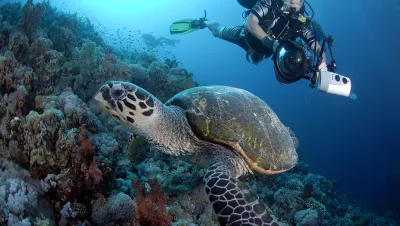
So, where do we start? And what type of camera do we buy? Should we go for the DSLR (Digital Single Lens Reflex)—basically a digital version of the old single lens reflex (SLR) camera where you compose your photograph through the lens of the camera—or should we go for a compact point-and-shoot camera, which has live-view screening.
The Florida sun was warm and high overhead as I donned my fins and slipped below the surface with camera in hand. A juvenile spotted eagle ray lazily glided away over the sand to avoid the impending intrusion of noisy bubbles and camera flashes. As I finned towards the shadows, I stopped to investigate a small male rosy razorfish in full breeding colors flitting about frantically, as I intruded on his territory. So consumed by the dance of the razorfish, I barely noticed the shifty dark mass in the distance making its way towards me.
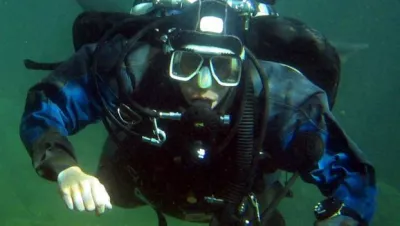
Diving is an activity that appeals to a huge selection of people, and within diving, there are almost as many ways to enjoy the sport as there are participants. During the 1990s, scuba diving became a mass participation sport.
The increase in holidays to exotic destinations, together with a growing commercialisation of diver training agencies, combined to make it was possible for people to do a basic open water course in a few days during the annual summer holiday. Whole families could do an open water diving qualification, which allowed Mum, Dad and the kids to experience the wonders of the undersea world.
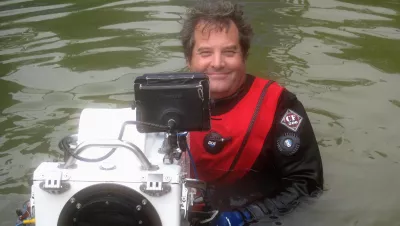
You wonder, sometimes, how things link up. For example, how is a scuba diving suit connected to the likes of household names such as Dr Who, Casino Royale, Trainspotting, Star Wars Episode I: The Phantom Menace, Basic Instinct II, Atonement and the latest Ridley Scott/Russell Crowe epic, Robin Hood?
Whilst on paper there’s not an obvious association, I know I’ll find the answer waiting for me in a small Chelsea café. A large gregarious Welshman, fizzing with energy, is talking in an animated fashion on a mobile. He is the renowned and much respected underwater cinematographer, Mike Valentine.
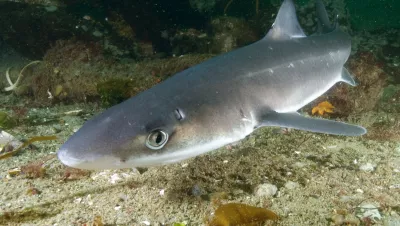
Spiny dogfish. Photo by Andy Murch
You won’t find Spiny dogfish on most shark diver’s ‘bucket lists’. In fact, the only time that your average diver will come into contact with a dogfish is when it is covered in batter, served with chips and bathed in an artery-constricting amount of salt and vinegar.
From a marine archeology and scientific standpoint, the Baltic Sea is a paradise. There could be as many as 100,000 shipwrecks dating back centuries in this dark and mysterious sea—Viking ships, trading ships and warships to name a few. No other place in the world is comparable to the Baltic Sea.
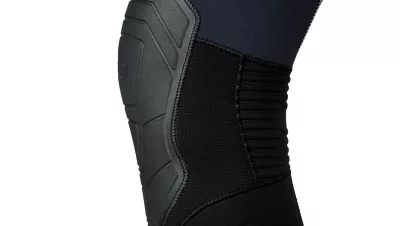
Today’s modern wetsuit embodies technology that benefits divers with an abundant choice of options to fit most any size and shape of diver, and any style of diving activities from mild tropical to very cold water.