Researchers have taken arterial blood samples from freedivers at depths down to 80m, revealing how oxygen and carbon dioxide levels change during deep breath-hold dives—and producing some unexpected results.
A study involving elite freedivers has provided the deepest direct measurements yet of arterial blood gases during breath-hold diving, challenging assumptions about what happens as divers descend beyond about 40m.
Researchers took arterial blood samples from three highly experienced freedivers during dives to 20, 40, 60 and 80m off Dominica. The divers included multiple world-record holder William Trubridge.
A panel of diving medicine experts has recommended revised exposure limits for central nervous system (CNS) oxygen toxicity when divers breathe an inspired partial pressure of oxygen (PO₂) of 1.3 atmospheres. The changes are based on recent research and field experience, aiming to bring guidelines in line with modern technical and scientific diving practice.
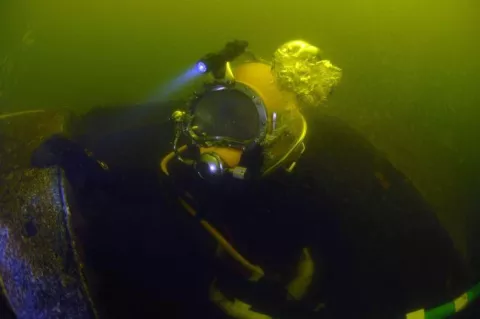
The Navy Experimental Diving Unit tested the Deep Sea Expeditionary with No Decompression (DSEND) Suit underwater last February.
The Atmospheric Diving Suit (ADS) used by the Navy at the moment is cumbersome, unmaneuverable, and requires relatively large sea craft for deployment. With this new project, it will be improved in a number of ways, including the rotary joint design that it now uses.
Professor Joseph Dituri from the University of South Florida broke a previous Guinness World Record when he surfaced after living underwater for 100 days.
A retired U.S. Navy Diving Officer and aquanaut, the 55-year-old Dituri embarked on the project in an effort to learn about the effects of hyperbaric pressure on the human body.
He hypothesises that increased pressure has the potential to help humans live longer and prevent diseases associated with ageing.
Will it become possible to diagnose decompression sickness through a blood test? We take a closer look at the implications of some recently published research.
That decompression causes bubbles to form in our tissues, which in turn could lead to decompression sickness (DCS) and serious injury, is elementary knowledge for any certified diver.
The family of Dr Richard Vann wishes to thank everyone for their tremendous outpouring of love for such a wonderful man.
Dick was a beloved husband, father, colleague and friend and we will all miss him dearly
Dick Vann's family have confirmed that in accordance with his wishes, his ashes will be scattered in Maine, where his parents and grandparents are interred.
The Undersea and Hyperbaric Medical Society has announced that it will live stream its annual scientific meeting. This will be held in Orlando from Thursday 28 to Saturday 30 June 2018 inclusive.
This is the first time that the UHMS has provided live streaming access to this meeting.
One of the most important lectures will take place on Friday 29 June. Dr Eugene Worth will give the Eric P. Kindwall memorial lecture at 13.00 (local time) on 'HBOT and diabetic foot ulcers: Do we have a leg to stand on?'
World-renowned diving medicine expert Dr Neal Pollock gave everyone a lot to think about with his talk on the thoughtful management of decompression stress.
Neal looked at the many factors that can alter decompression stress and the practical strategies all divers can use to optimise decompression safety.
“It is increasingly common for divers to rely on dive computers for their decompression safety. Dive computers do not yet measure or integrate a multitude of factors that can alter decompression stress.”- Dr Neal Pollock.
The Academy Of Underwater Arts And Sciences has announced that Dr. Richard D. Vann has been selected for induction into the 2014 Academy of Underwater Arts and Sciences (AUAS) Fellow Program. Dr. Vann’s work and lifetime dedication to dive science earns him a place alongside industry icons.
This coveted award is widely recognised as the oldest and most prestigious in the diving industry. The NOGI has been awarded on an annual basis since 1960 to a select group of divers and undersea visionaries who rank at the top of their fields in arts, science, sports / education, environment, and distinguished service. In 1993 the AUAS was created to administer the NOGI award.