WWI Wrecks

Replica of German WW2 V-1 Flying Bomb
From instrument of death to substrate of life. Replica of German WW2 V-1 Flying Bomb remains of which are now found in ammunition dumps and debris fields.

WWII Ammunition Dumps Found to Support Unexpected Marine Biodiversity

A new scientific study has revealed that World War II ammunition dumps on the seabed—long regarded solely as hazardous legacy sites—also support surprisingly rich marine biodiversity

The findings suggest that, in addition to posing management and safety concerns, these munitions fields may now function as unintentional artificial reefs hosting complex ecological communities.

The wreck of HMS Bayano
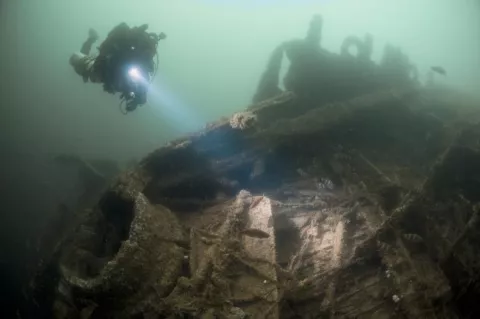
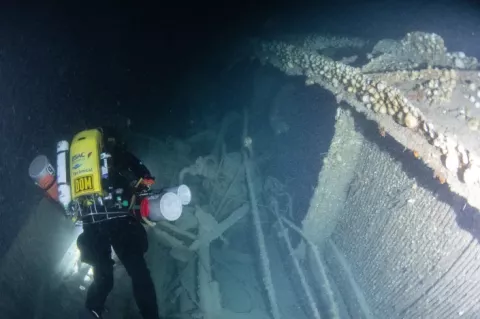
The wreck of HMS Bayano sits at 106m, with a minimum depth of 84m, lying bow NNW and stern SSE, with a 20-degree list to starboard. In places, the wreck rises over 15m above the seabed. Much of the vessel's superstructure is still in place.

Lost WWI Cruiser HMS Bayano Identified After 110 Years

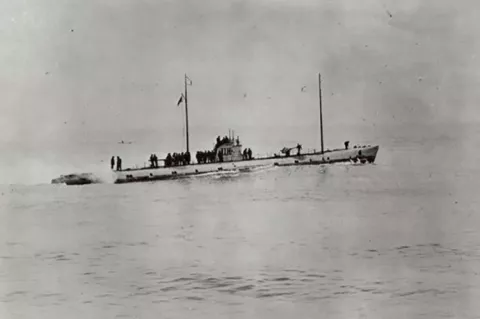
After more than a century of mystery, technical divers from the community-led initiative, ProjectXplore, have conclusively identified the wreck of HMS Bayano, a First World War armed merchant cruiser sunk by the German submarine U-27 on 11 March 1915. The 126-metre vessel now rests at a depth of 106 metres in the North Channel, between Scotland and Northern Ireland.

Gallery of underwater images of HMS Nottingham

Royal Navy Warship HMS Nottingham Lost for 110 Years Discovered in North Sea

After over a century of searching, the wreck of HMS Nottingham, a British First World War light cruiser, has been located and positively identified in the North Sea. The discovery was made by an international team of technical divers from ProjectXplore, bringing closure to a long-standing naval mystery and commemorating a vessel lost during a pivotal moment in naval history.

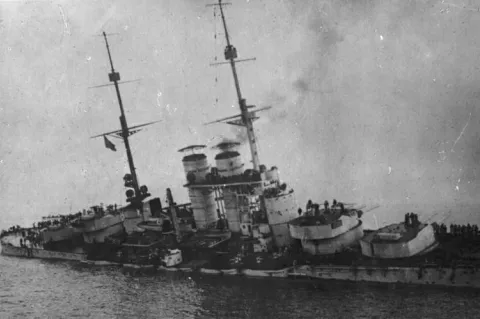
The entire Imperial German Navy's High Seas Fleet of 74 ships had been assembled in the natural harbour at Scapa Flow in the Orkney Islands, following the cessation of hostilities on 11th November 1918.

Scotland Grants Added Protection of Historic Wrecks at Scapa Flow and Shetland

From 1 November 2025, Scotland’s underwater heritage gains new protections: the shipwrecks of Scapa Flow and the 1745 wreck of the Swedish East Indiaman Queen of Sweden are now designated Historic Marine Protected Areas. The move ensures these powerful symbols of maritime history remain preserved—and accessible—while defended against disturbance.

Photogrammetric reconstruction of the submarine USS F-1 showing the conning tower and collision damage that caused the sub to sink.

World War I US Submarine Rendered in 3D

On 17 December 1917, USS F-1 collided with its sister ship, USS F-3, off the coast of San Diego during a training exercise in dense fog. The impact caused the F-1 to sink within ten seconds, resulting in the loss of 19 crew members. A mere five sailors survived the incident. The submarine now rests approximately 1,300ft (~396m) beneath the Pacific Ocean.

Postcard showing HMS Stephen Furness, from an unknown publisher

World War I Warship HMS Stephen Furness Discovered in Irish Sea

A team of researchers has successfully identified the wreck of HMS Stephen Furness, a WWI armed steamer, off the coast of the Isle of Man. Sunk by a German U-boat in 1917, the vessel has remained an enduring mystery, with the wreck recently pinpointed as part of Bangor University's “Towards a National Collection” project.

SS Cheltenham, later known as SS Topol, in a 20th-century photo by an unknown photographer. (Photo credit: © Sunderland Museums / Bridgeman Images / via press release)

WWI Shipwreck Found in North Sea Could Be SS Tobol

The SS Tobol was originally built as the SS Cheltenham in Sunderland in the early 20th century. The vessel featured a distinctive turret deck design and was operated by a British steamer company. In 1904, Russian warships seized the ship, and it was later transferred to the Russian Imperial Navy, where it was renamed SS Tobol after the Tobol River in Russia.

HMS Hawke, launched in 1891, was an Edgar-class protected cruiser.

Wreck of WWI Cruiser HMS Hawke Found in “Amazing” Condition

HMS Hawke was discovered earlier this week after an extensive search by Lost in Waters Deep—a group that searches for WWI shipwrecks—about 70 miles off the Aberdeenshire coast. It was found to be in "remarkable" condition, lying at a depth of around 110 metres (360ft).