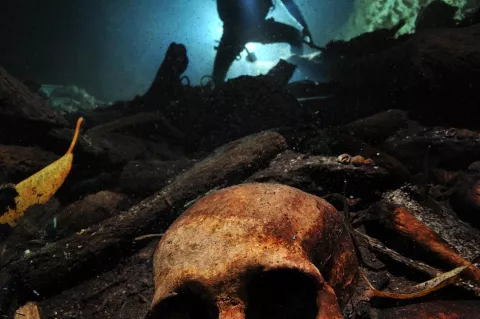
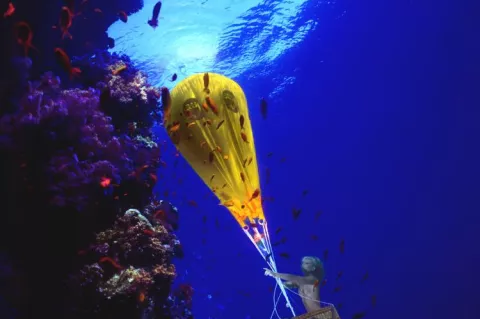
—A rare look behind the making of an iconic image. From conception of the idea to the execution, you will be surprised how little of it was left to chance.
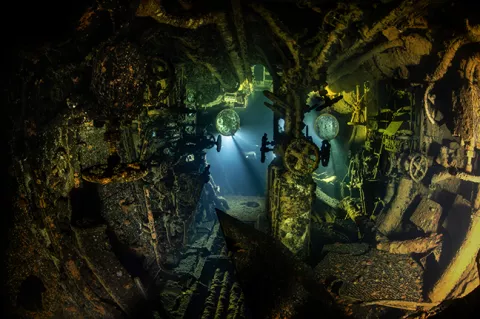
The sudden rocking of our truck shook me out of my slumber. I struggled to focus on my watch. Has it already been one-and-a-half hours since we set off, after loading the tanks? Looking out of the window at the jungle trail sort of threw me deeper into my world of confusion. Are we going diving? Being based in tropical Asia, diving to me usually means swaying palm trees, sunny skies, and white sandy beaches. So the 20°C air and dusty jungle trail was at the total opposite end of the spectrum for me.
For years and years, people have often asked me, “Hey, why aren’t you a cave diver?” And I would respond simply, “When I have dived all the wrecks of the world (twice), I will then think about diving Wet Rocks!”
I learnt to dive in 1989, doing my initial training dives in the quarry at Stony Cove in England, a popular inland dive location about 125 miles north of London. I remember, to this day, doing my first training dives. It was January, in mid-winter. The water temperature was 4°C (that’s the recommended temperature for drinking Heineken) and I was in a wetsuit!
In June at this year’s United Nations World Oceans Day photo contest, three of our regular contributors won awards. American photographer Beth Watson claimed the competition’s grand prize, the overall theme award “Healthy oceans, healthy planet”; French photographer Greg Lecoeur won first place in the Underwater Life category, second place in the Above Water Seascapes category and third place in the Underwater Seascapes category; and American photographer Brandi Mueller won third place in the Underwater Life category.
Safe House, Raja Ampat, Indonesia. My husband and I were diving the epic Birds Head Seascape region known as Raja Ampat, Indonesia. It was a blissful day and our next dive site was Citrus Ridge. This is a highly anticipated dive site known for its beauty and diversity.
Florida manatees are an endangered species found in the rivers, springs and ocean around the state of Florida in the United States. By far, one of the best places to encounter these gentle giants is at Three Sisters Springs in Crystal River, a state park filled with crystal clear blue water, perfect for capturing imagery of this sometimes curious and playful species.
Under special permit, underwater photographers are allowed to enter the water with camera in hand to photograph manatees within the state park. Strict regulations are in place to protect the manatees from harassment and abuse as they move into the spring head area to rest and to keep their young warm, as temperatures fall in the winter months.
Many times, manatees will approach swimmers and photographers alike, as this species can be quite playful. With a friendly and outgoing manatee, the photography opportunities are endless.
I have been an underwater photographer and filmmaker for more than 25 years. I share the grave concerns of many who fear that our generation will bequeath future generations the legacy of a planet, poisoned and stripped of its assets and its beauty.
Twenty-five years ago I made a film called the Ocean’s Daughter, that tried, in my own small way, to add a voice to the growing calls to protect our planetary future. It was a film that tried to express the sacredness of life and the magical beauty of nature and the fact that we, as humans, we're in danger of destroying ourselves, before we had the chance to evolve into mature adulthood as a species.