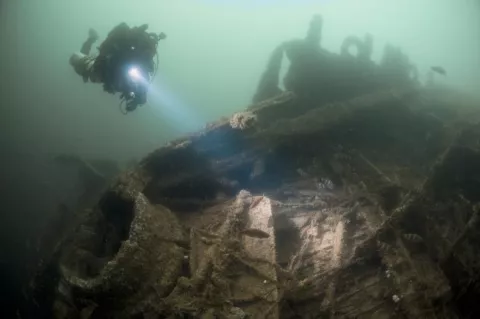
Over the summer, I met up with my buddy Eddie Huzzey in Dover for a week of wreck exploration. I was super excited, as Eddie had marked some new sites that had not been dived before.
In World War I, unrestricted warfare meant ships that were traditionally off limits became targets for surprise attacks by German U-boats. Steve Jones visits two of the most endearing wrecks in the English Channel that were a direct result of this highly controversial policy.
An upright stern emerged through the grey-green water around 10m below me. The last time I visited this wreck on a cold October day, I was in total blackness at this depth, but today was different and the high sun overhead at last revealed the HMHS Lanfranc in its full glory.
Afterthoughts
Thirteen allied hospital ships were torpedoed in World War I, along with several more on all sides lost to mines, including the most famous of them all—the Britannic. Yet even after Germany declared its intentions to target these ships, there were several examples where U-boat commanders chose not to attack, as humanity prevailed against their orders.
The author gives special thanks to Terry Ayling for his tireless modelling, lighting assistance and endless patience.Steve Jones is an underwater photographer and journalist whose award-winning work has been published in over 30 countries during a career spanning three decades.
A true all-rounder, his assignments have included colossal battleship wrecks in the deep north Atlantic and sub-zero encounters with apex polar predators to equatorial seascapes awash with strong currents.
References and further reading:
McGreal, S. (2009). The War on Hospital Ships 1914-1918. Pen and Sword Maritime. ISBN-13: 978-1844158584
McCartney, I. (2002). Lost Patrols: Submarine Wrecks of the English Channel. Periscope Publishing Ltd. ISBN-13: 978-1904381044
Young, R. and Armstrong, P. (2009). Silent Warriors: Submarine wrecks of the United Kingdom, Volume. 2. The History Press.
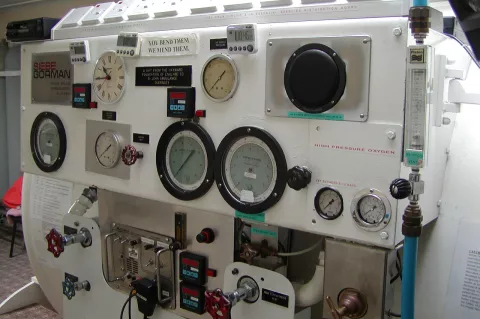
All divers intending to dive within Guernsey's 12-mile limit—both commercial and recreational divers—who subsequently require the use of the local hyperbaric chamber, will be charged GB£30,000 per treatment by the States of Guernsey.1 It should be noted that this fee does not include accident and emergency consultation charges (these are billed separately).
The chamber on Guernsey in the English Channel used to treat divers with decompression sickness, had been operated by St John Ambulance until April. The new chamber is expected to be operational by June, according to the Health and Social Services Department.
he old chamber which is over 40 years old, was run by St John Ambulance & Rescue Service and used to treat divers with decompression sickness until it was closed in April. It was solely funded by public donations and located at the Ambulance Station on the outskirts of Guernsey’s main town, St Peter Port.
The founder of Innerspace Explorers (ISE), Achim Schloffel, talks to X-RAY MAG about diving across the English Channel, explorations and running a dive training agency.