The wreck of the U.S. Coast Guard Cutter Tampa, lost with all hands during World War I, has been discovered off the coast of Cornwall, bringing closure to one of the service’s deadliest losses.
The remains of the USCG Cutter Tampa have been located off the coast of Cornwall, more than a century after the vessel was sunk during World War I.
The cutter was lost in September 1918 after being torpedoed by a German U-boat while escorting a convoy in the Bristol Channel. All 131 crew members on board were killed, making it the deadliest loss in U.S. Coast Guard history.
Authorities in southwest England are stepping up efforts to combat heritage crime at sea, introducing new guidance and enforcement coordination aimed at protecting historic shipwreck sites from looting and damage.
New measures aimed at protecting historic shipwrecks along England’s southwest coast are being introduced as authorities seek to address the growing problem of heritage crime at sea.
The initiative builds on guidance developed by Historic England and partner organisations to improve how agencies detect and respond to illegal activity on underwater heritage sites.
New dives funded by Historic England have revealed that the wreck of the 18th-century warship Northumberland, lost during the Great Storm of 1703, is far more intact than previously thought. The wreck, a Protected Site since 1981, lies in shallow waters off the Kent coast and is now confirmed to include multiple wooden decks, intact chests, and coils of rope—rare organic materials that have survived three centuries thanks to burial under seabed sediments.
In a move causing widespread concern within the diving community, NHS England has announced plans to reduce the number of commissioned hyperbaric oxygen therapy (HBOT) centres from ten to six.
This decision follows a recent procurement process where three recompression chambers in the Midlands, North West, and North East of England were unsuccessful in their bids to continue providing HBOT services. The British Sub-Aqua Club (BSAC) warns that this could leave vast regions without accessible treatment for decompression illness (DCI) and arterial gas embolism (AGE), conditions that require immediate medical attention.
The Earl of Abergavenny was launched in 1796 in Northfleet, Kent and is rare as one of only 36 ships of 1460 tons that formed a special class of the Company’s merchant fleet. It was an early example of the changing technologies in ship building of the time, incorporating the use of iron in its construction.
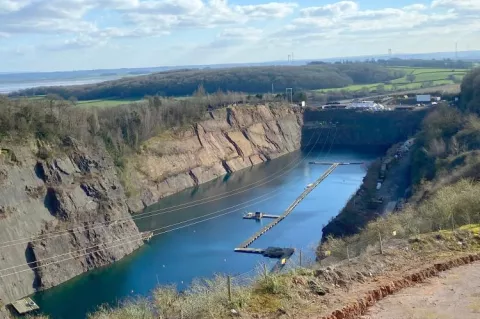
Workers at a quarry near Dungeness made the dramatic discovery of a rare Elizabethan-era shipwreck on the coast of Kent while dredging gravel for building materials out of a lake in April.
The location is now some 300 metres from the coast, but archaeologists believe that the site was once right on the coastline. The vessel could have been wrecked or abandoned on the former shoreline, and then gradually buried in sediment as time passed and the headland expanded.
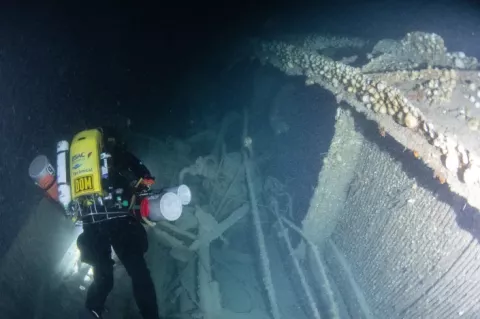
British divers have found the USS Jacob Jones, a US shipwreck from the First World War which has been missing since it was sunk in 1917, 40 miles off the coast of the Isles of Scilly.
The USS Jacob Joneswas the first American destroyer ever to be sunk by enemy fire. After the United States entered World War I in April 1917, Jacob Jones was sent overseas. On 6 December, Jacob Jones was steaming independently from Brest, France, for Queenstown, when she was torpedoed and sunk by the German submarine U-53 with the loss of 66 men out of a crew of 150. The vessel sank in eight minutes without issuing a distress call.
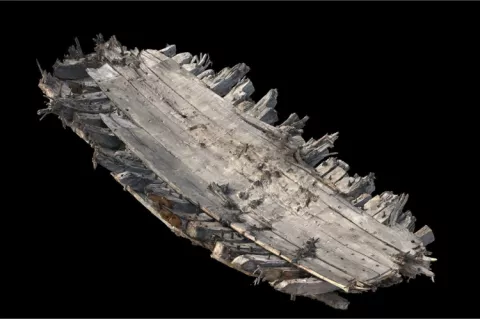
The remains of a medieval ship and its cargo dating back to the 13th century have been uncovered off the coast of Dorset by maritime archaeologists from Bournemouth University.
The survival of a vessel such as this is extremely rare, and there are no known wrecks of seagoing ships from the 11th to the 14th centuries in English waters. The discovery makes this the earliest English designated wreck site where hull remains can be seen, Bournemouth University writes.
The shipwreck was preserved due to unique environmental factors, according to maritime archaeologists now excavating and analyzing the site.
Brothers Lincoln and Julian Bardwell found the wreckage of HMS Gloucester, the warship that carried King James II, off Norfolk coast in 2007, but the discovery was kept secret until recently.
The Gloucester ran aground some 28 miles off the coast of Great Yarmouth, Norfolk, on 6 May 1682, nearly killing the Duke of York, who became King James II of England. The incident happened after a dispute about navigating the treacherous Norfolk sandbank which the ship hit at about 5.30 and sank within the hour. Between 130 and 250 people died.