  • Sportsdykkeren.dk 🇩🇰
  • XRay-Mag.SE 🇸🇪
  • Dykmässan (diveshow)

Secondary menu - Advertising and subscriptions

  • Got stories? - Guidelines
  • Advertising
  • Subscribe to X-Ray Mag
Home
  • Magazine
  • News
      1. Latest news
      2. Press releases
      3. Breaking News
  • Travel
      1. Destinations
        1. Australia & New Zealand
        2. Continental Asia
          • Japan
          • China
          • South Korea
        3. Southeast Asia
          • Indonesia
            • Bali
            • Komodo
            • Lembeh
            • Maluku
            • Raja Ampat
            • Sulawesi
          • Malaysia
          • Papua New Guinea
          • Philippines
          • Thailand
          • Timor-Leste
        4. South Pacific & Oceania
          • Fiji
          • French Polynesia
          • Micronesia
            • Chuuk (Truk)
            • Marshall Islands
            • Yap
          • Palau
          • Samoa
          • Solomon Islands
          • Tonga
          • Vanuatu
        5. Indian Ocean
          • Madagascar
          • Maldives
          • Seychelles
        6. Red Sea
        7. Africa
          • Egypt
          • Malawi
          • Mozambique
          • Namibia
          • South Africa
          • Sudan
          • Tanzania
        8. Mediterranean & Adriatic
          • Croatia
          • Cyprus
          • France
          • Greece
          • Italy
          • Malta & Gozo
          • Portugal
          • Spain
          • Turkey
        9. Europe
          • Northern Europe
            • Denmark
            • England
            • Finland
            • Iceland
            • Ireland
            • Norway
            • Scotland
            • Sweden
          • Eastern Europe
            • Albania
            • Bosnia-Hercegovina
            • Croatia
            • Czech Republic
            • Hungary
            • Poland
            • Russia
              • Northwest Russia
              • Russian Far East
              • Siberia
          • Western Europe
            • Austria
            • France
            • Germany
            • Switzerland
          • Southern Europe
            • Cyprus
            • Greece
            • Italy
            • Malta & Gozo
            • Portugal
            • Spain
        10. Atlantic
          • Azores
          • Canary Islands
          • Falkland Islands
          • St Helena
        11. North America
          • Canada
          • Great Lakes
          • United States
            • East Coast
            • West coast
            • Alaska
            • Hawaii
            • US Virgin Islands
            • Guam
          • Mexico
        12. Caribbean & Central America
          • Bahamas
          • Belize
          • Cayman Islands
          • Bonaire
          • Cuba
          • Dominican Republic
          • Mexico
          • Columbia
          • Grenada
          • Costa Rica
          • Saba
          • Honduras
          • Turks & Caicos
          • US Virgin Islands
          • Nicaragua
        13. South America
          • Argentina
          • Brazil
          • Ecuador
        14. Polar Regions
          • Artic
          • Antarctica
      2. Promotions
      3. My Favorite Dive
  • Ecology
      1. Ocean Mysteries series by Ila France Porcher
      2. Sharks, Rays and Nudibranch stories by Andy Murch
      3. Sentience
      4. Conservation
      5. Coral Reefs
      6. Dolphins
      7. Fish
      8. Jellyfish
      9. Mantas & Stingrays
      10. Nudibranchs
      11. Octopus & Squid
      12. Sea Turtles
      13. Seals & Sea Lions
      14. Sharks
      15. Whales
  • Wrecks
      1. Vic Verlinden
      2. Ancient Wrecks
      3. Artificial Reefs
      4. Marine Archaeology
      5. Older Warships
      6. Steamships & Cargo
      7. Tall & Wooden Ships
      8. WWI Wrecks
      9. WWII Wrecks
  • Training & Tech
      1. Rebreathers
      2. Sidemount
      3. Deep Wrecks
      4. Cave Diving & Mines
      5. Ice Diving
      6. Diver Health & Safety
        1. Divers Alert Network - DAN
        2. Safety Culture
      7. Adaptive Diving
  • More
      1. Equipment
        1. BCDs, Wings & Sidemounts
        2. Dive Computers
        3. Dive Watches
        4. Drysuits & Undergarments
        5. Hoods, Gloves & Boots
        6. Lamps & Torches
        7. Masks, Fins & Snorkels
        8. Regulators
        9. Wetsuits & Rashguards
      2. Photo & Video
        1. Equipment
          • Cameras & Optics
          • Editing & Post-processing
          • Housings
          • Lighting
          • Useful Tools
        2. Tutorials
          • Techniques & Tips
            • Mike Bartick
            • Rico Besserdich
          • Composition
          • Editing & Post-processing
        3. News & Announcements
        4. Contributors' Picks
      3. Books & Media
        1. Works by our contributors
      4. Profiles & Interviews
        1. In Memoriam
      5. Lifestyle
        1. Portfolios & Ocean Arts
        2. Apres Dive & Apparel
        3. Editorials
      6. Contributors
        1. Pundits
          • Mike Ange
          • Gareth Lock
          • Michael Menduno
          • Mark Powell
          • Simon Pridmore
        2. Regular writers
          • Scott Bennett
          • Andrey Bizyukin
          • Larry Cohen & Olga Torrey
          • Pierre Constant
          • Brent Durand
          • Jennifer Idol
          • Scott Johnson
          • Steve Jones
          • Kate Jonker
          • Kelly LaClaire & Kate Holt
          • Matthew Meier
          • Brandi Mueller
          • Svetlana Murashkina
          • Barb Roy
          • Don Silcock
          • Claudia Weber-Gebert
          • Lawson Wood
        3. Columnists
          • Scott Bennett
          • Rico Besserdich
          • Rosemary 'Roz' E. Lunn
          • Ila France Porcher
  • ⚲ Search
X-RAY MAGAZINE FEATURE

Conscious Fish?

For decades, the question of whether fish feel pain has been stalled by a deeper, largely unexamined assumption: that fish, along with other “low”, “cold” animals, are not conscious. This raises an immediate contradiction, for how can a creature experience pain without being aware of it?

Words:
Ila France Porcher
Images:
Common lionfish
➥ Download the full article as pdf ⬅︎
Ecology & Science

Pain, by its very nature, is a subjective experience—something felt. To argue that fish feel pain, but are not conscious, is to separate sensation from awareness in a way that collapses under scrutiny.

Masters of Light: From Forest Canopies to Coral Reefs

There are places on Earth where evolution seems to have lingered longer than usual, experimenting not merely with survival, but with beauty. In the high branches of tropical forests, a chameleon sways like a leaf in the wind. Far below, drifting over sandy plains, a cuttlefish ripples in living light. They are separated by vast distances—by air and water, by reptile and mollusc, by ancient evolutionary divergence. And yet, they share a remarkable gift: mastery over light itself.

Cuttlefish
Ecology & Science

The art of becoming

The chameleon bends light through structure. Beneath its skin lie layers of cells that manipulate reflection, shifting crystal lattices to alter the wavelengths that reach our eyes. A mood, a rival, a shift in temperature, and forest-green suddenly blooms across its flanks.

Dolphin Intelligence: Do They Talk?

Dolphins have long fascinated humans with their intelligence, complex behaviours, and remarkable social structures. Now, with advanced techniques for analysing intelligent actions, communication researchers are finding that dolphins are not only one of the most intelligent animals, but that they may actually talk to each other!

Dolphin portrait
Ecology & Science

Dolphin intelligence is evident in a variety of ways. They demonstrate problem-solving abilities, self-awareness and complex social interactions. Studies have shown that dolphins can recognise themselves in mirrors, which so far has only been achieved by the most intelligent of animals. Furthermore, they can understand symbolic language and have been observed using tools. For example, they use marine sponges to protect their rostrums while foraging on the ocean floor.

Fish Recognises Itself in Photographs

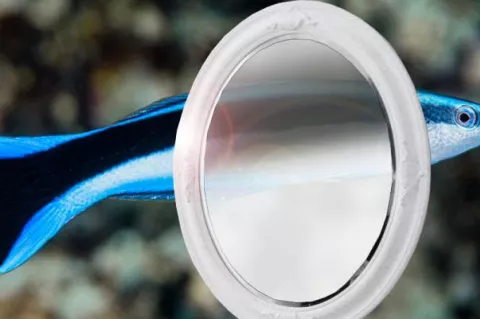
Cleaner fish (Labroides dimidiatus) likely recognise their own mirror image using a mental image of the self-face, comparable to humans.

Ecology & Science

A new study demonstrates how animals recognise self-images.

Some animals have the remarkable capacity for mirror self-recognition (MSR), yet any implications for self-awareness remain uncertain.

In a test of MSR ability in cleaner fish, mirror-naive fish initially attacked photograph models of both themselves and unfamiliar strangers. In contrast, after all fish had passed the mirror mark test, they did not attack their own (motionless) images, but still frequently attacked those of unfamiliar individuals.
X-RAY MAGAZINE FEATURE

Seeking Eye Contact: Fish Gaze Reveals Self-Awareness

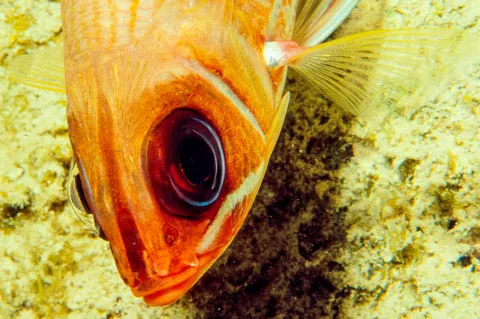
For many years, I held a weekly feeding session for the resident reef sharks and their visitors in the study area where I observed their behaviour. If I had enough shark food, I would scatter crumbs into the water for the fish after the sharks had left. The fish knew this, so they had to wait, and while they were waiting, they were excited.

Words:
Ila France Porcher
Images:
Peter Symes
Squirrelfish
Download the full article as pdf ⬇︎
Ecology & Science

As the session wore on and darkness fell, they gathered. They would creep ever closer as the moment I would feed them approached. The surface glimmered with the continually circling needlefish, who looked at me gravely with their big eyes. Hundreds flashed through the silvery surface lights while some circled solemnly upcurrent. Below them, wrasses, goatfish, butterflyfish, angelfish, pennantfish and many others flitted in an effervescent cloud.

Do fish really possess higher cognitive powers?

In this magazine, we have frequently pondered the intelligence, sentience and self-awareness of the creatures we encounter on our ventures into the aquatic environment and reported on various scientific findings and philosophical discussion held in that regard (see references at the end).

Ecology & Science

Mirror self-recognition test

The standard method for testing whether an animal is self-aware is placing a mark on its body that cannot be viewed directly and then letting it have a look in a mirror. If the animal responds to its reflection and attempts to remove the mark it is considered evidence that the animal is self-aware.


X-RAY MAGAZINE FEATURE

Cognition and Self Awareness in Manta Rays

Although born in the landlocked country of Hungary in Budapest, Dr Csilla Ari fell in love with the sea as a child and has never looked back. Today, she is a research associate at the University of South Florida, where she strives to better understand the biology and behavior of manta rays. She has also set up the Manta Memories project, which aims to help end illegal manta ray fishing.

Words:
Edited by Ila France Porcher
Images:
Download the full article as pdf ⬇︎
Ecology & Science

X-RAY MAG: How did you become interested in studying the behavior of manta rays?

What Are Sharks Aware Of?

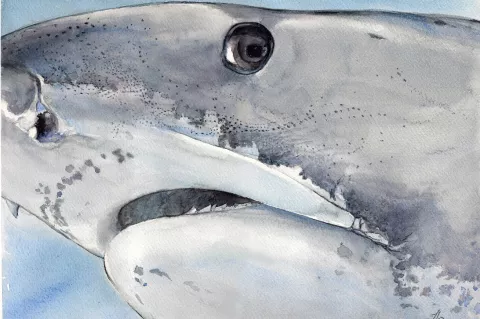
With the return of summer, more and more divers are meeting sharks for the first time, and wondering, “What do they see when they pass, so slowly, gazing at us gazing at them?”

Sharks can see very well
Ecology & Science

Sharks have a very different set of senses than we do, yet the eyesight of the free swimming species is good, so when they look at you, they are seeing you. But you may have the impression that they are using senses other than their eyes most often, and indeed, apart from our shared good eyesight, it is impossible for us to imagine how sharks experience their liquid realm.

Does this whale talk?

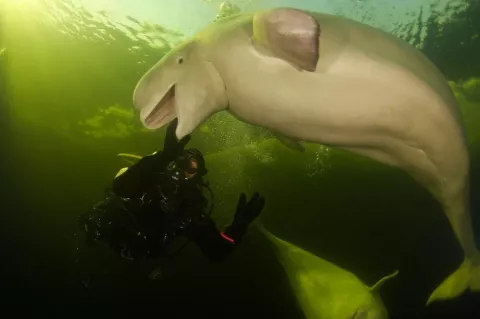
Researchers in the US have been shocked to discover a beluga whale whose vocalisations were remarkably close to human speech. After seven years in the care of humans a white whale called NOC began, spontaneously, to make unusual sounds. The researchers interpreted the whale’s vocalizations as an attempt to mimic humans.

Ecology & Science

Excerpts from Current Biology, Volume 22, Issue 20, R860-R861, 23 October 2012

The whale lived among a group of dolphins and socialized with two female white whales. The whale was exposed to speech not only from humans at the surface -- it was present at times when divers used surface-to-diver communication equipment.

X-RAY MAGAZINE FEATURE

Dolphin Ecology

When you are on the way back to the harbor after the afternoon dive, wild dolphins often swim in front and along the dive boat. They seem to love following boats. Sometimes they then perform for us, in form of huge jumps out of the water and “tail shows”, keeping the tail up for minutes remaining still in the water.

Words:
Images:
Download the full article as pdf ⬇︎
Ecology & Science

My biggest surprise was to see how fast these beautiful animals actually swim underwater. One of these young dolphins tried to teach me her kind of swimming, but quickly gave up on such a clumsy student. This recent first encounter made me think about how much – or how little - do we actually know about dolphins: their biology, ecology and behavior?

Subscribe to Self-awareness

Latest updates

Rediscovered Benin coral reef
Coral Communities Rediscovered off Benin After 60 Years
16 Aug, 2026 - 17:37
Bonnethead shark
Bonnethead Sharks Grow Into Their Distinctive Head Shapes
16 Aug, 2026 - 16:47
Bull Sharks Keep It in the Family
16 Aug, 2026 - 15:58
Great Barrier Reef Shows Signs of Recovery
16 Aug, 2026 - 15:56
More

Upcoming Events & Expos

23 Oct, 2026 ➢ 26 Oct, 2026

Diving Talks

Lisbon, Portugal

3 Nov, 2026 ➢ 6 Nov, 2026

DEMA 2026

New Orleans, Lousiana

5 Dec, 2026 ➢ 6 Dec, 2026

Dive-Expo

Antwerp Expo, Belgium

16 Mar, 2027 ➢ 19 Mar, 2027

ABOFA – Aqaba Blue Ocean: Future in Action

Aqaba, Jordan

Stay Social

Don’t forget that you can connect with us through all major social media, by simply clicking on the corresponding logo below.

Reviews

Books & Media

Scuba Diving Operational Risk Management

An SAS approach to principles, techniques and application in recreational and technical diving.

Book cover
Review
Books
Books & Media

Secret Seas

Professional underwater photographer, Paul Flandinette and marine scientist and underwater photographer Michel Claereboudt take the reader on a breathtaking journey of discovery into Oman's underwater world.

Book cover
Review
Books
Books & Media

Reefs of Time

In Reefs of Time, geoscientist and science educator Lisa S. Gardiner offers a compelling and accessible exploration of how fossil coral reefs can inform our understanding of the threats facing reefs today. 

Book cover:  Reefs of Time
Review
Books & Media

Yes, Fish Feel Pain

A thought-provoking examination of fish sentience, behaviour and the growing scientific debate surrounding pain perception in aquatic animals.

Yes, Fish Feel Pain
Works by Our Contributors
Review
Books
Ila France Porcher
Advertisement
Advertisement
Home
International Dive Magazine

About X-Ray Mag

AquaScope Media logo

Compiled by an international network of top dive editors and world-class underwater photographers, X-RAY MAG is the planet's only truly global premier dive lifestyle magazine. Subscription and downloads are free. Published since 2003.

Image
DEMA Member

Published by:

AquaScope Media ApS - Copenhagen - © 2026

A closer look below the surface.

Advertising

  • General info / Distribution
  • Rate cards
    • Media kit - $ (USD)
    • Media kit - € (EUR)
    • Media kit - £ (GBP)
  • Ad Sizes and Formats
    • Magazine Ad Copy sizes
    • Banner ad sizes
  • General trading terms

Privacy & GDPR

  • Privacy and Cookie Policy

Subscriptions

  • US Newsletter
  • Canadian Newsletter
  • European Newsletter
  • UK Newsletter
  • Asia-Pacific Newslettre
  • Other / Global
  • 😪 Unsubscribe

Brand Assets / Logos

  • Banner ads
  • Logos
  • SoMe Collaterals

Contact

  • Contact us
  • About us

Brugerkontomenu

  • Log in
Clear keys input element