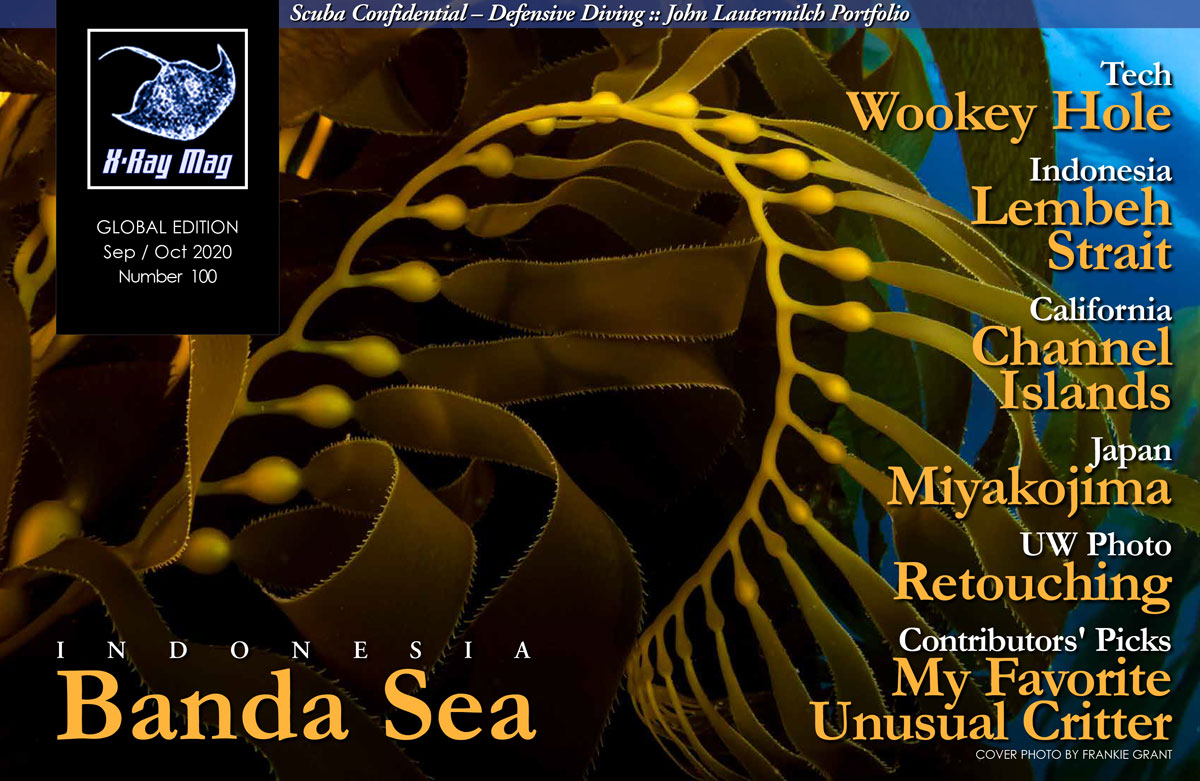
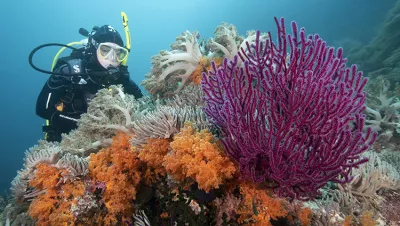
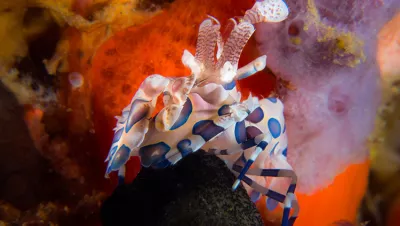
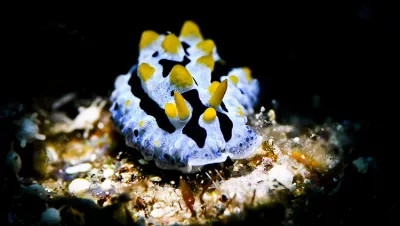
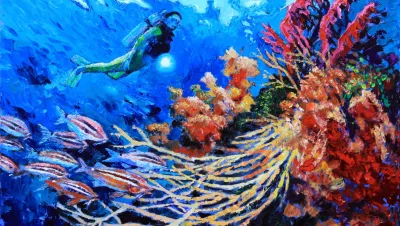
Underwater photographer and regular contributor Olga Torrey talks about how fine art and photography can influence each other, as she illustrates in her recent works undertaken in the X-Ray Mag Photo Challenge, which asks participants, who are homebound during the coronavirus lockdown, to recreate an underwater image they have taken with objects found around the home or things they can photograph from their windows. Torrey took the challenge to a whole new level by creating original art drawings and paintings inspired by underwater images.
Feature articles in this issue with stand-alone pdfs
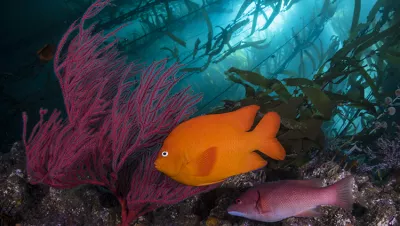
Due to their unique position relative to the eastern Pacific current, or the California Current, the Channel Islands off California’s coast receive an ideal amount of nutrients and water circulation for optimum growth of California giant kelp. This colonial algae forms forests over the rocky reefs and walls surrounding the islands, and act as one of the world’s most productive marine ecosystems. Eight islands and numerous offshore seamounts comprise this island chain, which is for the most part uninhabited and full of unique anchorages and protected coves for divers to explore.
When we learn to scuba dive, we are given a little knowledge and taught some basic skills. We take a theory test and demonstrate that we can perform the skills and that’s it, we get a licence.
The beginnings of cave diving can be traced to the Wookey Hole Caves in England. And 85 years later, divers like Matt Jevon are still doing their part to discover this cavern’s full potential.
Five minutes into my first dive in the Banda Sea, I came face-to-face with a scalloped hammerhead shark, gliding effortlessly in its underwater realm as it emerged from the depths to investigate the alien visitors descending from above. A second hammerhead swam past a moment later but was less bold in its approach and quickly disappeared back into the abyss. I had come to this remote corner of the globe after hearing stories of schooling hammerhead sharks, abundant sea snakes, magnificent coral formations, huge sponges and the possibility of observing other pelagic migrants such as manta rays, false killer whales, leatherback sea turtles and the pygmy blue whale. My efforts would not go unrewarded.
For underwater photographers, when we talk about Lembeh Strait in Indonesia, lots of macro subjects and small critters come to mind. “Muck diving,” which involves diving in muddy areas where lots of small animals can be found, is actually the main business of the localresorts and dive centres. But as you will find out in this article, there are lots of other things to see here too.
Year 2020. The coronavirus pandemic has confronted the world with an unprecedented situation. Many countries went into lockdown, and as a result, many people were forced to stay indoors, including myself in Japan. Although Japan never went into an official “lockdown”—it instead went into a so-called state of emergency—I could not wait to get out of the Tokyo metropolis as soon as restrictions were lifted.
John Lautermilch, an award-winning American artist from Saint Louis, Missouri, and graduate of the Washington University School of Fine Arts, has created paintings for 60 years, which have been shown in numerous solo exhibitions and include commissions for individual collectors and institutions. Among his plethora of paintings of the natural world are artworks featuring vivid and dynamic underwater scenes with divers and coral reefs. X-Ray Mag interviewed the artist to learn more about his creative process and perspectives.
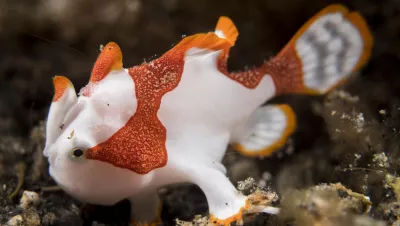
We asked our contributors what their favorite unusual critter dive was and they answered with stories and photos of weird and wonderful creatures, big and small, giving first-hand accounts of their often bizarre behaviors under the waves. X-Ray Mag contributors reveal the strange, rare or other-worldly yet endearing denizens of the underwater realm—from the tropical paradise of Indonesia and the Philippines to the temperate waters off California, British Columbia, South Africa and South Australia, to the frigid waters of the Barents and East seas off Russia—where they captured images of their favorite critters.
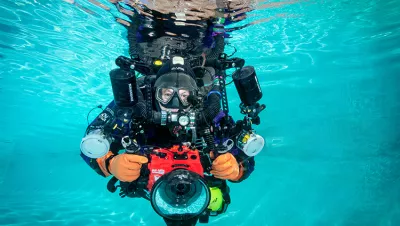
The Northeast US dive season usually starts with divers dusting off the cobwebs at Dutch Springs in Bethlehem, Pennsylvania. This year, the season started in the middle of a pandemic. Dutch Springs did not open in April, as it does most years. If you are a technical diver that is drying out, what is one to do? In our case, we took our drysuits, rebreathers, camera housings and sidemount rigs to our friend Gregory Borodiansky’s pool.
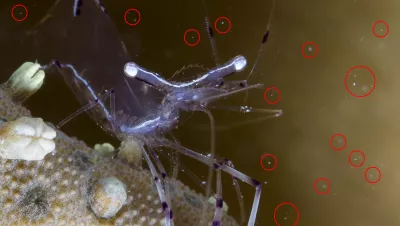
It should not happen but sometimes it does anyway: those annoying little white dots in our underwater images, which detract from the overall impression of the photograph. Known as backscatter, these dots appear when small particles in the water reflect the light from a strobe. The more directly the strobe light hits a subject, the higher the risk of backscatter. That is why a strobe should not be pointed straight at a subject. Indirect lighting (by angling your strobes slightly outwards or inwards but never directly toward the subject) is the main “trick” to minimise or even prevent backscatter.