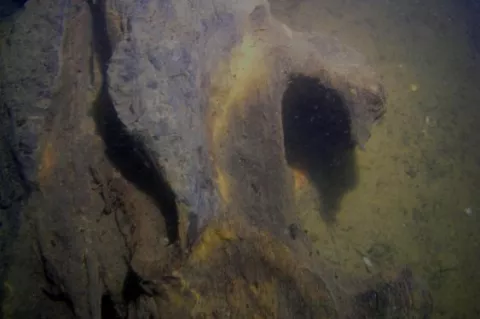
More than twenty years after a conversation with a Norwegian diving friend first sparked the idea, German technical diver and underwater photographer Steffen Schmitt made the trek north to explore the mysterious depths of Norway’s Trondheim Fjord.
It was late evening when I rolled onto the ferry in Frederikshavn, Denmark. The hum of the engines and the salty breeze signalled the start of a long-awaited expedition. As the ferry glided towards Gothenburg, Sweden, I sank into my reclining chair, my mind drifting back to a conversation with a Norwegian diving friend over two decades ago. His tales of the fjords had sparked a dream, and now, I was chasing it.
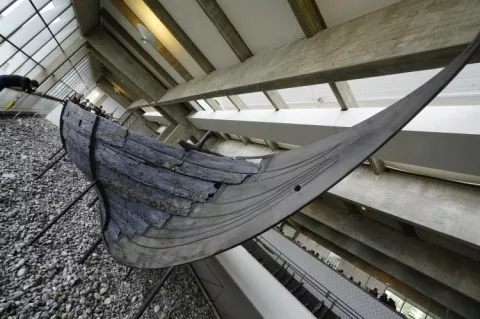
Trading and transport by sea goes back to prehistoric times. Stone Age settlements and canoes, Viking ships, medieval cogs, fluyts, tall ships, warships, defence systems, jetties, harbour installations and aircraft wrecks—Denmark has got it all.
Archaeology is concerned with the excavation, surveying and protection of historical artefacts, both on land and under the sea. The findings provide an important key to our understanding of shipbuilding traditions, trade and life in the past, and political and military confrontations.
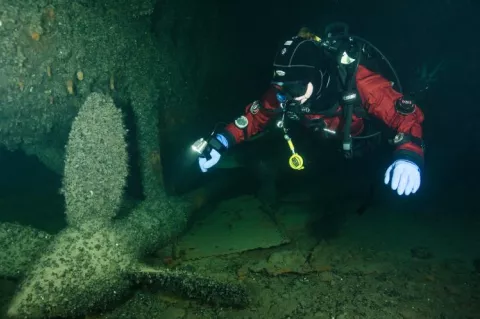
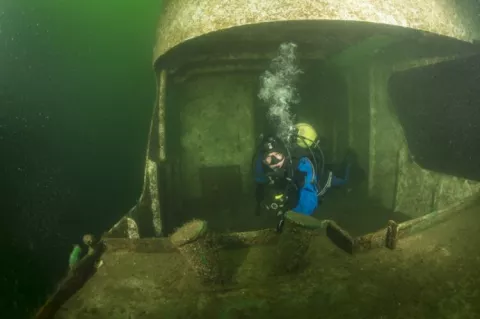
M/F Ærøsund is a former ferry that served the islands in the South Funen archipelago. It was scuttled in 2014 in a sheltered bay just 550m off Funen’s southern coastline where it now rests at a depth of only 19m. It is easily visible from the surface.
I remember attending the sinking, which was a much-hyped media event. News helicopters were whizzing about like giant wasps and an armada of leisure crafts encircled the ferry, which was anchored in its designated sinking spot, awaiting the scuttling. We were far out in the countryside and had to go down many small winding side roads to make it to a camping ground in the south-eastern corner of the island of Funen (or “Fyn,” in Danish)—a short distance west of the lovely town of Svendborg.
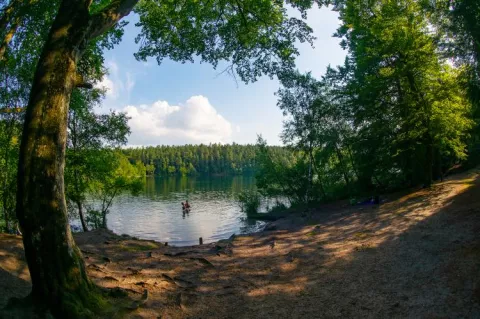
Approximately right in the centre of Jutland, the western peninsular part of the realm, there is a region called Søhøjlandet, which translates to “The Lake Highland.” It is a sparsely populated and largely forested area with many lakes, a large part of which make up a reserve.
Denoting it as a highland is a bit of an embellishment, causing some Scandinavian brethren in Norway and Sweden, who have real mountains in their outback, to scoff. Afterall, the highest “peaks” are only about 150m above sea level. However, in Denmark, which is otherwise largely flat and predominately farmland, it stands out—and for good reason. It is picturesque!
Generously scattered among rolling hills, which are draped in forest or heath, are plenty of freshwater lakes and they are among the cleanest and clearest in the country.
Diving in Denmark, how does it really measure up? Since Morten Bjørn Larsen lives in Copenhagen, he talks about his favorite dives in and around the island of Zealand, where the capital city is located. Several wrecks in Øresund and a bridge in Isefjord top the list.
As one of my good friends and diving partners usually says: We are lucky with a lot of things living here in Denmark, but if you like cycling in the mountains, skiing or diving in warm waters... then you are not super well-placed as a Dane. I myself usually see my dives in Denmark as training, understood in terms that if you can complete a wreck dive in Øresund and come up with a useful picture or two and a big smile on your face, then you are as well prepared as you can be to dive the rest of the world.
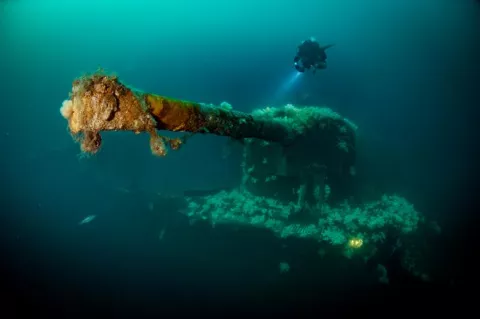
The seas around Denmark have seen thousands of shipwrecks from ancient times until today. We take a look at a selection of wrecks from WWII minesweepers to WWI Battle of Jutland armoured cruisers to Age of Sail vessels with cannons.
The Battle of Jutland was the largest surface naval battle ever, in terms of displacement, and the only full-scale clash of battleships during the First World War. Britain suffered more casualties and lost more ships than Germany, but the outcome was a strategic success for the British since it resulted in the successful containment of the German Imperial Navy’s High Seas Fleet. Of the 249 ships that fought in the Battle of Jutland, 25 were sunk.
The Baltic Sea offers some very treacherous waters even under the best of circumstances. The price to pay for sailing the Baltic through the millenniums has been high, and traces of those costs are scattered over the bottom.
The value is not measured in money, but in knowledge. Due to extremely favorable conditions, the wrecks and the remains found are virtual time capsules, waiting to tell their stories about people and their way of living in the past, about the countries and the cultures of Europe.
Located in the Åland Archipelago of the Baltic Sea is the wreck of the late 19th-century, German-made, three-masted, iron-hulled barque named Plus, which was lost on a stormy night in 1933. Andrea Murdock Alpini describes his journey there and his dives on this wreck.
Today, I head to Stockholm. There, a ship is waiting, which will carry me to Mariehamn, the largest town in the Åland Islands. Once I arrive in this autonomous region of Finland, my return to the Baltic Sea will finally be accomplished. The last time I was here was 15 years ago, and since then, I have never forgotten it.
A flooded prison, a Russian submarine, and a wreck with a two-million-dollar cargo are some of what diving in Estonia has to offer. Susanne Lundvall visited these sites on the last of three weekends she had spent on the dive team with Project BALTACAR, Baltic History Beneath the Surface—an EU initiative developing dive tourism in the Baltic region. Here, she shares her report.
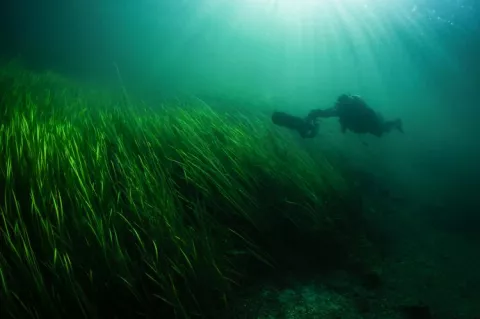
It was a Wednesday afternoon and the destination for the day was Tallinn. The flight left from Landvetter via Arlanda, where I met fellow divers Jessika and Micke, and then together we flew on to Tallinn.
A new photo competition has taken root on the western coast of Sweden, where local and international participants enjoy an exciting week of shooting underwater in Smögen, competing for attractive prizes. One of the contest’s organisers, Annika Malmberg, shares the story of the event, from the initial idea to the final result, as well as plans for its future.
For over 15 years, I have been a dive buddy to an underwater photographer. I have seen how the technology has developed, how the images have become more creative, and how more divers are getting underwater cameras. Nowadays, it is almost unusual if there are not several cameras on a dive boat or at a dive site, alongside all the other dive equipment.
Competing in underwater photography is fantastic and fun but it can also be extremely frustrating. It is an adjudicated sport, and there are probably as many opinions about the photo entries as there are people judging them.