Ecosystems

Replica of German WW2 V-1 Flying Bomb
From instrument of death to substrate of life. Replica of German WW2 V-1 Flying Bomb remains of which are now found in ammunition dumps and debris fields.

WWII Ammunition Dumps Found to Support Unexpected Marine Biodiversity

A new scientific study has revealed that World War II ammunition dumps on the seabed—long regarded solely as hazardous legacy sites—also support surprisingly rich marine biodiversity

The findings suggest that, in addition to posing management and safety concerns, these munitions fields may now function as unintentional artificial reefs hosting complex ecological communities.

Humpback Whale
Humpback Whale (Charles J. Sharp, CC BY-SA 4.0)

The Fall of a Whale

The Descent into Blue

A whale’s body sinks slowly through the water, passing layer after layer of drifting life. Small fish, sharks, and seabirds may feed briefly at the surface, but soon the great shape slips out of sight, falling into deeper, quieter realms.

As it sinks, it becomes a kind of travelling oasis — shedding nutrients, attracting small creatures, and nourishing life as it goes. This falling world can take hours or even days to reach the abyssal plain, thousands of metres below.

Luminous fish illustration
Illustration of "luminous deep sea fish" (Charles Frederick Holder (1892) Public domain)

Sea of Shadows: The Mystery of the Twilight Zone

In this dim layer, life has taken extraordinary forms. Many creatures are small and transparent, some studded with lights of their own. Lanternfish, hatchetfish, and comb jellies shimmer like stars, using bioluminescence to confuse predators or to signal one another in the gloom. Shrimp flash warning pulses, squid glow along their arms, and gelatinous drifters flow through beams of pale blue light.

A brinicle
A brinicle (Illustration: Ila France Porcher / AI)

Brinicles: Icicles of Death

The birth of a brinicle

When seawater begins to freeze at the surface, pure ice crystals form and push out the salt, leaving behind pockets of extremely cold, salty brine. This dense brine seeps downward through cracks in the ice. Because it is much colder and heavier than the seawater around it, it sinks—freezing the water it touches as it falls.

a seamount
A seamount near the surface

Deep-Sea Oases: The Mysterious Life of Seamounts

These giants are born of fire. Most seamounts began as volcanoes, formed where molten rock burst through the oceanic crust at weak points or along tectonic boundaries. Over time, many became dormant, sculpted by currents and covered in marine life. Others, like those in the Pacific “Ring of Fire,” remain active, still growing and occasionally shaking the sea above them with tremors.

Marine snow
A submarine snowfall (NOAA National Ocean Service, Public domain)

The Endless Fall: Life in the Ocean’s Dark Snowstorm

A snowstorm of life

Marine snow is made of tiny particles drifting down through the ocean—bits of plankton, algae, faecal pellets and other organic material that begin their journey near the surface. To the deep-sea world, it is as vital as sunlight is to a coral reef. Every flake carries the remains of life from above, feeding creatures that live where light never reaches.

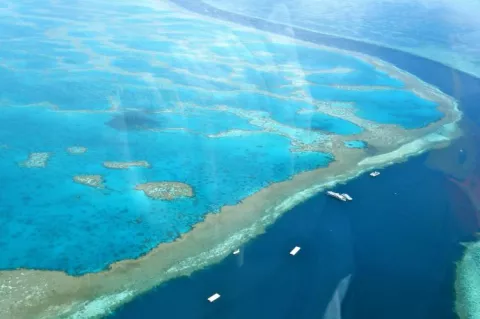
Aerial image of Scott Reef

Connectivity Enhances Coral Reef Resilience

Coral reefs are among the planet’s most vital ecosystems, yet they face increasing threats from climate change, including bleaching events and destructive storms. A new study by the Australian Institute of Marine Science (AIMS) sheds light on the crucial role of connectivity between coral communities in helping reefs recover and adapt to environmental challenges.

El Hierro's rugged coastline seen from above

Spain Declares First Marine National Park on the Island of El Hierro

The marine reserve is located in the Atlantic Ocean at the southwestern tip of the island of El Hierro, the westernmost of the Canary Islands. The area is known for its exceptional marine biodiversity, including sharks, dolphins, tuna, rays and turtles. The waters are calm because they are sheltered from the trade winds, and its tropical nature is home to species not found in the rest of the archipelago. The almost complete kelp cover and the diversity of the seabed support a high level of biodiversity. The area is also an essential habitat for beaked whales.