  • Sportsdykkeren.dk 🇩🇰
  • XRay-Mag.SE 🇸🇪
  • Dykmässan (diveshow)

Secondary menu - Advertising and subscriptions

  • Got stories? - Guidelines
  • Advertising
  • Subscribe to X-Ray Mag
Home
  • Magazine
  • News
      1. Latest news
      2. Press releases
      3. Breaking News
  • Travel
      1. Destinations
        1. Australia & New Zealand
        2. Continental Asia
          • Japan
          • China
          • South Korea
        3. Southeast Asia
          • Indonesia
            • Bali
            • Komodo
            • Lembeh
            • Maluku
            • Raja Ampat
            • Sulawesi
          • Malaysia
          • Papua New Guinea
          • Philippines
          • Thailand
          • Timor-Leste
        4. South Pacific & Oceania
          • Fiji
          • French Polynesia
          • Micronesia
            • Chuuk (Truk)
            • Marshall Islands
            • Yap
          • Palau
          • Samoa
          • Solomon Islands
          • Tonga
          • Vanuatu
        5. Indian Ocean
          • Madagascar
          • Maldives
          • Seychelles
        6. Red Sea
        7. Africa
          • Egypt
          • Malawi
          • Mozambique
          • Namibia
          • South Africa
          • Sudan
          • Tanzania
        8. Mediterranean & Adriatic
          • Croatia
          • Cyprus
          • France
          • Greece
          • Italy
          • Malta & Gozo
          • Portugal
          • Spain
          • Turkey
        9. Europe
          • Northern Europe
            • Denmark
            • England
            • Finland
            • Iceland
            • Ireland
            • Norway
            • Scotland
            • Sweden
          • Eastern Europe
            • Albania
            • Bosnia-Hercegovina
            • Croatia
            • Czech Republic
            • Hungary
            • Poland
            • Russia
              • Northwest Russia
              • Russian Far East
              • Siberia
          • Western Europe
            • Austria
            • France
            • Germany
            • Switzerland
          • Southern Europe
            • Cyprus
            • Greece
            • Italy
            • Malta & Gozo
            • Portugal
            • Spain
        10. Atlantic
          • Azores
          • Canary Islands
          • Falkland Islands
          • St Helena
        11. North America
          • Canada
          • Great Lakes
          • United States
            • East Coast
            • West coast
            • Alaska
            • Hawaii
            • US Virgin Islands
            • Guam
          • Mexico
        12. Caribbean & Central America
          • Bahamas
          • Belize
          • Cayman Islands
          • Bonaire
          • Cuba
          • Dominican Republic
          • Mexico
          • Columbia
          • Grenada
          • Costa Rica
          • Saba
          • Honduras
          • Turks & Caicos
          • US Virgin Islands
          • Nicaragua
        13. South America
          • Argentina
          • Brazil
          • Ecuador
        14. Polar Regions
          • Artic
          • Antarctica
      2. Promotions
      3. My Favorite Dive
  • Ecology
      1. Ocean Mysteries series by Ila France Porcher
      2. Sharks, Rays and Nudibranch stories by Andy Murch
      3. Sentience
      4. Conservation
      5. Coral Reefs
      6. Dolphins
      7. Fish
      8. Jellyfish
      9. Mantas & Stingrays
      10. Nudibranchs
      11. Octopus & Squid
      12. Sea Turtles
      13. Seals & Sea Lions
      14. Sharks
      15. Whales
  • Wrecks
      1. Vic Verlinden
      2. Ancient Wrecks
      3. Artificial Reefs
      4. Marine Archaeology
      5. Older Warships
      6. Steamships & Cargo
      7. Tall & Wooden Ships
      8. WWI Wrecks
      9. WWII Wrecks
  • Training & Tech
      1. Rebreathers
      2. Sidemount
      3. Deep Wrecks
      4. Cave Diving & Mines
      5. Ice Diving
      6. Diver Health & Safety
        1. Divers Alert Network - DAN
        2. Safety Culture
      7. Adaptive Diving
  • More
      1. Equipment
        1. BCDs, Wings & Sidemounts
        2. Dive Computers
        3. Dive Watches
        4. Drysuits & Undergarments
        5. Hoods, Gloves & Boots
        6. Lamps & Torches
        7. Masks, Fins & Snorkels
        8. Regulators
        9. Wetsuits & Rashguards
      2. Photo & Video
        1. Equipment
          • Cameras & Optics
          • Editing & Post-processing
          • Housings
          • Lighting
          • Useful Tools
        2. Tutorials
          • Techniques & Tips
            • Mike Bartick
            • Rico Besserdich
          • Composition
          • Editing & Post-processing
        3. News & Announcements
        4. Contributors' Picks
      3. Books & Media
        1. Works by our contributors
      4. Profiles & Interviews
        1. In Memoriam
      5. Lifestyle
        1. Portfolios & Ocean Arts
        2. Apres Dive & Apparel
        3. Editorials
      6. Contributors
        1. Pundits
          • Mike Ange
          • Gareth Lock
          • Michael Menduno
          • Mark Powell
          • Simon Pridmore
        2. Regular writers
          • Scott Bennett
          • Andrey Bizyukin
          • Larry Cohen & Olga Torrey
          • Pierre Constant
          • Brent Durand
          • Jennifer Idol
          • Scott Johnson
          • Steve Jones
          • Kate Jonker
          • Kelly LaClaire & Kate Holt
          • Matthew Meier
          • Brandi Mueller
          • Svetlana Murashkina
          • Barb Roy
          • Don Silcock
          • Claudia Weber-Gebert
          • Lawson Wood
        3. Columnists
          • Scott Bennett
          • Rico Besserdich
          • Rosemary 'Roz' E. Lunn
          • Ila France Porcher
  • âš² Search

Sea Urchins: All Brain and Spiky Too!

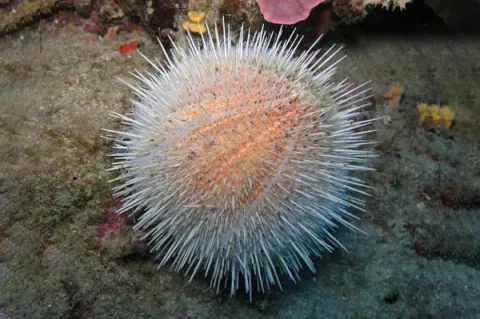
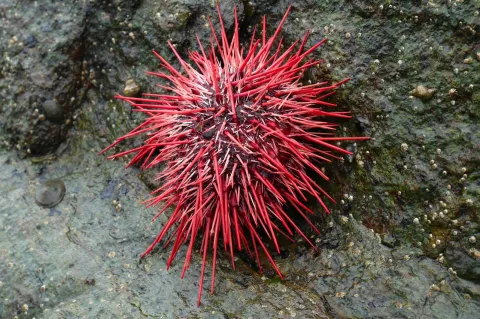
Divers tend to think of sea urchins as simple animals—spiky, slow-moving, and mostly interested in grazing on algae. But an international research team has found that sea urchins are far more complex than they look. In fact, you could say that a sea urchin’s entire body acts in a way like a brain.

sea urchin
Ecology & Science

Their study, using the purple sea urchin (Paracentrotus lividus), discovered that these animals have a highly sophisticated nervous system—one that shares organisational features with the brains of vertebrates, including humans.

Two body types

To understand how strange and fascinating this is, it helps to know something about echinoderms—the group that includes sea urchins, starfish, sea cucumbers, and brittle stars.

X-RAY MAGAZINE FEATURE

Stars of the Ocean: 12 Things You Might Not Know About Sea Stars

They can have up to 40,000 feet, produce millions of offspring and eat with their stomachs outside their bodies. Sounds like something from a sci-fi film? You probably see them on every dive you make! Christian Skauge and Peter Symes provide 12 intriguing insights into sea stars.

Words:
Christian Skate and Peter Symes
Images:
Christian Skauge
➥ Download the full article as pdf ⬅︎
Ecology & Science

Sea stars (or starfish—but they are not fish) are a common sight for divers, as they occur in all the world’s oceans, from tropical reefs to the polar seabed. But how much do you know about these slow-moving predators?

They can have between five and 30 arms, arranged in radial symmetry, and they lack blood, a brain, a heart and other vital organs. Yet they have conquered the world’s oceans. Here are some interesting facts about starfish:

Transglobal Spread of a Sea Urchin Parasite

Researchers at the University of South Florida have made a concerning discovery: a marine parasite known for devastating sea urchins in the Caribbean and Florida in 2022 has now been found afflicting sea urchins in the Sea of Oman, over 7,000 miles away. This single-celled organism, identified as a ciliate, has caused alarm among scientists who fear it may lead to a pandemic for sea urchins.

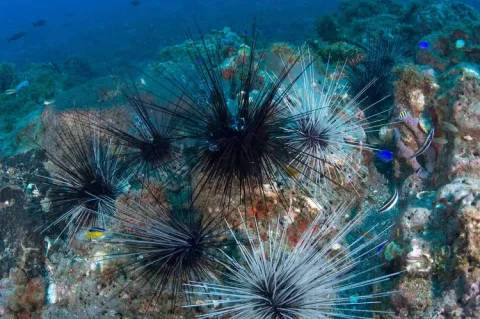
Long-spined sea urchins
Ecology & Science

The study identified the parasite that devastated 95 percent of long-spined sea urchins in affected areas in the Caribbean Sea two years ago. It burrows into the tissue of the sea urchins and triggers abnormal behaviour. The urchins droop and lose their ability to control their tube feet, which are crucial for movement. They lose their spines, then tissue necrosis sets in, leading to the death of the sea urchins.
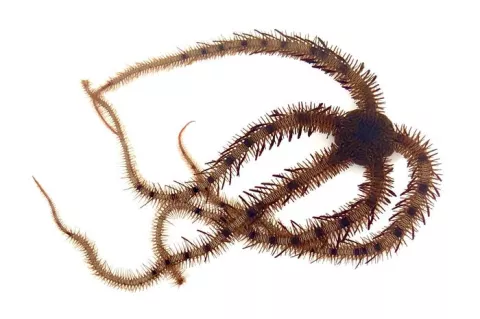

Brittle Stars Can Learn Without a Brain

Although a brittle star does not have a brain, scientists have discovered that they are capable of learning by association.

Ecology & Science

Instead of a brain or eyes, brittle stars have nerve cords that run down each of their five arms, which join to form a nerve ring near the mouth. 

Nonetheless, according to a recent study, they possess the ability to learn by association, which involves making an association with different stimuli via a process called classical conditioning (like Pavlov’s dogs or us learning not to touch a pot of boiling water after we had been scalded before.

Sea urchins see with their whole body

Study reveals that spiny invertebrates utilize their feet as retinas. From the ends of their "feet" to the tips of their spines, sea urchins may utilize their bodies as one big eye.

Sea urchins move slowly, crawling with tube feet, and also propel themselves with their spines
Ecology & Science

According to a study that appeared in the Journal Proceedings of the National Academy of Sciences, new research has indicated that sea urchins may use the entire surfaces of their bodies—from the ends of their "feet" to the tips of their spines—as huge eyes. Scientists have long known that marine invertebrates react to light without any obvious eye-like structures, raising the question of how the animals see.

Sea Urchin Could Help Cure Diseases

Researchers found that humans and sea urchins share a lot of the same biology

Ecology & Science

A purple sea urchin has 70 percent of its genes in common with humans, including genes associated with such diseases as Huntington’s, Parkinson’s, Alzheimer’s and muscular dystrophy.

There are roughly 100 human disease genes in the sea urchin genome.

Researchers said they believe similarities in the genes of sea urchins could one day help them better understand how the human immune system works.

X-RAY MAGAZINE FEATURE

Fantastic Feather Stars and the Creatures Within

Most divers take a quick look at the shapes and varieties of feather stars, but usually pass on by, in search of other interesting subject matter. However, there is more to them than meets the eye!

Words:
Steve Rosenberg
Images:
Download the full article as pdf ⬇︎
Ecology & Science

Crinoids, or "feather stars" as they are commonly known to the scuba diving community, are echinoderms, members of the phylum Echinodermata, meaning "spiny skin," which includes many well-known species like sea stars, sea urchins and brittle stars. 

X-RAY MAGAZINE FEATURE

Sea Cucumbers In Peril

Sea Cucumbers are a group of marine species belonging to the Class Holothuroidea. They are characterised by fleshy, elongated bodies, covered in numerous projections known as papillae. When disturbed, many species eject an effluvium of sticky, white threads designed to distract predators, and if removed from the marine environment, they quickly become foul smelling—not your ideal culinary ingredient, one might think. Yet the market for sea cucumber is booming, so much so that several species have seen significant population crashes.

Words:
Christophe Mason-Parker
Images:
Download the full article as pdf ⬇︎
Ecology & Science

As with many marine species, it is the Asian market that is driving the trade, with Hong Kong and China the main hubs. Sea cucumbers have traditionally been harvested throughout their range and have long been considered a delicacy in numerous countries. However, in recent years the rise of an affluent middle class in China has led to a surge in demand, in part due to the animals’ popularity as a food source, but also as a result of its association with male virility in Chinese folk medicine.

Subscribe to Echinoderms

Latest updates

Closed-circuit rebreathers, DPVs and technical diving systems were used by the Finnish recovery team to search the cave.
Maldives Recovery: Exclusive Interview With DAN Europe’s Laura Marroni and Sami Paakkarinen
8 Jul, 2026 - 17:29
Juvenile sea turtle photo by Tay Liang Wei
Lens Beyond Ocean Photo Competition 2026 Winners
8 Jul, 2026 - 16:52
Advanced nitrox diving
Crucible, Part I: A Deep Dive Into the Early Days of Technical Diving
8 Jul, 2026 - 16:12
Java Sidemount
Java Sidemount
8 Jul, 2026 - 13:55
More

Upcoming Events & Expos

9 Sep, 2026 ➢ 12 Sep, 2026

ABOFA – Aqaba Blue Ocean: Future in Action

Aqaba, Jordan

23 Oct, 2026 ➢ 26 Oct, 2026

Diving Talks

Lisbon, Portugal

3 Nov, 2026 ➢ 6 Nov, 2026

DEMA 2026

New Orleans, Lousiana

5 Dec, 2026 ➢ 6 Dec, 2026

Dive-Expo

Antwerp Expo, Belgium

Stay Social

Don’t forget that you can connect with us through all major social media, by simply clicking on the corresponding logo below.

Reviews

Books & Media

Marine Life of the North Sea and English Channel

Lawson Wood’s Marine Life of the North Sea and English Channel is an extensive guide dedicated to the exploration and understanding of the diverse marine ecosystems found between the British Isles and the coasts of northern France, Belgium, the Netherlands, Denmark, Norway and southern Sweden.

Cover  Marine LIfe of the North Sea and English Channel
Works by Our Contributors
Review
Books
Lawson Wood
Books & Media

Yes, Fish Feel Pain

A thought-provoking examination of fish sentience, behaviour and the growing scientific debate surrounding pain perception in aquatic animals.

Yes, Fish Feel Pain
Works by Our Contributors
Review
Books
Ila France Porcher
Books & Media

Reefs of Time

In Reefs of Time, geoscientist and science educator Lisa S. Gardiner offers a compelling and accessible exploration of how fossil coral reefs can inform our understanding of the threats facing reefs today. 

Book cover:  Reefs of Time
Review
Books & Media

Scuba Diving Operational Risk Management

An SAS approach to principles, techniques and application in recreational and technical diving.

Book cover
Review
Books
Advertisement
Advertisement
Home
International Dive Magazine

About X-Ray Mag

AquaScope Media logo

Compiled by an international network of top dive editors and world-class underwater photographers, X-RAY MAG is the planet's only truly global premier dive lifestyle magazine. Subscription and downloads are free. Published since 2003.

Image
DEMA Member

Published by:

AquaScope Media ApS - Copenhagen - © 2026

A closer look below the surface.

Advertising

  • General info / Distribution
  • Rate cards
    • Media kit - $ (USD)
    • Media kit - € (EUR)
    • Media kit - £ (GBP)
  • Ad Sizes and Formats
    • Magazine Ad Copy sizes
    • Banner ad sizes
  • General trading terms

Privacy & GDPR

  • Privacy and Cookie Policy

Subscriptions

  • US Newsletter
  • Canadian Newsletter
  • European Newsletter
  • UK Newsletter
  • Asia-Pacific Newslettre
  • Other / Global
  • 😪 Unsubscribe

Brand Assets / Logos

  • Banner ads
  • Logos
  • SoMe Collaterals

Contact

  • Contact us
  • About us

Brugerkontomenu

  • Log in
Clear keys input element